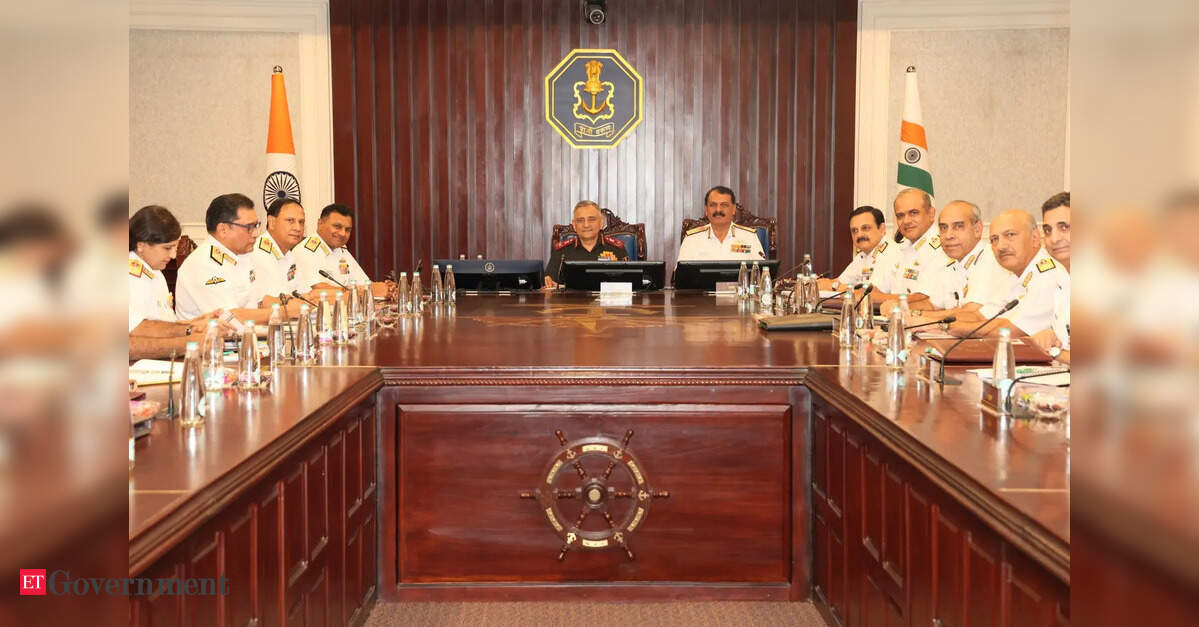
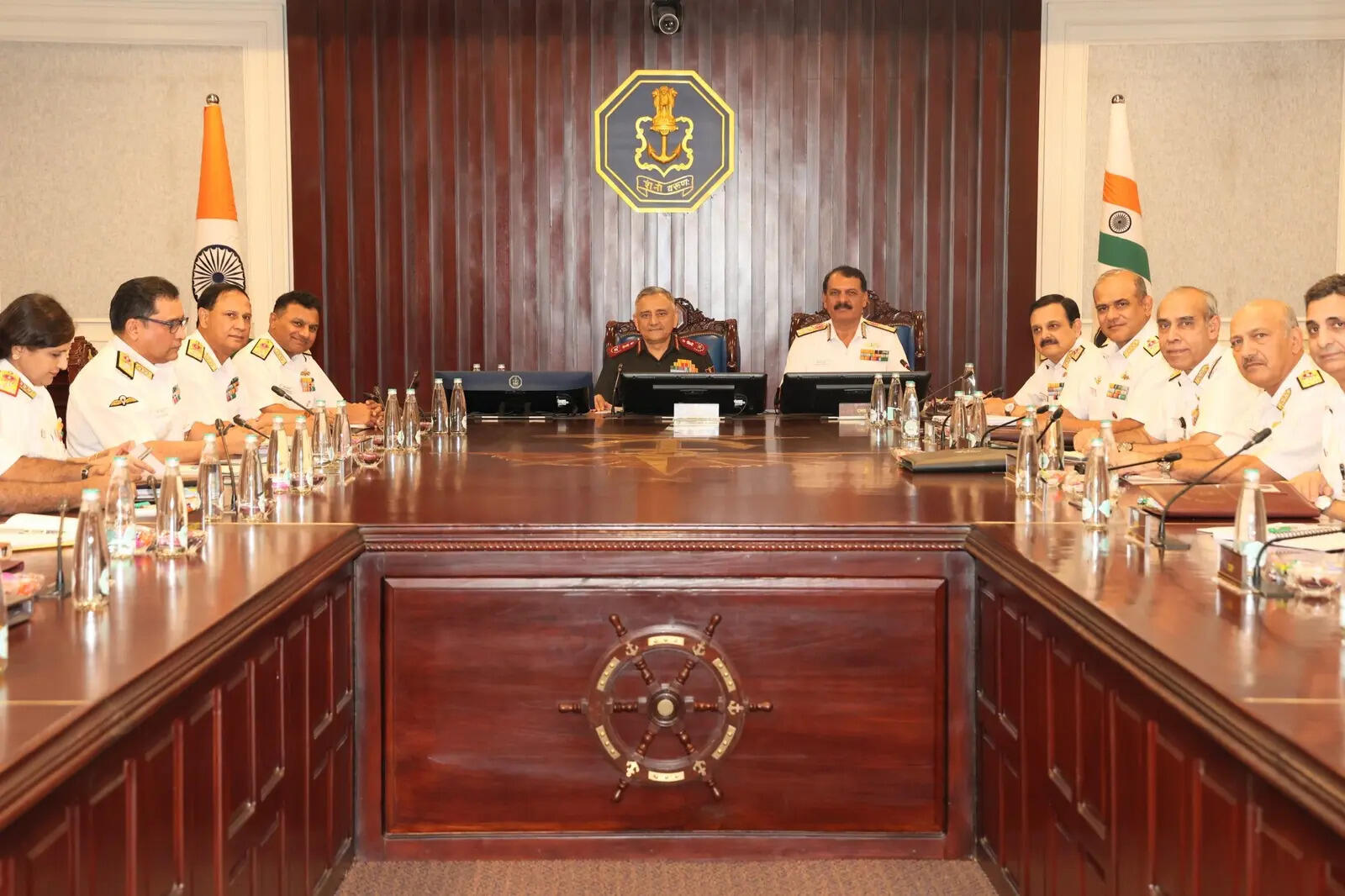
The first edition of the Naval Commanders’ Conference 2026, held from April 14 to 17 at Nausena Bhawan in New Delhi, unfolded against a sharply altered global security landscape.
With active conflicts in West Asia disrupting maritime trade routes and the prolonged war in Eastern Europe accelerating geopolitical fragmentation, the conference assumed significance well beyond its institutional mandate. It became, in effect, a strategic audit of India’s maritime preparedness in an era where the seas are once again central to power projection and economic security.
The deliberations were led by Admiral Dinesh Kumar Tripathi, Chief of the Naval Staff, who set the tone by underlining the growing complexity of the maritime domain. He pointed to a convergence of factors—simultaneous conflicts, erosion of the rules-based international order, and the rise of non-state threats—that are transforming the oceans into a contested operational theatre.
His emphasis on sustained combat readiness and rapid adoption of emerging technologies reflected a clear doctrinal shift: the Indian Navy must prepare not just for conventional engagements, but for a spectrum of hybrid and multi-domain challenges.
A Maritime Theatre Under Stress
The instability in West Asia has already demonstrated how vulnerable global supply chains are to disruptions at critical chokepoints such as the Strait of Hormuz and the Red Sea.
At the same time, the war in Eastern Europe has triggered deeper economic realignments, affecting energy flows, shipping insurance costs, and strategic alignments. For India, whose trade is overwhelmingly seaborne, these developments translate into immediate operational imperatives for the Navy.
It is in this context that the conference placed significant emphasis on reviewing operational and materiel preparedness, logistics resilience, and infrastructure readiness. The message was unambiguous: maritime security can no longer be treated as a distant or secondary concern—it is central to national stability.
The Expanding Geometry of Warfare
A critical dimension of the conference was the interaction with General Anil Chauhan, Chief of the Defence Staff, who framed the discussion within the broader transformation of warfare. He highlighted that conflicts today are no longer confined to physical battlefields but extend into economic systems, technology ecosystems, and information domains.
For the Navy, this implies a need to integrate seamlessly with joint military structures while developing capabilities that operate across cyber, space, and electromagnetic spectrums.
This perspective reinforces the transition from platform-centric strength to network-centric warfare. Data superiority, real-time situational awareness, and technological agility are becoming as decisive as fleet size. The Indian Navy’s increasing focus on artificial intelligence, autonomous systems, and advanced surveillance platforms is aligned with this emerging paradigm.
Coastal Security and Internal Convergence
The conference also underscored the importance of internal security linkages, particularly through the interaction with Govind Mohan, Union Home Secretary. His remarks highlighted the necessity of deeper coordination between the Navy and paramilitary forces to strengthen coastal security architecture.
This dimension is often underappreciated but strategically vital. Threats such as trafficking, infiltration, and illegal maritime activities operate in the grey zone between external defence and internal security. Addressing them requires a unified framework that integrates surveillance, intelligence sharing, and rapid response across agencies.
The emphasis on such coordination reflects a maturing understanding of security as a continuum rather than a set of isolated domains.
Indian Ocean Imperatives
India’s role in the Indian Ocean Region (IOR) was another central theme. The Navy’s responsibility as a net security provider is becoming increasingly complex as the region witnesses heightened activity by major powers and intensified competition over infrastructure and influence.
The conference reaffirmed the importance of proactive engagement with friendly foreign countries through bilateral and multilateral exercises. These engagements are not merely symbolic; they are instrumental in building interoperability, enhancing maritime domain awareness, and reinforcing India’s position as a reliable security partner in a fragmented global order.
Strategy for an Uncertain Decade
One of the most consequential outcomes of the conference was the release of the Indian Navy Maritime Security Strategy (INMSS-2026) by Admiral Dinesh Kumar Tripathi. Anchored in the broader framework of Defence Forces Vision 2047 and Indian Navy Vision 2047, the strategy outlines a roadmap for safeguarding India’s maritime interests over the next decade.
What distinguishes the document is its grounded realism. It recognises the disruptive impact of emerging technologies, the evolving nature of warfare, and the need for reforms in higher defence organisation. It also situates maritime security within the larger geopolitical flux, acknowledging that economic resilience and technological capability are now integral to military strength.
Industry, Innovation, and Strategic Autonomy
On the sidelines of the conference, the Chief of the Naval Staff hosted “Sagar Manthan,” bringing together naval leadership and domain experts to deliberate on reforms in defence research and capability development. The emphasis on greater industry participation signals a structural shift in India’s defence ecosystem.
As global supply chains become more uncertain, the push for indigenous capability assumes strategic urgency. For the Navy, this translates into a stronger focus on domestic shipbuilding, advanced systems development, and innovation-led partnerships. The underlying logic is clear: strategic autonomy in defence production is not merely an economic objective but a security imperative.
The Larger Strategic Signal
Taken together, the Naval Commanders’ Conference 2026 reflects a military leadership that is acutely aware of the changing global order and is actively recalibrating its doctrine and capabilities. While the conference was anchored in naval priorities, its implications extend to India’s broader strategic posture.
In a world where maritime routes are increasingly contested and economic security is intertwined with naval capability, the Indian Navy’s evolution will play a decisive role in shaping national power. The presence and perspectives of leaders such as Admiral Dinesh Kumar Tripathi, General Anil Chauhan, and Govind Mohan underscore the integrated approach that India is adopting—one that bridges operational readiness, joint warfare, and internal security.
As conflicts continue to reshape the global landscape, the message from Nausena Bhawan is clear: the seas are no longer peripheral to geopolitics—they are its central arena. India’s response, as reflected in the deliberations of this conference, is to prepare not just for the challenges of today, but for the uncertainties of a far more contested maritime future.