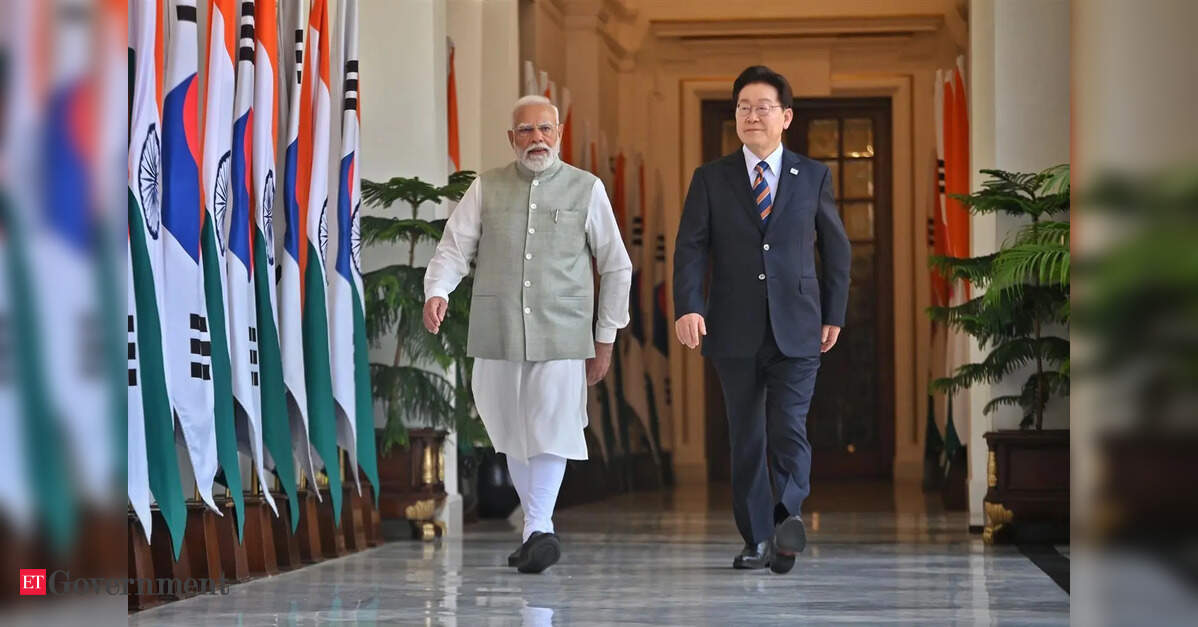
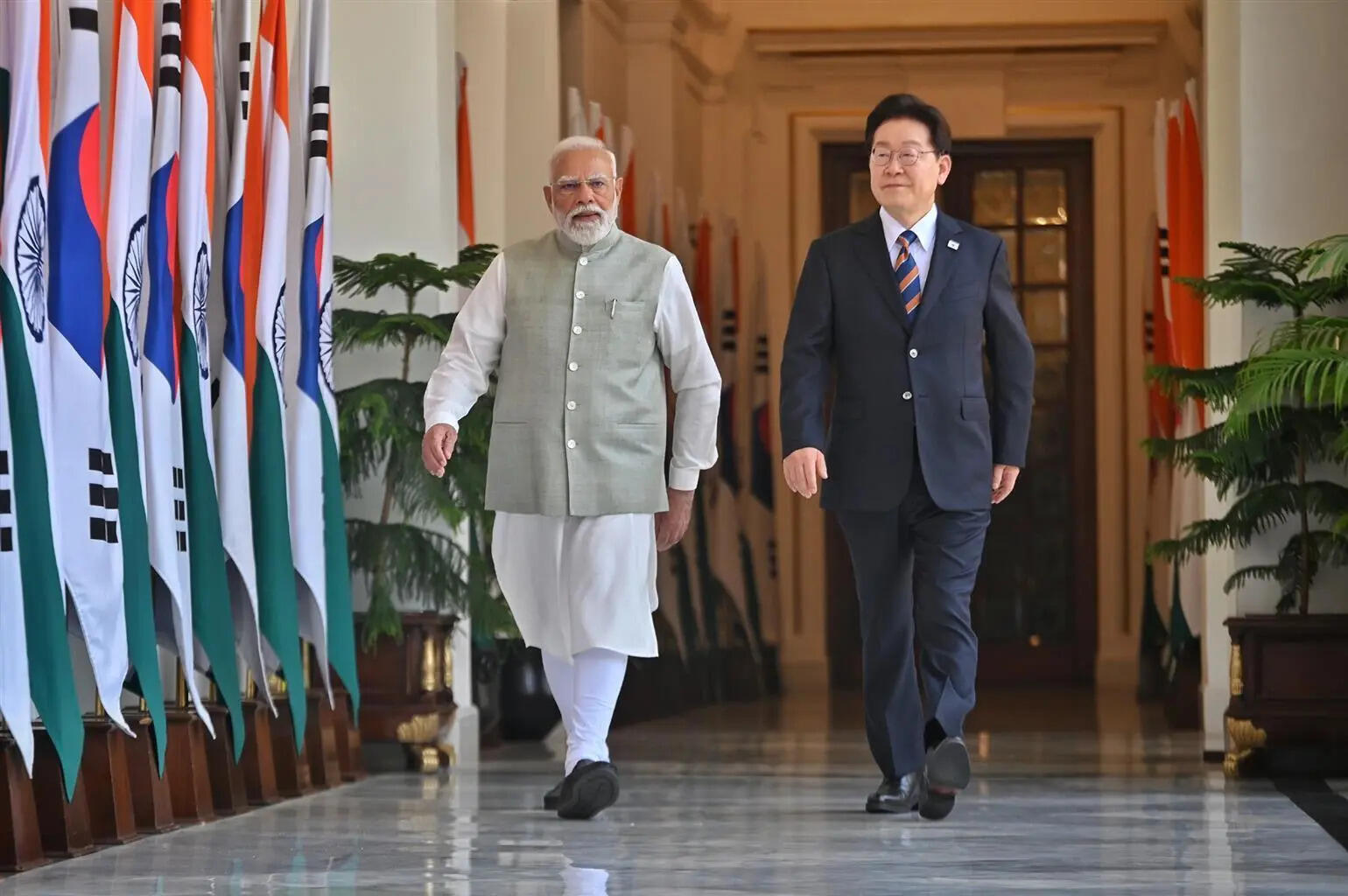
The choreography of power in New Delhi this week was less about ceremony and more about strategic recalibration.
As Lee Jae-myung arrived in India, the visit unfolded against a backdrop of disrupted supply chains, technological realignments, and intensifying geopolitical contestation in the Indo-Pacific. What emerged was not merely diplomatic reaffirmation, but a deliberate attempt by two industrial democracies to reposition their partnership for a more uncertain world.
Touching down in New Delhi on April 19, 2026, President Lee undertook a tightly structured state visit that concluded on April 21 before his onward journey to Vietnam. The compressed timeline belied the depth of engagement, with the visit producing 21 key outcomes that reinforced the India–South Korea “Special Strategic Partnership,” first articulated in 2015.
A Partnership Recast for Strategic Realities
The meetings between President Lee, Narendra Modi, and Droupadi Murmu reflected a partnership moving beyond declaratory diplomacy. Both sides reviewed the full spectrum of cooperation—ranging from trade and technology to defence and maritime security—while acknowledging the need to adapt to global economic fragmentation and geopolitical volatility.
Prime Minister Modi framed the relationship in explicitly strategic terms, stating that “India and Korea together send a message of peace and stability” in a period marked by global tensions. He further underlined the breadth of cooperation, describing the partnership as spanning “from chips to ships, talent to technology,” a formulation that captures the expanding scope of bilateral engagement.
President Lee, for his part, positioned the relationship within a broader global context, observing that India has “emerged as a leader in the Global South” and emphasising that the two countries are “the most ideal partners for comprehensive cooperation” in an era of uncertainty.
Strategic Outcomes and Institutional Deepening
At the core of the visit were 21 agreed outcomes that seek to institutionalise cooperation across critical domains. These include frameworks for technology collaboration, defence coordination, and economic integration, alongside the establishment of new mechanisms such as an Economic Security Dialogue.
This initiative reflects a structural shift in how both countries approach economic engagement—viewing trade, investment, and supply chains through a national security lens.
The creation of such a dialogue aligns with broader global trends where economic resilience, particularly in critical sectors like semiconductors, energy, and digital infrastructure, is increasingly tied to geopolitical considerations. Both India and South Korea have recognised that their long-term economic security depends on diversification and trusted partnerships.
Maritime Collaboration and the “Chips to Ships” Doctrine
Among the most consequential aspects of the visit was the emphasis on maritime cooperation. India’s ambitions to expand its shipbuilding capacity and modernise its maritime infrastructure align closely with South Korea’s global leadership in shipbuilding technology. An agreement to enhance collaboration in shipyard modernisation, skills development, and port infrastructure underscores the scale of opportunity in this sector.
The focus on maritime logistics is not merely economic. It is embedded in a larger strategic calculus shaped by disruptions in global shipping routes and the vulnerability of energy supply chains, particularly in regions such as the Strait of Hormuz. President Lee underscored this dimension, noting the importance of ensuring that “all vessels can navigate… safely and freely,” signalling deeper coordination on maritime security.
Technology, Supply Chains, and Industrial Convergence
The discussions on artificial intelligence, semiconductors, and advanced manufacturing reflect a convergence of national priorities. South Korea’s strength in semiconductor fabrication and industrial engineering complements India’s growing digital ecosystem and ambitions to build sovereign technological capacity.
Prime Minister Modi emphasised that the two nations are “laying the foundation for the success story of the next decade,” highlighting the role of technology partnerships in shaping future growth trajectories. Meanwhile, President Lee pointed to the need to upgrade economic cooperation frameworks to create “a new engine for shared growth,” signalling intent to move beyond incremental collaboration.
The emphasis on supply chain diversification is particularly significant. As global disruptions—from geopolitical tensions to energy shocks—reshape trade flows, both India and South Korea are seeking to reduce vulnerabilities and build resilient industrial ecosystems.
Trade Ambitions and Structural Constraints
The visit reaffirmed an ambitious target: to elevate bilateral trade to $50 billion by 2030, nearly doubling current levels. This goal is accompanied by renewed efforts to upgrade the Comprehensive Economic Partnership Agreement (CEPA), which has faced challenges related to market access and trade imbalances.
President Lee acknowledged that economic cooperation between the two countries remains “still very low” relative to potential, underscoring the need for structural reforms and deeper integration. Modi, in turn, emphasised the need to strengthen supply chains, improve market access, and encourage investment to achieve the trade target.
However, the pathway to this target is not without friction. Regulatory barriers, asymmetrical trade flows, and operational challenges for investors continue to constrain the relationship. The success of the trade agenda will depend on how effectively both sides address these structural issues.
A Convergence Shaped by Geopolitics
Beyond economics, the visit reflects a broader geopolitical convergence. Both India and South Korea are navigating an increasingly complex international environment marked by great-power competition and regional instability. Their shared democratic values, industrial capabilities, and strategic autonomy provide a foundation for deeper alignment.
Modi articulated this convergence by highlighting the role of both nations in contributing to a “peaceful, progressive and prosperous Indo-Pacific.” Lee echoed this sentiment, stressing that stability in regions like the Middle East is critical for global economic security.
From Intent to Execution
What distinguishes this visit is its emphasis on execution. The articulation of 21 outcomes, the prioritisation of sectors such as shipbuilding and semiconductors, and the creation of institutional mechanisms like the Economic Security Dialogue indicate a move toward actionable diplomacy.
The India–South Korea partnership is no longer defined by potential alone. It is increasingly shaped by necessity—by the need to secure supply chains, build technological capacity, and navigate a fragmented global order.
As President Lee’s visit concludes, the central question is whether this momentum can be sustained. The answer will depend on the ability of both nations to translate strategic alignment into tangible outcomes. In an era where partnerships are judged by delivery rather than declarations, the India–South Korea relationship is entering its most consequential phase yet.