For decades, economists treated remittances as a peripheral statistic—important for household consumption, certainly, but secondary to exports, manufacturing output, or foreign direct investment. That assumption no longer holds in India.
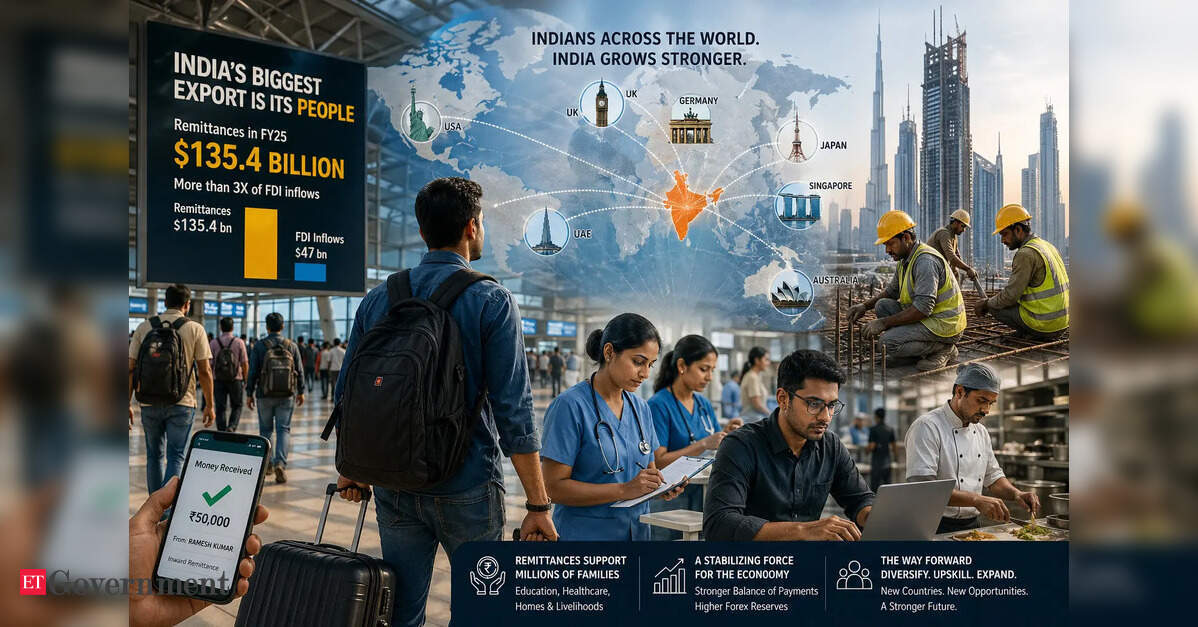
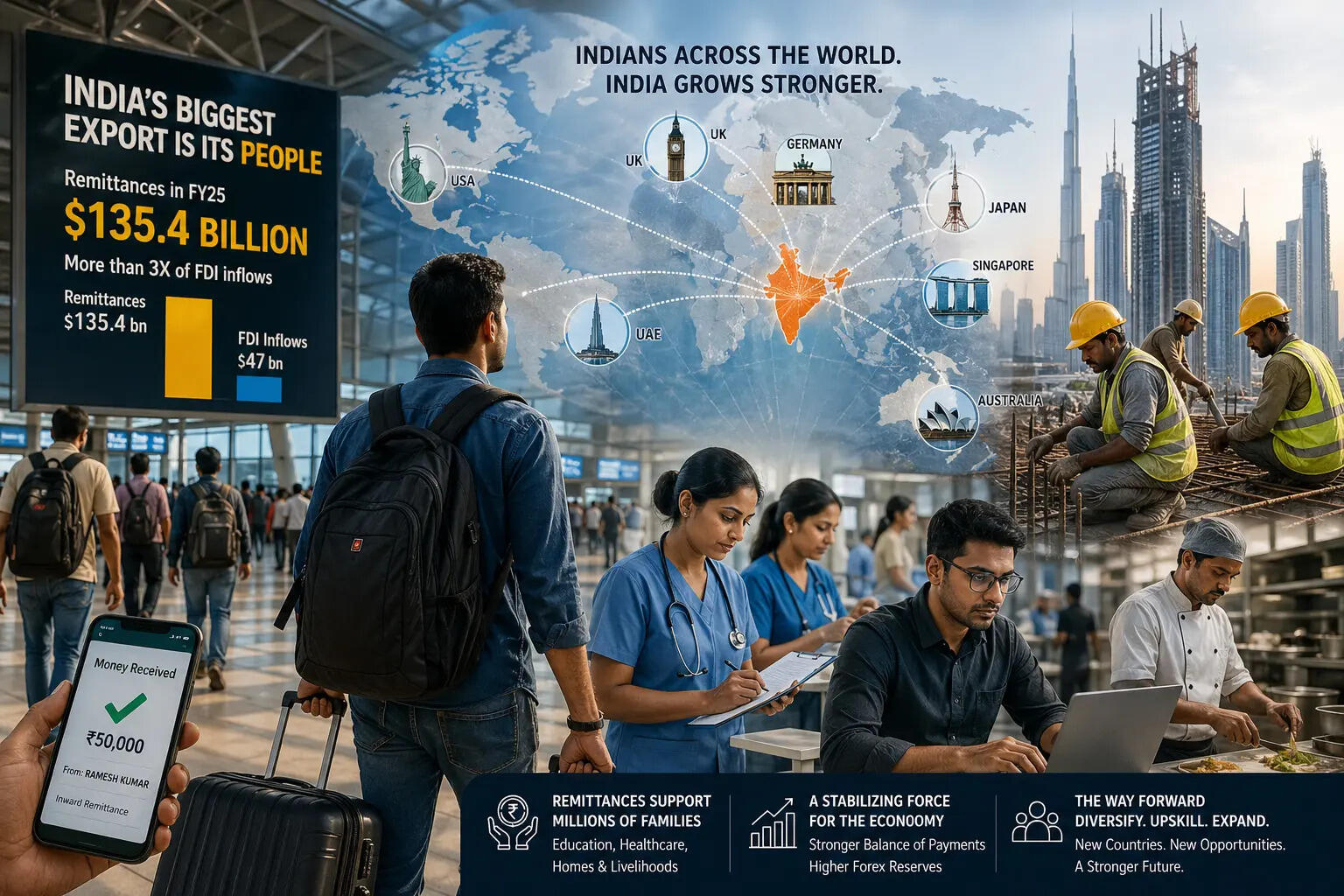
In FY25, India received $135.4 billion in remittances, according to the Economic Survey 2025–26 tabled in Parliament—making it the largest remittance recipient in the world for yet another year. The number is staggering not merely because of its size, but because of what it now exceeds.
During the same period, India’s gross FDI inflows stood at approximately $47 billion, meaning Indian workers abroad sent home nearly three times more capital than foreign investors brought into India.
That single statistic reveals a profound truth about the Indian economy: even as New Delhi celebrates semiconductor fabs, electronics manufacturing, defence exports and digital public infrastructure, one of India’s most valuable global assets remains its human capital exported to the world.
Indian engineers in Silicon Valley, nurses in Britain, construction workers in Dubai, hospitality staff in Saudi Arabia, doctors in Australia, finance professionals in Singapore and truck drivers in Canada collectively sustain one of the largest external financial pipelines in modern economic history.
But this model now faces a strategic challenge.
The escalating instability across West Asia in 2026, widening regional conflict, oil market volatility, labour nationalisation policies in Gulf economies, and tightening immigration politics in parts of the developed world are forcing India to confront an uncomfortable question: what happens if the remittance engine slows down?
The silent pillar of India’s external economy
India’s remittance story is often overshadowed by narratives around IT exports and startup valuations. Yet remittances have quietly become one of the most stabilising forces in India’s external account.
The Economic Survey notes that India’s current account deficit narrowed to $15 billion in H1 FY26, compared to $25.3 billion in H1 FY25, largely because of strong services exports and private transfers—of which remittances form a major component.
India’s foreign exchange reserves stood at $701.4 billion as of January 2026, enough to cover nearly 11 months of imports. Remittance inflows have played a significant role in strengthening this cushion.
Unlike FDI, remittances are often more resilient during crises. During global recessions, migrant workers tend to reduce personal consumption before reducing transfers to families. That makes remittances a uniquely stable source of external financing.
Globally, remittances to low- and middle-income countries crossed $905 billion, according to World Bank estimates, and India alone accounts for a disproportionately large share of that flow.
This money is not merely flowing into metropolitan India. It funds education in Bihar, real estate in Kerala, consumption in Uttar Pradesh, healthcare in Punjab, and small businesses in Andhra Pradesh and Tamil Nadu. For millions of Indian households, migration remains the most effective anti-poverty programme available.
The Gulf built the remittance economy—but that model is changing
For decades, India’s remittance model was heavily dependent on the Gulf.
Workers from Kerala, Telangana, Uttar Pradesh, Bihar and Rajasthan migrated in large numbers to the UAE, Saudi Arabia, Kuwait, Qatar and Oman. They worked in construction, retail, logistics, domestic services and infrastructure sectors. That model is now under structural pressure.
According to RBI’s remittance survey, the geography of remittance inflows has changed dramatically. The United States now accounts for 27.7% of India’s remittances, overtaking the UAE at 19.2%. The UK contributes 10.8%, Singapore 6.6%, and Saudi Arabia’s share has declined.
This shift reflects two major realities.
First, Gulf economies are changing. Saudi Arabia’s labour localisation policies, the UAE’s push toward automation, and broader economic restructuring are reducing dependence on low-skilled migrant labour.
Second, Indian migration itself is becoming more skilled. Doctors, coders, AI engineers, data scientists, chartered accountants and healthcare professionals are increasingly moving to advanced economies.
India’s remittance economy is therefore transitioning from a blue-collar Gulf model to a white-collar global model.
Why West Asia remains a major vulnerability
Despite diversification, the Gulf remains enormously important. Nearly 9 million Indians live in the Gulf Cooperation Council countries, according to various government estimates. The region remains critical for semi-skilled workers who do not have access to high-skilled migration pathways.
The worsening geopolitical crisis in West Asia in 2026 introduces several risks. Energy infrastructure disruptions can slow construction projects. Regional military escalation can reduce tourism and hospitality activity. Oil price volatility can pressure fiscal budgets of Gulf monarchies. Large-scale evacuations—as seen during previous regional crises—could disrupt employment for Indian workers.
India has already witnessed such shocks during the Gulf War, the Iraq conflict, the Libya crisis and evacuations from conflict zones such as Yemen and Sudan. A prolonged regional crisis would not merely be a foreign policy challenge. It would directly affect India’s rural household incomes, domestic consumption patterns and foreign exchange stability.
India’s demographic pressure makes outward mobility inevitable
India adds millions of young people to its labour force every year. The country’s formal domestic economy simply cannot absorb all of them at high wages quickly enough.
India’s nominal GDP per capita remains roughly $2,800, according to multilateral estimates, while PPP-adjusted income is far higher—but PPP does not determine migration choices. Workers compare actual wage differentials.
A nurse earning ₹35,000 a month in India can earn several multiples of that in the UK. A welder in Germany can earn more than an equivalent worker in India. Truck drivers in Canada, aged care workers in Japan and software engineers in the US all continue to benefit from large wage arbitrage.
The argument is not that “148 countries are richer than India, therefore Indians should migrate there.” That would be economically simplistic. Migration depends on visa regimes, labour demand, language barriers, qualification recognition and geopolitical alignment.
But the broader point is correct: India’s wage differentials with much of the world remain large enough to sustain migration for decades.
Where India should send workers next
The next frontier for India’s remittance economy lies beyond the Gulf.
Germany is facing acute shortages in engineering, manufacturing and healthcare due to ageing demographics. Its skilled immigration reforms are making entry easier.
Japan needs caregivers, hospitality workers, construction professionals and technical trainees as its ageing crisis deepens.
Canada, despite tighter immigration debates, continues to require healthcare workers, logistics professionals and STEM talent.
Australia remains attractive for healthcare, mining, engineering and education-linked migration.
The United Kingdom continues to absorb Indian healthcare workers, finance professionals and technology talent.
Singapore remains a major destination for financial services, logistics and technology professionals.
Nordic countries increasingly require healthcare workers and digital talent.
Africa may emerge as an underexplored destination as infrastructure development accelerates in countries such as Kenya, Rwanda, South Africa and Nigeria.
Even parts of Eastern Europe facing demographic decline could become future labour destinations.
India needs a migration strategy—not just migration
India’s migration policy remains reactive rather than strategic. The country needs bilateral labour mobility agreements with developed economies. It must negotiate faster visa processing.
Indian skill certification needs global recognition. Language training for Germany, Japan and Europe must expand. Worker protection frameworks must improve. Financial tools should encourage remittances to move toward productive investments rather than only consumption and real estate.
The Philippines has long treated labour export as a structured economic strategy. India, despite being far larger, still behaves as though migration is accidental. That is a strategic mistake.
Remittances vs. FDI: Financing the future
India often speaks about becoming a global manufacturing hub. That ambition is important. But until domestic per capita incomes rise dramatically and job creation accelerates at scale, India’s most globally competitive export will remain its people.
The software engineer in California. The nurse in London. The electrician in Dubai. The caregiver in Tokyo. The logistics worker in Toronto. The entrepreneur in Singapore. Together, they are quietly financing India’s macroeconomic stability in ways that foreign investors often do not.
In FY25, remittances did not merely beat FDI. They exposed a deeper truth about the Indian growth story: while capital still debates India, the world is already hiring India.