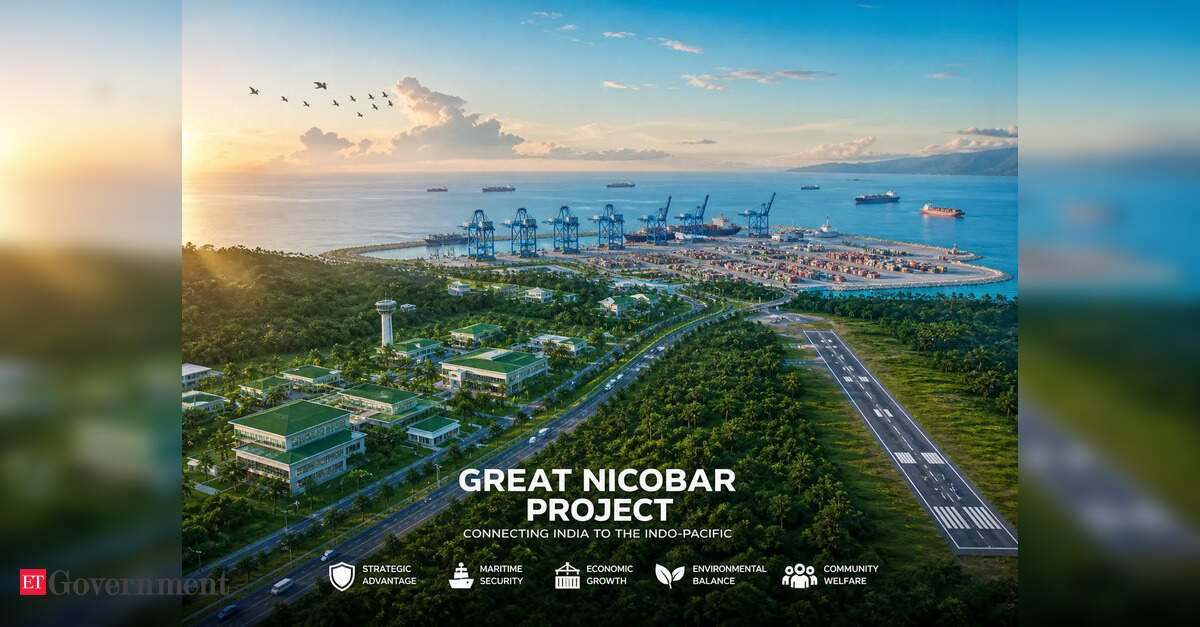
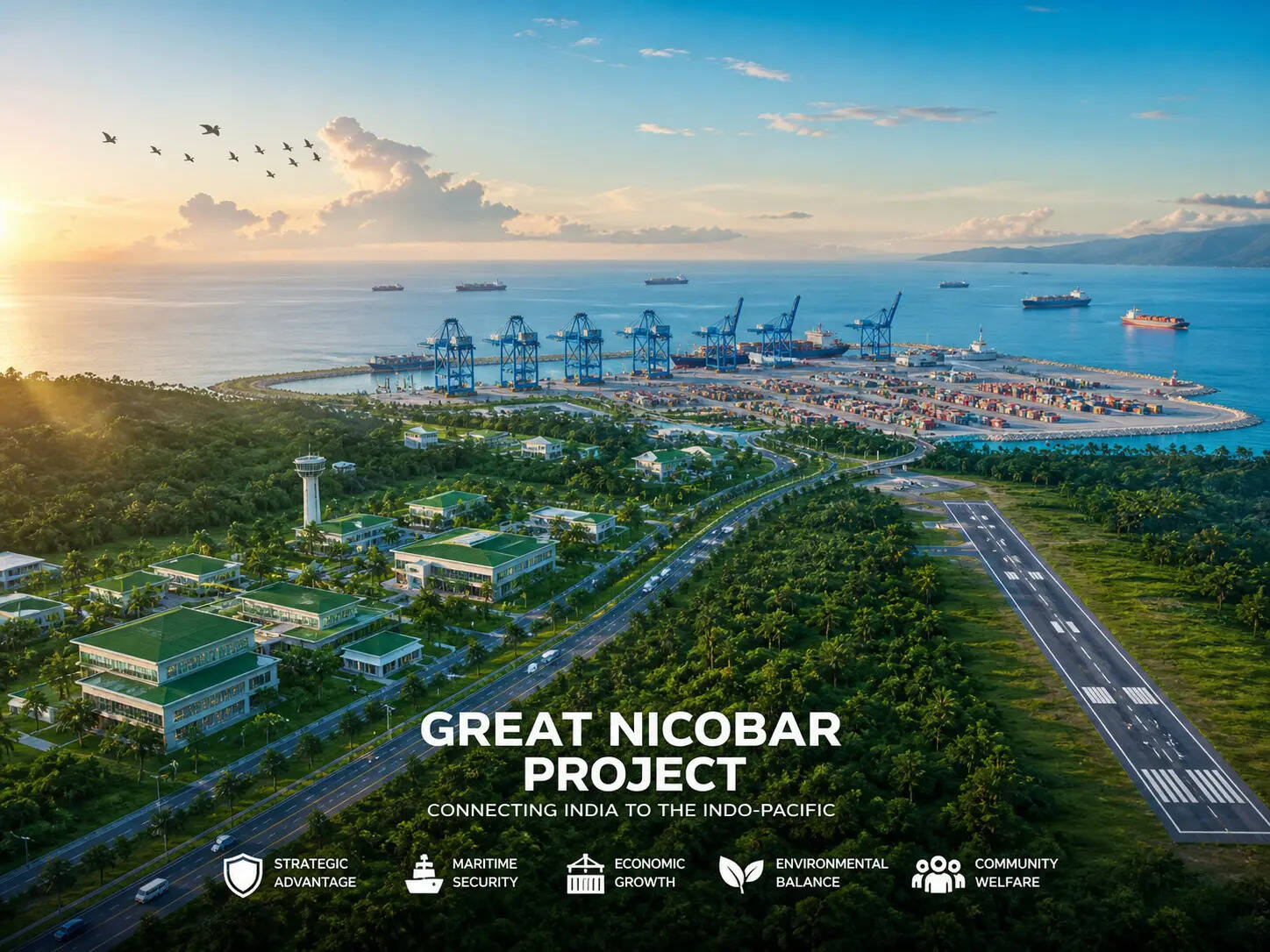
A recent editorial in a prominent national newspaper presents a deeply alarmist view of the Great Nicobar development project, framing it as an impending ecological disaster. Such a characterisation, however, does not stand up to closer scrutiny.
The argument appears to rely on dated information, selective interpretation, and, in parts, factual inconsistencies. For a project of such national significance, it is essential that discourse be grounded in geography, strategy, and verifiable data rather than conjecture.
At the heart of the project lies the proposed International Container Transshipment Port at Galathea Bay, located near Indira Point—India’s southernmost extremity.
This region itself underwent significant geological transformation following the 2004 Indian Ocean tsunami, which caused tectonic shifts and partial submergence of land. Any evaluation of the project must therefore begin with an understanding of this altered geography.
Strategic and Economic Significance
Great Nicobar occupies a position of exceptional geopolitical importance. It sits proximate to the Strait of Malacca, one of the world’s busiest maritime corridors linking the Indian Ocean with the Pacific. A substantial proportion of global energy flows—particularly crude oil and natural gas—passes through this narrow passage. Its constricted nature forces vessels to slow down, making them vulnerable to piracy, interdiction, and surveillance.
For India, this geography presents both an opportunity and a strategic necessity. A significant share of energy supplies for major economies transits this route, and disruptions here would have global repercussions.
The vulnerability associated with this passage has long been recognised internationally, often referred to in strategic discourse as the “Malacca dilemma.” In a world marked by intensifying great power competition, maritime dominance and situational awareness in such chokepoints are critical.
India’s strategic calculus is further shaped by the presence of rival powers across key maritime nodes in the Indian Ocean Region. Continuous surveillance operations, including those undertaken by the Indian Navy, already reflect this reality. Strengthening infrastructure at Great Nicobar—particularly through enhanced port and air capabilities—will significantly augment India’s maritime posture and deterrence capacity.
The economic rationale is equally compelling. At present, a substantial volume of India-bound cargo is transshipped through foreign ports, particularly Singapore. This results in an estimated annual outflow of approximately $230 million in transshipment-related revenue.
Establishing a domestic transshipment hub would not only retain this value within the Indian economy but also position India as a logistics hub in the region. The development of supporting inland infrastructure further amplifies this economic multiplier.
Ecology and Tribal Concerns: Contextualising the Debate
Concerns regarding ecological impact and tribal welfare are valid in principle, but they must be evaluated in context. Available inputs suggest that due processes under the Forest Rights Act, 2006 and other environmental regulations have been followed.
Importantly, representation from tribal communities—through institutional mechanisms such as the Andaman Adim Janjati Vikas Samiti and local administrative committees—has been integrated into the decision-making framework.
The rights and interests of Particularly Vulnerable Tribal Groups (PVTGs), including the Shompen and Nicobari communities, have been formally considered. It is critical to note that development proposals of this scale undergo multi-layered scrutiny, and approvals are contingent upon compliance with statutory safeguards.
The Question of Displacement
Assertions regarding displacement of the Shompen tribe reflect a limited understanding of local geography. The Shompen primarily inhabit regions such as Mount Thullier and surrounding forested areas, which are approximately 30 kilometres—across difficult terrain—from Galathea Bay. Given this spatial separation, the likelihood of direct displacement is minimal.
Moreover, the Shompen are known to be a reclusive community with limited external interaction. Administrative engagement with them has historically been minimal and carefully managed. The Nicobari community, on the other hand, is more integrated and geographically dispersed, with a long history of movement across the Nicobar group of islands.
The demographic context is also relevant. The Shompen population has been gradually declining, a trend attributed to internal social factors such as limited female population and intra-community marriage patterns. Preservation efforts for these communities have remained a consistent priority for the Andaman and Nicobar administration.
Environmental Claims and Ground Realities
Estimates suggesting that 32 to 58 lakh trees will be felled appear exaggerated when compared with more grounded local assessments, which place the figure between 10 to 15 lakh. Such discrepancies underscore the need for calibrated and evidence-based discussion.
The ecological sensitivity of the region is acknowledged, particularly with the presence of the Galathea National Park. However, development and conservation are not mutually exclusive objectives. Globally, large-scale infrastructure projects operate within regulatory frameworks designed to mitigate environmental impact. The effectiveness of these frameworks depends on enforcement, not on the abandonment of development altogether.
Strategic Ecosystem: Beyond the Island
The project must also be viewed within the broader strategic architecture of the region. India’s collaboration with Indonesia in developing the Sabang port—located approximately 170 kilometres from Great Nicobar—illustrates the growing emphasis on maritime partnerships. Together, these initiatives enhance India’s strategic depth in the eastern Indian Ocean.
The presence of INS Baaz further reinforces the island’s defence significance. Expansion of airfield capabilities to support aircraft such as the C-130J will enable rapid troop deployment and strengthen surveillance operations across critical sea lanes.
Conclusion
Every major development project involves a complex balancing act between economic gains, strategic imperatives, and environmental considerations. The Great Nicobar Project is no exception. However, framing it as an “ecological disaster” oversimplifies a far more nuanced reality.
India’s long-standing underinvestment in its island territories has limited both their economic potential and strategic utility. The Great Nicobar initiative represents a decisive shift in this approach. It is not merely an infrastructure project; it is a statement of intent—one that seeks to align national security, economic efficiency, and regional influence.
Environmental safeguards must be rigorously enforced, and tribal welfare must remain non-negotiable. But equally, national development cannot be held hostage to exaggerated fears or selective narratives. The path forward lies not in abandonment, but in responsible execution.
(Vice Admiral Shekhar Sinha (Retd), is former Chief of Integrated Defence Staff & Commander in Chief, Western Naval Command; Views expressed are personal)