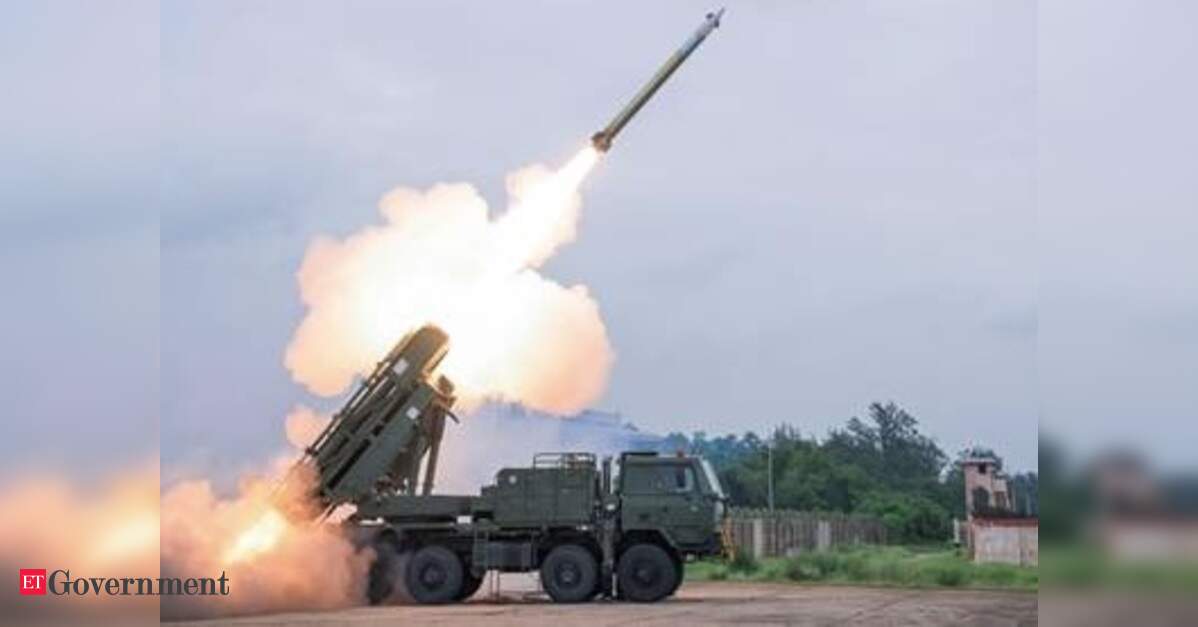
The successful flight test of the Pinaka Long Range Guided Rocket (LRGR) at the Integrated Test Range (ITR), Chandipur, on July 8 marks an important advance in India’s indigenous artillery capabilities.
By validating precision engagement at a user-defined minimum operational range of 60 kilometres, the test demonstrated the system’s ability to operate effectively across an expanded engagement envelope.
Developed by the Defence Research and Development Organisation (DRDO), the rocket completed all planned in-flight manoeuvres, followed the predicted trajectory and struck the designated target with what the Ministry of Defence described as “textbook precision.”
The trial represents more than an incremental improvement in range. It reflects the continuing transformation of the Pinaka Multiple Launch Rocket System from a conventional area-saturation weapon into a long-range precision-strike platform capable of engaging critical battlefield targets with greater accuracy and operational flexibility.
Defence Minister Rajnath Singh described the successful trial as an important step towards strengthening the Indian Army’s precision-strike capabilities. “The successful flight-test of Pinaka Long Range Guided Rocket is another milestone towards enhancing the precision strike capability of the Indian Army,” Singh said while congratulating DRDO, the Armed Forces and the industry partners associated with the programme.
The achievement is significant because modern artillery systems are increasingly evaluated not merely by how far they can fire, but by their ability to deliver accurate effects across their complete operational range. The latest trial demonstrated that the Pinaka LRGR can operate effectively at the lower end of its engagement envelope while retaining the advantages of long-range precision fire.
From Area Bombardment to Precision Strike
Rocket artillery was traditionally designed to deliver large volumes of fire over broad areas. Multiple rockets were launched in rapid succession to suppress troop concentrations, defensive positions, logistics hubs and other battlefield targets. Accuracy was often secondary because the volume of fire compensated for the limitations of individual rockets.
Modern warfare is changing that operational model. Command headquarters, radar installations, air-defence systems, ammunition depots, communication centres, bridges and logistics nodes increasingly require precise engagement. Military commanders seek to achieve maximum operational effect while using fewer munitions and reducing unintended damage.
The emphasis is gradually shifting from the volume of fire to the precision and effectiveness of each strike. The Pinaka LRGR reflects this transition. By combining extended range with improved guidance and accuracy, the system provides the Indian Army with an additional precision-strike capability between conventional tube artillery and more expensive tactical missile systems.
Its operational value lies not only in its ability to reach distant targets but also in its capacity to engage targets across varying ranges using the same launcher platform.
Why the 60-Kilometre Test Matters
The latest trial followed the maiden flight test of the Pinaka LRGR-120 in December 2025, when the rocket demonstrated a maximum range of approximately 120 kilometres. That test validated critical technologies, including the rocket motor, guidance package, navigation system and flight-control algorithms.
The July 2026 trial focused on the minimum operational range of 60 kilometres.
Although maximum-range demonstrations generally attract greater attention, minimum-range testing can present complex technological challenges. A precision-guided rocket travelling over a shorter distance has less time to stabilise, execute trajectory corrections and complete the required flight manoeuvres before entering its terminal phase.
The successful test therefore validated the performance of the rocket’s guidance and control systems under a different and demanding flight profile.
For artillery commanders, accuracy across the complete engagement envelope is essential. A weapon capable of operating only near its maximum range would have limited tactical flexibility. The validation at 60 kilometres indicates that the Pinaka LRGR can be employed against targets at different battlefield depths without requiring a separate launcher or weapon system.
This capability could allow commanders to use the same artillery platform for a wider range of operational requirements.
Existing Launcher, Enhanced Capability
One of the most important features of the Pinaka LRGR is its compatibility with the existing in-service Pinaka launcher. Rather than developing an entirely new launcher for the long-range rocket, DRDO has upgraded the capabilities of the existing system through advances in propulsion, guidance, navigation and flight-control technologies.
The common launcher architecture offers significant operational and logistical advantages. Multiple generations and variants of Pinaka rockets can be deployed without requiring the Army to replace its launcher fleet or create entirely new maintenance, training and logistics infrastructure.
This modular approach enables the capability of the system to evolve while preserving investments already made in launchers, support vehicles, command systems and trained personnel. Commonality can also simplify battlefield deployment. Depending on the operational requirement, artillery units could employ different rocket variants while continuing to operate within the established Pinaka ecosystem.
The approach reflects a broader trend in modern defence development, where armed forces increasingly seek adaptable platforms that can incorporate new weapons and technologies through progressive upgrades rather than complete replacement.
An Indigenous Defence Ecosystem
The Pinaka LRGR has been developed through collaboration among several specialised DRDO laboratories.
The Armament Research and Development Establishment (ARDE) in Pune led the design effort in collaboration with the High Energy Materials Research Laboratory (HEMRL). The Defence Research and Development Laboratory (DRDL) and Research Centre Imarat (RCI) provided technological support, while the Integrated Test Range and the Proof & Experimental Establishment contributed to flight testing and evaluation.
The programme brings together expertise in propulsion, energetic materials, guidance, navigation, electronics, control systems, warhead technologies and flight testing.
This multi-laboratory model reflects the growing integration within India’s defence research ecosystem. Advanced weapon systems increasingly require expertise across several technological domains, making collaboration essential for reducing development timelines and improving system performance.
Defence Secretary and DRDO Chairman Rajesh Kumar Singh described the successful test as “a significant milestone” in strengthening the Indian Army’s long-range precision-strike capability.
Congratulating the DRDO teams, the Armed Forces and industry partners, he highlighted the contribution of indigenous technologies and India’s expanding defence industrial capabilities to the development of advanced rocket systems.
The Pinaka programme also reflects closer cooperation between DRDO, the Armed Forces and Indian industry. Public-sector organisations and private manufacturers contribute to the production of rocket motors, launcher vehicles, control systems, warheads, propellants, electronic equipment and precision-engineered components.
The participation of industry is critical because successful development trials must ultimately be followed by large-scale manufacturing, timely induction and sustained lifecycle support.
The Evolution of Pinaka
The Pinaka programme was initiated in the late 1980s to meet the Indian Army’s requirement for an indigenous multi-barrel rocket launcher capable of delivering rapid and sustained fire while maintaining battlefield mobility.
Named after the mythical bow of Lord Shiva, the system was initially developed primarily as an area-fire weapon. Over several decades, improvements in propulsion, electronics, navigation, automation and fire-control technologies have expanded its range and enhanced its accuracy. The modern Pinaka family is considerably more advanced than its original configuration.
The system has evolved into a modular artillery platform capable of employing multiple rocket variants. The introduction of guided rockets has progressively transformed Pinaka from a system designed mainly for area suppression into one capable of delivering precision effects against high-value targets.
The LRGR represents the latest stage of that technological evolution.
Instead of replacing the original architecture, successive improvements have expanded the capabilities of the existing platform. This evolutionary model can reduce costs, simplify logistics and enable the Army to introduce enhanced capabilities without fundamentally altering established operational structures.
Strengthening Layered Firepower
The Pinaka LRGR forms part of the Indian Army’s wider artillery modernisation programme.
India is developing and inducting multiple artillery systems designed to address different operational requirements. These include the Dhanush artillery gun, the Advanced Towed Artillery Gun System (ATAGS), the K9 Vajra-T self-propelled gun and the M777 Ultra-Light Howitzer, along with improved surveillance platforms, digital fire-control networks and battlefield management systems.
Within this layered architecture, conventional artillery guns provide sustained fire support at shorter ranges, while guided Pinaka rockets can engage targets at greater battlefield depths. Tactical missile systems provide additional options for longer-range and strategically important targets. These systems are complementary rather than interchangeable.
Commanders can select a weapon according to the location, characteristics and operational importance of a target. A guided rocket may provide an effective and economical option for targets that require greater range and accuracy than conventional artillery but may not justify the use of a more expensive tactical missile.
The mobility of the Pinaka launcher further enhances its operational value. Mobile artillery systems can be rapidly deployed, conduct strikes and relocate, reducing their vulnerability to counter-battery fire and improving survivability in contested environments.
Responding to the Changing Battlefield
Recent conflicts have demonstrated the growing importance of long-range precision fires.
Command centres, ammunition storage facilities, logistics networks, bridges, radar installations, communication systems and air-defence sites have emerged as priority targets. The ability to engage such assets rapidly from stand-off distances can disrupt an adversary’s operational capability before it directly influences the battlefield.
For India, this capability has relevance across diverse operational environments—from desert terrain in the west to mountainous and high-altitude sectors in the north. A mobile guided-rocket system capable of engaging targets across a range of 60 to approximately 120 kilometres could provide field commanders with greater flexibility in responding to different tactical situations.
The effectiveness of such systems, however, increasingly depends on their integration with surveillance and targeting networks.
Future artillery operations are likely to rely on data from unmanned aerial vehicles, satellites, ground-based sensors, radars and battlefield intelligence systems. The speed with which information moves from detection to engagement—the sensor-to-shooter cycle—will be as important as the range of the weapon itself.
The full operational potential of the Pinaka LRGR will therefore depend on its integration with digital command-and-control systems and real-time intelligence, surveillance and reconnaissance networks.
Strategic Self-Reliance and Export Potential
The successful LRGR trial also supports India’s broader objective of strengthening indigenous defence manufacturing and reducing dependence on imported military technologies. Domestic development provides greater control over production, upgrades, maintenance and supply chains. It also allows weapon systems to be adapted to the specific operational requirements of the Indian Armed Forces.
The Pinaka programme demonstrates how indigenous technologies can evolve continuously rather than remain dependent on overseas suppliers for major capability upgrades.
The system also has export potential. India has already exported Guided Pinaka rockets, indicating international interest in the country’s artillery technologies. As demand grows for mobile and cost-effective precision-strike systems, advanced Pinaka variants could attract countries seeking alternatives to more expensive foreign rocket artillery platforms.
Future export growth will depend not only on technical performance but also on production capacity, training, maintenance, lifecycle support and India’s ability to build long-term defence partnerships.
The Road Ahead
The successful test at Chandipur is an important technological milestone, but further steps will be necessary before the system achieves its full operational potential.
Developmental trials must be followed by user evaluations, production, induction and integration with the Army’s operational networks. Manufacturing capacity will have to be scaled while ensuring reliable supplies of critical components and consistent quality across production batches.
Future upgrades may focus on improving navigation resilience, electronic-warfare resistance, targeting speed and integration with drones, satellites and battlefield management systems. The Pinaka LRGR nevertheless represents a significant advance in India’s artillery modernisation programme.
From its origins as an indigenous multi-barrel rocket launcher, Pinaka has evolved into a family of increasingly sophisticated weapons capable of combining mobility, range, precision and operational flexibility.
For the Indian Army, the LRGR promises a wider range of precision-strike options. For DRDO, it validates decades of research across multiple laboratories. For Indian industry, it creates opportunities to expand the domestic production of advanced weapon systems.
Most importantly, the successful trial demonstrates that India’s artillery capability is moving beyond improvements in range alone. The focus is increasingly on precision, adaptability, network integration and the ability to deliver effective battlefield outcomes using indigenous technologies.
As warfare becomes more data-driven and dependent on rapid, accurate engagement, the Pinaka Long Range Guided Rocket is positioned to become an important component of India’s evolving long-range precision-strike capability.