 “>
“>Guyana has emerged as one of the world’s fastest-growing economies, powered by major offshore oil discoveries and an ambitious development agenda centred on renewable energy, infrastructure and sustainable growth.
As the South American nation leverages its new energy wealth to transform its economy, India is becoming an increasingly important partner across sectors ranging from energy and healthcare to digital public infrastructure, agriculture and capacity building.
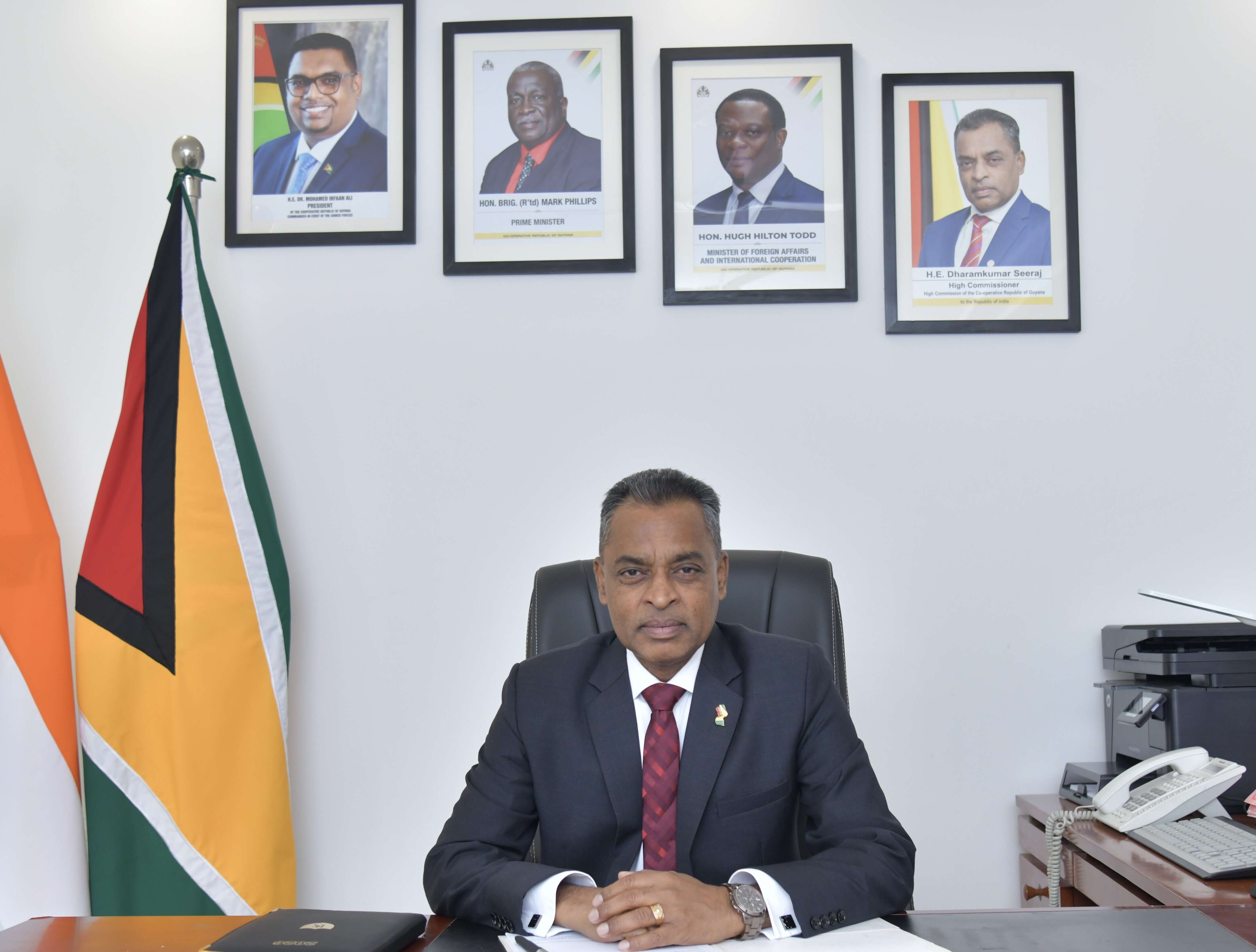
In this conversation with Anoop Verma, Dharamkumar Seeraj, High Commissioner of Guyana to India, speaks about the opportunities for Indian investment, cooperation in oil and renewable energy, the country’s Low Carbon Development Strategy, digital governance, food security, and the growing strategic partnership between India and Guyana.
The High Commissioner also explains how the two democracies can work together to advance the interests of the Global South while strengthening collaboration in trade, technology and sustainable development.
Edited excerpts:
Guyana has emerged as one of the world’s fastest-growing economies following major offshore oil discoveries. How has this economic transformation reshaped Guyana’s relationship with India?
Guyana’s economic transformation has been remarkable. During the 1970s, 1980s and even much of the 1990s, our economy struggled because successive governments lacked the policies and vision needed to stimulate growth. That period saw significant outward migration as many Guyanese sought better opportunities abroad.
A turning point came with the restoration of democracy in 1992, when a reform-oriented government began focusing on economic development, particularly in agriculture and infrastructure. The discovery of offshore oil in 2015, followed by commercial production in 2019, fundamentally changed the country’s economic trajectory. In 2024, Guyana recorded economic growth of around 46 percent, making it one of the fastest-growing economies in the world.
This rapid expansion has naturally strengthened our relationship with India. Bilateral trade has grown significantly, particularly in pharmaceuticals, engineering services and crude oil. Increased government revenues have enabled Guyana to invest heavily in roads, hospitals, schools, energy projects and transport infrastructure.
India’s expertise in infrastructure development, renewable energy and engineering makes it an ideal development partner. Indian companies are already active in Guyana, constructing roads, hospitals, water treatment facilities and solar power projects. As Guyana continues its transformation, I believe our economic partnership with India will become even stronger, supported by greater investment, technology transfer and capacity building.
India has developed significant expertise in refining, energy services, pharmaceuticals, digital public infrastructure and capacity building. Which sectors offer the greatest opportunities for Indian investment in Guyana over the next decade?
Our national development agenda is guided by Guyana’s Low Carbon Development Strategy, which seeks to achieve economic growth while maintaining environmental sustainability. Renewable energy is at the heart of this strategy, and we see considerable opportunities for collaboration with India in building our clean energy infrastructure.
Another major area is oil and gas. Although Guyana has become an important oil producer, we are still a young energy economy with limited experience in refining and downstream petroleum industries. At present, we export crude oil and import refined petroleum products. India’s vast experience in refining, petrochemicals and energy management can play an important role in helping Guyana develop these capabilities.
The pharmaceutical sector already demonstrates the strength of our partnership. Nearly 80 percent of Guyana’s pharmaceutical imports come from India, reflecting the quality, affordability and reliability of Indian medicines. As President Dr. Mohamed Irfaan Ali works towards making Guyana a healthcare hub for the Caribbean, Indian pharmaceutical companies, hospitals and medical professionals can contribute significantly through investments, training and technology transfer.
Digital public infrastructure is another promising area. Guyana is in the advanced stages of introducing a national digital payments platform inspired by India’s Unified Payments Interface (UPI). Indian technology companies are already supporting the development of our digital ecosystem, and we expect this cooperation to expand into digital identity, e-governance and public service delivery.
Energy security has become a major strategic concern worldwide. How do you see India and Guyana cooperating in oil and gas, renewable energy, refining, petrochemicals and energy technology?
Energy security is one of the defining challenges of our time, but it cannot be pursued in isolation from climate security. Our objective is to ensure that the country’s growing energy needs are met while remaining committed to environmental sustainability.
Guyana’s approach is to gradually diversify its energy mix by increasing the share of renewable sources such as solar, wind and hydropower. India has made tremendous progress in this area over the past few decades and has emerged as a global leader in renewable energy deployment. There is a great deal that Guyana can learn from India’s experience.
At the same time, India possesses extensive expertise across the oil and gas value chain. As one of the world’s largest consumers of energy and home to some of the world’s largest refining complexes, India has developed considerable knowledge in refining, petrochemicals and energy management.
As Guyana expands its energy sector, we see opportunities to benefit from Indian expertise in refining crude oil, developing petrochemical industries and creating value-added products such as fertilisers and plastics. If Guyana develops refining capacity in the future, Indian companies would be valuable partners in bringing technology, operational experience and investment.
Ultimately, our objective is to build an energy system that combines responsible utilisation of our hydrocarbon resources with rapid expansion of renewable energy. India is exceptionally well placed to support Guyana in achieving that balance.
Guyana and India share deep historical and cultural ties through the Indian diaspora. How is your High Commission working to strengthen people-to-people exchanges, education, tourism and cultural diplomacy between the two countries?
The relationship between Guyana and India is unique because it is built not only on diplomacy but also on shared history and people-to-people connections that date back nearly 188 years. The first Indians arrived in Guyana in 1838 as indentured labourers after the abolition of slavery. Despite the difficult circumstances, they preserved much of their heritage, including their traditions, religious practices, festivals, cuisine and family values.
Unlike many other communities that lost significant aspects of their cultural identity during colonial rule, the Indian community in Guyana consciously maintained its customs across generations. Although many descendants no longer speak the languages of their ancestors, they have retained a strong cultural connection with India.
Today, these historical ties are evolving into a modern partnership. As both countries become more prosperous, we are witnessing greater movement of people in both directions. Many Guyanese travel to India to trace their ancestral roots, while cultural exchanges, educational programmes and official visits have expanded considerably.
Institutions such as the Indian Council for Cultural Relations (ICCR) play an important role by offering scholarships and cultural exchange programmes that enable young Guyanese of Indian origin to experience India’s traditions, education system and heritage firsthand.
Tourism has also grown significantly. Increasing numbers of Guyanese living in North America and Europe are visiting India through organised heritage tours. Last year alone, more than 200 members of the Guyanese diaspora travelled to India to explore places connected with their ancestral history.
Food security and agriculture have become critical global priorities. What opportunities do you see for collaboration between India and Guyana in agricultural technology, food processing, irrigation and sustainable farming?
Agriculture has always been central to Guyana’s economy, and it remains one of the sectors with the greatest potential for cooperation with India. For many years, Guyana’s industrial and manufacturing sectors remained underdeveloped because of limited investment and high energy costs. As a result, our agro-processing capabilities have not expanded as rapidly as we would have liked.
India’s experience is particularly relevant because many of the crops cultivated in Guyana are also grown here. Over the years, India has developed practical, affordable technologies for small and medium-scale farming, food processing and value addition. These innovations are highly suitable for Guyana’s agricultural landscape.
We have been sending agricultural scientists, researchers and technical professionals to India for specialised training, and we hope to expand these programmes further. One area where India can make a significant contribution is agro-processing. Rather than exporting raw agricultural produce, Guyana wants to develop industries that process crops into higher-value products. India’s expertise in affordable processing equipment, rural technology and cooperative farming models offers lessons for us.
Another important area is irrigation and sustainable water management. Guyana is a member of the International Solar Alliance (ISA) and the Coalition for Disaster Resilient Infrastructure (CDRI), both of which provide valuable opportunities for collaboration with India in climate-resilient agriculture, irrigation systems and sustainable farming practices.
Agriculture is not only about food production—it is also about creating rural employment, increasing exports and ensuring long-term food security. India has demonstrated how these objectives can be achieved simultaneously, and we hope to benefit from that experience.
India has built globally recognised Digital Public Infrastructure through platforms such as Aadhaar, UPI and DigiLocker. Is Guyana looking to adopt similar digital governance solutions?
Digital transformation is one of our government’s major priorities, and India has become a very important partner in this journey. As I mentioned earlier, Guyana is working with Indian companies to implement a digital payments platform inspired by India’s UPI. This will significantly improve financial inclusion and digital transactions across the country.
Beyond digital payments, our vision is much broader. We intend to introduce a comprehensive digital identity system through which citizens will have secure digital ID cards, digital driving licences and integrated access to government services. We already issue digital passports, and the next phase is to create a secure digital ecosystem where citizens can access multiple public services through a single digital identity.
Naturally, privacy and cybersecurity remain essential. Different categories of personal information—such as healthcare records, banking details and government documents—will remain securely protected and accessible only through authorised permissions. India’s expertise in building large-scale DPI has been invaluable. We see opportunities for continued collaboration in digital governance, cybersecurity, e-governance and digital inclusion.
India and Guyana are both important voices of the Global South. How do you view cooperation between the two countries in multilateral forums on issues such as climate finance, sustainable development and reform of global governance?
Guyana and India share remarkably similar perspectives on many global issues. We are both committed to sustainable development, environmental protection and creating a more equitable international order. Because our priorities are closely aligned, we naturally cooperate in multilateral institutions and international forums. Climate action, environmental sustainability and food security are areas where our interests converge strongly.
India has played an important leadership role within the Global South and through platforms such as BRICS, where emerging economies are working together to promote more balanced global governance. As Guyana’s international profile continues to grow, particularly as an energy-producing nation, we look forward to working even more closely with India on issues such as climate finance, sustainable development, energy transition and reform of international institutions.
Our countries may differ in size, but we share a common vision—that developing nations should have a stronger voice in shaping the global agenda. I believe India and Guyana will continue to work together to advance that objective in regional and international forums.
Guyana has earned recognition for balancing economic growth with environmental conservation. How do you reconcile oil production with climate commitments, and what lessons can other developing countries learn from Guyana’s experience?
This is one of the defining policy challenges of our time, and Guyana has tried to address it through a long-term strategy rather than viewing economic growth and environmental protection as competing objectives.
One of the most important initiatives has been our Low Carbon Development Strategy, which recognises that our forests are among Guyana’s greatest national assets. Instead of exploiting them indiscriminately, we have positioned them as a global environmental resource.
Guyana has successfully developed a carbon credit programme based on the conservation of its forests. Our argument has been straightforward: by preserving our forests, we provide an essential service to the world by absorbing and storing carbon dioxide. That environmental service deserves financial recognition.
Countries such as Norway have supported this approach by providing payments for verified forest conservation. These payments are linked to rigorous international auditing to ensure that forest management remains sustainable. This model demonstrates that environmental conservation can also generate economic value. It provides an alternative to unsustainable exploitation while creating resources that can be invested in national development.
At the same time, revenues from our oil sector are being invested in renewable energy, climate-resilient infrastructure, drainage and irrigation systems, flood management and modern agricultural infrastructure. In other words, we are using today’s hydrocarbon revenues to finance tomorrow’s low-carbon economy.
Over time, renewable sources such as solar, wind and hydropower will account for an increasingly larger share of Guyana’s energy mix, reducing our dependence on fossil fuels while ensuring long-term energy security.
Bilateral trade between India and Guyana has grown steadily but remains below its full potential. What practical steps can both governments take to accelerate trade and investment?
There is certainly considerable scope for expanding bilateral trade. Guyana already exports products such as bauxite, timber, gold, diamonds and scrap metal to India, while India exports pharmaceuticals, engineering products, machinery and other manufactured goods to Guyana.
Many pharmaceutical products entering Guyana from India already receive preferential treatment because they are essential to our healthcare system. Similar arrangements could be explored for other strategic sectors. As trade volumes continue to increase, there may also be opportunities to examine preferential trade arrangements or even a broader free trade framework, provided both countries identify areas of mutual benefit.
More importantly, we need greater business-to-business engagement. Companies should be encouraged to explore investment opportunities rather than limiting the relationship to traditional merchandise trade.
Looking ahead over the next decade, what is your vision for India-Guyana relations?
I believe the partnership between Guyana and India has enormous potential, and the coming decade will be defined by deeper cooperation in several strategic sectors. Healthcare is one of the most promising areas. Guyana aims to become a regional healthcare hub for the Caribbean, and India’s world-class expertise in medical education, pharmaceuticals, hospital management and healthcare technology can make a significant contribution to that ambition.
Agriculture is another major priority. We want Guyana to become the food basket of the Caribbean, and India’s remarkable success in agricultural innovation, cooperative farming, agro-processing and value addition provides a valuable model for us. Energy will remain equally important. As Guyana develops its oil and gas industry while simultaneously expanding renewable energy, India’s technological expertise, engineering capabilities and investment will play a crucial role.
We are already seeing this partnership take shape. Indian companies are helping to build large-scale solar power projects in Guyana. The speed and scale at which these renewable energy projects can be deployed is truly impressive and will significantly strengthen our national energy capacity.
Education will also remain a key pillar of cooperation, with greater exchanges between universities, research institutions and technical training organisations. I see India and Guyana evolving from traditional partners into comprehensive strategic development partners, working together across energy, healthcare, agriculture, technology, education and infrastructure.