As artificial intelligence reshapes the future of work and learning, schools are under growing pressure to move beyond memorisation and prepare students with the skills needed for an uncertain future. Yet, according to Vardan Kabra, Founder of Fountainhead School, India’s education system continues to be constrained by outdated assessments, rigid curricula and a disconnect between policy intent and classroom implementation.
Founded in Surat, Fountainhead School is among India’s largest International Baccalaureate (IB) continuum schools, with over 2,600 students and expansion plans underway. In an exclusive conversation with ETEducation, Kabra speaks candidly about the implementation of the National Education Policy (NEP) 2020, AI in classrooms, board examinations, teacher preparation, curriculum reform and why schools must prioritise curiosity, problem-solving and real-world learning over rote memorisation.
Q: It has been six years since the National Education Policy (NEP) 2020 was announced. What has genuinely changed in Indian classrooms, and where do you still see the biggest implementation gaps?
Vardan Kabra: There have been some positive changes, particularly within CBSE. The board has rationalised parts of the curriculum to reduce unnecessary rote memorisation and has introduced improvements in assessment practices and teacher professional development. Those are encouraging developments.
However, the larger implementation gap remains significant. Education is a state subject, while the NEP serves as a broad guideline. Given the scale of India’s school system, there is still a considerable distance between what the policy envisions and what is happening in classrooms across the country.
Q: Artificial Intelligence is rapidly reshaping education. What part of today’s curriculum could become irrelevant over the next decade, and what should replace it?
Vardan Kabra: AI has made it clear that our education system should have changed much earlier. Students continue to spend far too much time memorising facts. Basic knowledge will always matter, but schools now need to focus far more on application, creativity and solving real-world problems.
The future belongs to students who know how to ask better questions, solve complex problems and use AI effectively. Rather than teaching children to code in the traditional sense, schools should teach them how to work with AI as a learning and productivity tool. That shift is far more important.
Q: Schools today are investing heavily in AI. Are they using it effectively?
Vardan Kabra: Not yet. Most schools simply don’t know what to do with it. Board examinations still reward memorisation, while real life increasingly rewards problem-solving. As long as examinations continue to test memory, schools will continue teaching to the test.
Teachers are trying to build foundational skills, but students are often using AI to complete homework without actually learning. At the same time, schools also face practical challenges such as access to devices, internet connectivity, cybersecurity and responsible technology use.
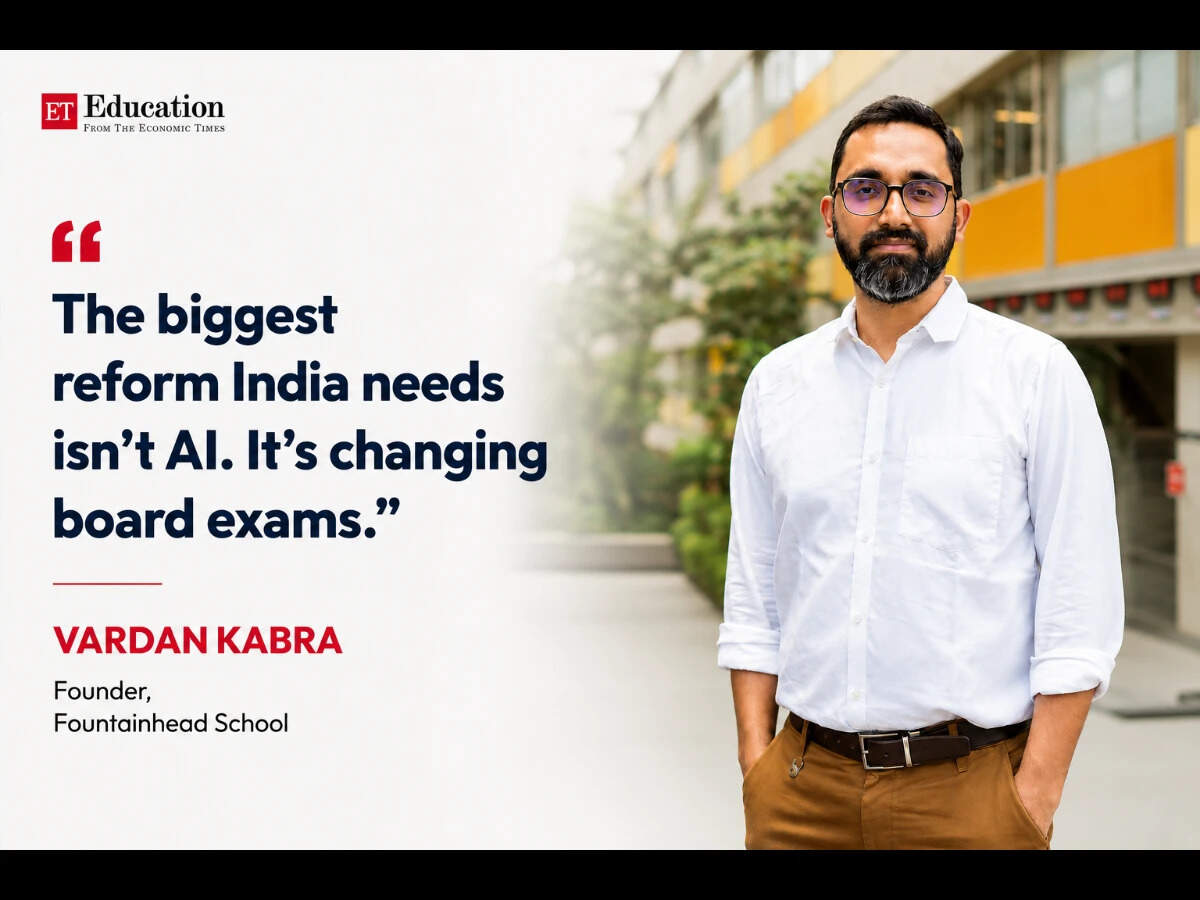
The biggest reform must happen in board examinations. If we continue to assess students on rote memorisation, schools cannot change.
Q: Parents continue to judge schools by board results and college admissions. Does India need a new framework to measure school success?
Vardan Kabra: Yes, but creating one is not straightforward. Schools should be evaluated on how well they build character, curiosity and lifelong skills rather than simply producing examination scores. The challenge is that qualities like integrity, resilience and creativity are much harder to measure than marks.
Over time, I believe recruitment practices will drive this change. As employers increasingly hire based on portfolios and demonstrated skills rather than degrees alone, college admissions and school education will also begin to evolve.
Q: If you had to redesign a school today for a child entering Grade 1, what would you stop and what would you build?
Vardan Kabra: First, I would drastically reduce the overload of factual memorisation. Second, if something being taught has no clear real-world relevance, it should not be part of the curriculum.
Third, examinations must shift from testing memory to testing application.
Instead, schools should build curiosity, problem-solving abilities and practical skills from an early age. Project-based learning and authentic problem-solving should become central to the learning experience.
Q: What is one trend in education that you believe is overhyped, and what deserves greater investment?
Vardan Kabra: Coding and digital classrooms are overhyped. Technology alone has never transformed education. Content has been freely available online for years, yet that hasn’t automatically improved learning outcomes.
What deserves far greater investment is helping children develop curiosity during their foundational years. If students don’t learn how to think, question and explore between the ages of three and twelve, technology alone cannot compensate later.
Q: Teacher quality remains central to learning outcomes. What needs to change?
Vardan Kabra: Teacher quality is closely linked to the larger education system. As long as examinations reward memorisation, teachers will naturally teach towards those expectations.
We also need to rethink teacher recruitment. Rather than focusing excessively on formal qualifications, we should invest in high-quality teacher training and continuous professional development. Teach For India is a good example. Many of its fellows don’t have traditional education degrees, but with rigorous training and ongoing support, they perform exceptionally well in challenging classrooms.
Q: If you could recommend three major reforms to the Ministry of Education, what would they be?
Vardan Kabra: First, government should move away from prescribing detailed curricula and allow schools and education boards greater flexibility to innovate. Second, instead of primarily funding schools, governments should consider funding students through mechanisms such as education vouchers or direct benefit transfers, allowing families greater choice.
Third, India needs much greater investment in education. The current regulatory framework discourages large-scale investment that could improve quality across schools serving different socio-economic groups.
Q: Fountainhead School has built a strong reputation over the years but hasn’t expanded as aggressively as some other school groups. Why?
Vardan Kabra: Our priority has always been to understand what truly high-quality education looks like before expanding.
Today, Fountainhead School has more than 2,600 students and is among India’s larger IB continuum schools. We are now entering our next phase of growth with a new IB school coming up in Surat, an IB residential school in Vapi and a partnership to manage a school in Chhatrapati Sambhajinagar. We are actively exploring additional opportunities while remaining committed to educational quality.