
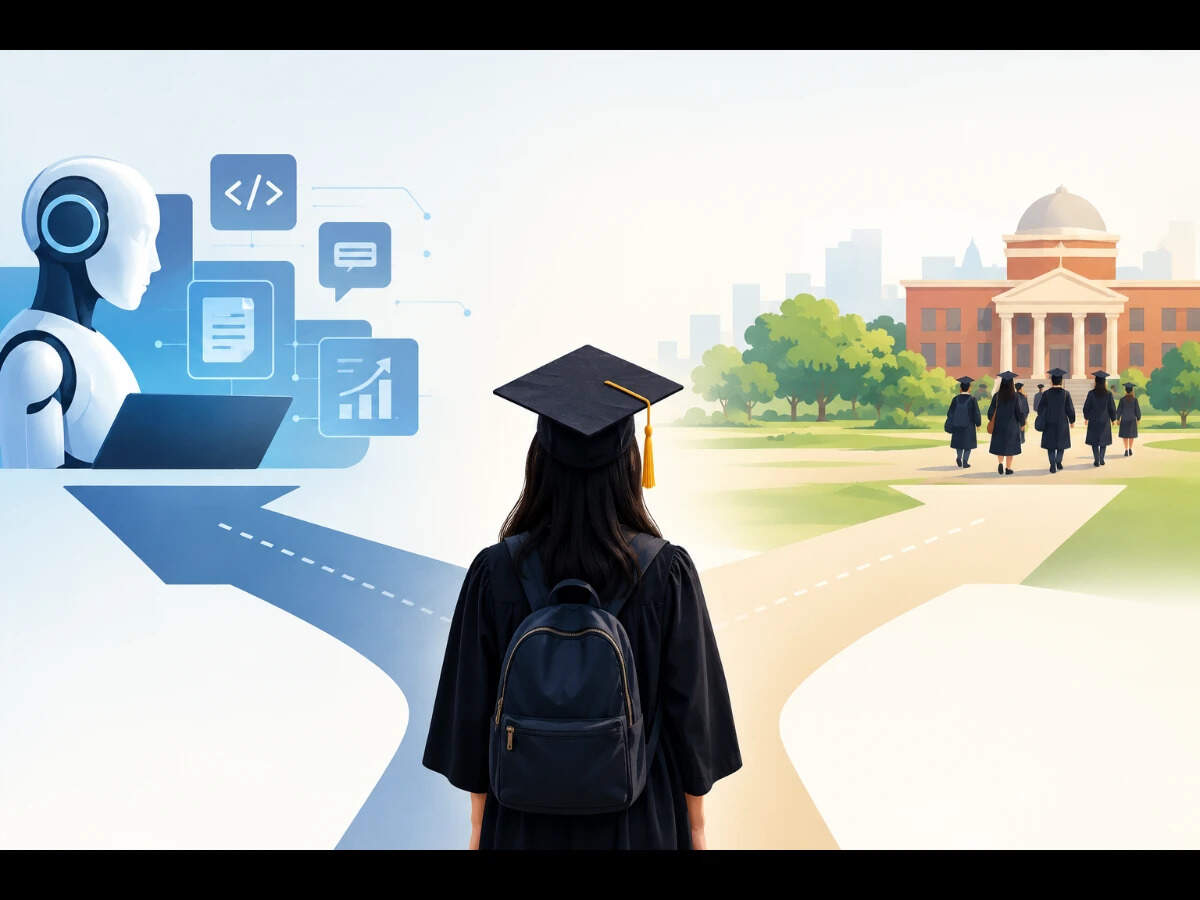
New Delhi: Artificial intelligence (AI) could narrow traditional entry-level career pathways by automating routine tasks through which young professionals acquire workplace experience, according to a new white paper from the Indian Institute of Technology Madras (IIT Madras).
The paper, How AI Is Reconfiguring Work in India, by the Centre for Responsible AI (CeRAI) at the Wadhwani School of Data Science and AI, argues that AI’s impact on employment cannot be understood simply by asking whether a technology will replace a particular job. Instead, it calls for examining which tasks within a job can be automated, which still require human judgement and how these changes affect employment.
The paper identifies the entry-level career pipeline as particularly vulnerable, especially in India’s IT, business process outsourcing (BPO), finance and professional services sectors, which have traditionally absorbed large numbers of graduates.
Junior employees often begin with repetitive, process-oriented assignments before progressing to work requiring greater judgement and accountability. AI systems can now perform several of these routine tasks, from basic coding and customer support to bookkeeping and document review.
This raises a longer-term concern for employers and universities: if AI takes over some of the work through which professionals traditionally gain experience, how will organisations develop the next generation of experienced employees?
The paper does not estimate how many entry-level jobs will be lost. Instead, it identifies a potential gap between the automation of junior-level tasks and the continued need for experienced professionals.
AI is already performing a share of entry-level tasks
The IIT Madras paper cites a 2026 study by Cognizant and Pearson, based on a survey of 750 HR leaders, which found that 37% of entry-level tasks in India were already being performed by AI, compared with 33% globally.
The figures refer to tasks rather than jobs eliminated. A role may include several activities, some of which can be automated while others continue to require human intervention.
What the data shows
| Indicator | Finding | Significance |
| Entry-level tasks in India performed by AI | 37% | Indicates the extent of AI’s reported role in junior-level work |
| Global share of entry-level tasks performed by AI | 33% | India’s reported share was four percentage points higher |
| Fully loaded cost of a human BPO agent in India | ₹8–20 per minute | IIT Madras’ estimate based on multiple industry pricing sources |
| Managed, production-grade voice AI cost | ₹4–9 per minute | Estimated cost range for AI-based voice support at scale |
| New AI-related jobs potentially created in India over five years | Up to 4 million | A conditional projection cited from NITI Aayog’s 2025 roadmap, not a guaranteed outcome |
Sources: IIT Madras CeRAI white paper, citing Cognizant and Pearson (2026), industry pricing estimates and NITI Aayog’s Roadmap for Job Creation in the AI Economy (2025). The BPO figures are indicative estimates rather than an audited industry-wide comparison.
The cost comparison helps explain why routine tasks are among the first candidates for automation. According to IIT Madras, relatively inexpensive AI systems can handle basic customer queries and other structured activities without requiring the most advanced models.
However, the paper cautions that technical capability alone does not determine whether a job will disappear. Costs, service quality, regulatory requirements and the need for human judgement all influence how companies deploy AI.
Which entry-level tasks are most exposed?
The paper examines AI’s impact across sectors, including software engineering, BPO, finance, manufacturing and legal services. Its examples illustrate how tasks can change even when the overall occupation continues to exist.
| Sector | Routine tasks AI can perform | Human work that remains important |
| Software engineering | Boilerplate coding and routine programming assignments | Complex debugging, system architecture and technical judgement |
| BPO and customer support | Password resets, order-status queries, appointment confirmations and routine calls | Escalations, complex customer interactions and quality oversight |
| Finance and accounting | Invoice processing, ledger classification, bank reconciliation and GST return pre-filling | Exception handling, verification and professional sign-off |
| Legal services | Parts of legal research and contract review | Litigation strategy, advocacy and client counsel |
| Manufacturing | AI-assisted visual inspection and identification of defects | Interpreting flagged defects and handling operational exceptions |
Source: IIT Madras CeRAI, How AI Is Reconfiguring Work in India. These are illustrative examples, not estimates of the proportion of each occupation that has been automated.
In software engineering, AI can reduce the need for junior employees to write routine code, while experienced engineers remain responsible for architecture and complex technical decisions. In BPO, voice AI can handle straightforward customer queries, leaving human agents to address more difficult cases.
The paper argues that this could create a “missing middle” in the workforce: routine tasks traditionally performed by junior employees may shrink even as demand for experienced professionals holds up or grows.
The challenge for graduate employability
For higher education institutions, the implications extend beyond adding AI tools or courses to existing curricula.
The IIT Madras paper raises a fundamental question about how professional judgement is developed. Junior employees traditionally acquire experience through repetitive assignments, observing experienced colleagues and gradually taking on more complex responsibilities. If AI performs a greater share of these tasks, the training ground for future experts could become narrower.
For engineering colleges, this could mean preparing students to evaluate AI-generated code, identify errors, test systems and explain technical decisions. In management, finance and law programmes, students may need more experience in validating AI-generated analysis, recognising limitations and taking responsibility for decisions.
The paper does not assess university curricula or measure graduate employability. Its findings instead point to a question institutions and employers will need to address: whether graduates are being prepared for jobs in which AI performs more of the routine work from the outset.
Will companies redesign entry-level roles or hire fewer graduates?
One possible response, according to IIT Madras, is to redesign entry-level jobs around supervising and correcting AI outputs rather than performing routine tasks directly.
In BPO, for instance, a potential career path could move from a customer-service agent to an escalation specialist, quality evaluator, AI conversation designer and eventually an operations supervisor. Such roles would require employees to evaluate AI performance, manage exceptions and improve automated workflows.
The paper stresses, however, that whether companies will invest in redesigned career pathways or simply recruit fewer junior employees remains an open question.
It also points to new roles emerging around AI deployment, including AI trainers, ethical AI specialists, forward-deployed engineers and remote robot operators. Citing NITI Aayog’s 2025 roadmap, the paper notes that India could generate up to four million new AI-related jobs over five years. This is a projection dependent on coordinated investment in skilling and reskilling, rather than an assured employment outcome.
The creation of new roles does not automatically mean that workers displaced from existing positions will be able to move into them. The paper calls for structured transition pathways to help workers acquire the skills required for changing roles.
Why a task-based approach matters
IIT Madras argues that India’s AI and employment debate needs more detailed labour-market evidence. Its framework distinguishes between tasks that can be automated cheaply, tasks that require expensive or advanced AI systems, work that continues to depend on human judgement and situations in which automation may be inappropriate or may compromise service quality.
The paper draws on examples from multiple sectors but explicitly describes its evidence as illustrative rather than representative of the Indian labour market. It does not quantify the overall effect of AI on employment, wages or job quality across the country.
Its central recommendation is to encourage AI adoption while investing in India-specific labour-market research and structured worker-transition pathways.
For India’s higher education system, the longer-term question is how universities and employers will adapt training and early-career roles as AI takes over more routine work. The challenge is not only to prepare graduates to use AI, but also to ensure they can acquire the judgement and experience needed to become the experienced professionals on whom organisations will continue to depend.