Uttar Pradesh is preparing a comprehensive roadmap to position itself as a national hub for artificial intelligence (AI), startups, robotics, quantum computing, semiconductors and other deep technologies.
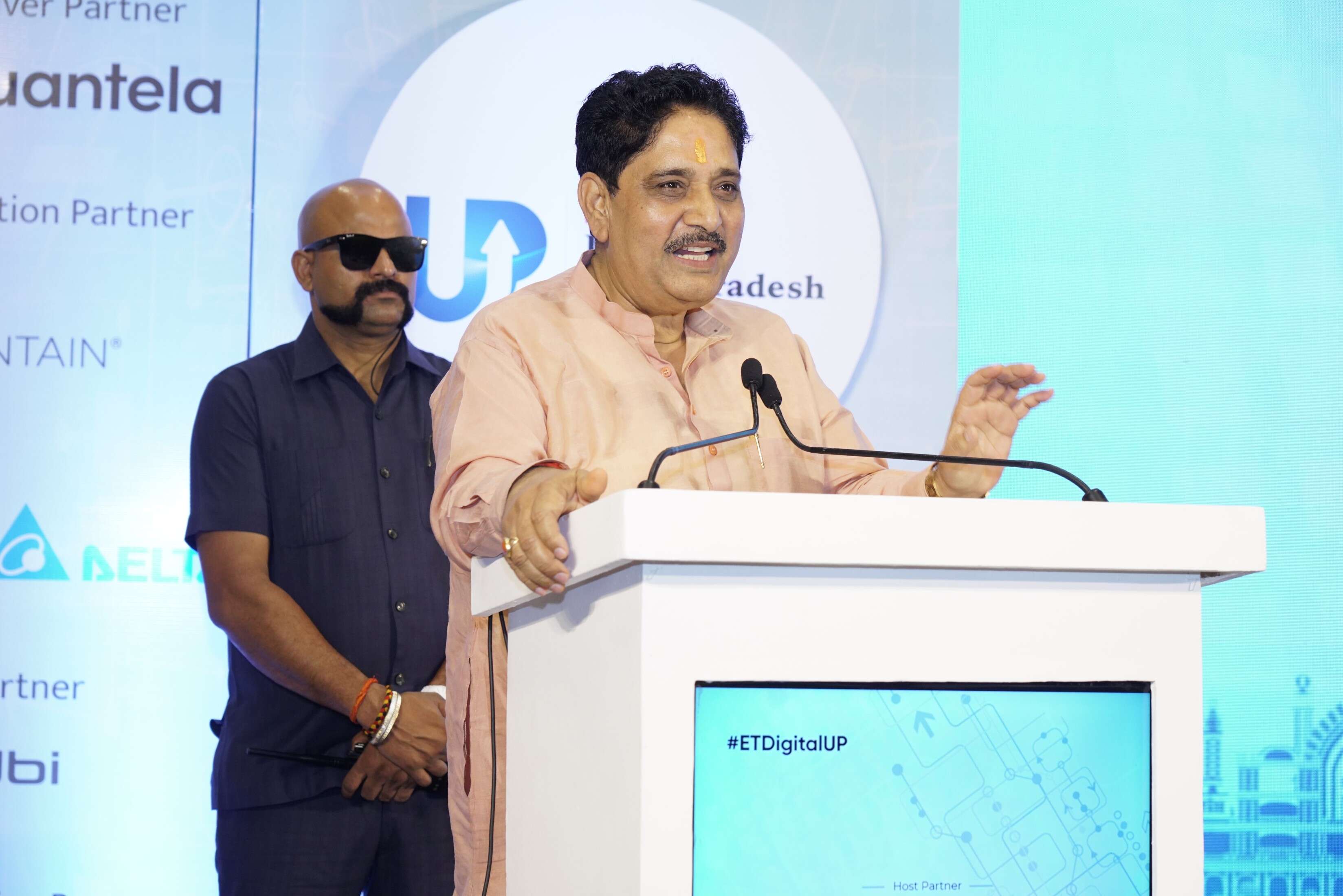
Sunil Kumar Sharma, Minister for IT & Electronics, Government of Uttar Pradesh, speaks to ETGovernment’s Arpit Gupta about the state’s AI roadmap, startup ecosystem, electronics manufacturing, data centres and the next phase of digital transformation.
Edited excerpts:
Uttar Pradesh has recently revised its Startup Policy and Data Centre Policy while simultaneously announcing an AI Hub, U-Hub, Startup Mission and AI City. How do these initiatives fit into the state’s long-term vision?
We are preparing Uttar Pradesh for the economy of the future. Technology is evolving rapidly, and artificial intelligence will become the foundation of governance, industry, education and entrepreneurship. That is why we are not looking at AI, startups, electronics manufacturing or data centres as separate initiatives, they are all part of one integrated digital ecosystem.
Our government is working on a comprehensive AI Policy and an AI Mission that will provide direction to research, innovation, skilling and industrial adoption. Alongside this, we are developing AI City as a world-class technology destination with plug-and-play infrastructure, commercial spaces, residential townships and every facility that technology companies require.
The objective is simple: when a global technology company decides to invest in India, Uttar Pradesh should be its first choice.
Artificial Intelligence has become central to the state’s technology strategy. How is Uttar Pradesh preparing its workforce for the AI era?
Technology creates opportunities only when people possess the right skills. That is why skilling is our biggest priority.
Under the Government of India’s AI Pragya Mission, nearly one million people are being trained in AI-related skills. We are complementing these efforts at the state level by expanding digital infrastructure and creating employment opportunities through initiatives such as Mission Ganga, which aims to strengthen connectivity across villages and generate livelihood opportunities for rural youth.
Our next major objective is to introduce AI learning at the school level. Hon’ble Chief Minister Yogi Adityanath has consistently emphasised that AI education should not remain confined to higher institutions. We want students in primary and secondary schools to become familiar with emerging technologies from an early age so that they are prepared for the jobs of tomorrow.
AI education is evolving rapidly, with multiple platforms, languages and training providers. How will the government ensure quality and accessibility?
AI is a new and fast-changing domain, so naturally there will be challenges. Our approach is to work closely with industry leaders, academic institutions, technology companies and domain experts to create high-quality learning programmes. We are open to collaborating with global companies and consultants wherever necessary. Our focus is not only on making AI education accessible but also on ensuring that it remains relevant to industry requirements. As technology evolves, our policies and programmes will evolve accordingly.
The state’s digital ambitions are already attracting global technology companies. IBM has established its AI Innovation Hub in Lucknow. Are more global players expected to invest in Uttar Pradesh?
Absolutely. There is tremendous interest among leading technology companies in investing in Uttar Pradesh. Many companies are already in discussions with the government. Every investor has specific requirements, and we carefully evaluate each proposal to ensure that investments create long-term value for both industry and the state.
Today, Uttar Pradesh offers political stability, transparent policies, world-class infrastructure and proactive governance. Investors are confident that projects move quickly here, and that confidence is translating into new investments across AI, IT services, electronics manufacturing and digital infrastructure.
Uttar Pradesh’s startup ecosystem has grown remarkably from around 1,000 registered startups a few years ago to over 18,000 today. What has driven this transformation?
Our objective has never been limited to creating job seekers; we want to create job creators. Young entrepreneurs often have innovative ideas but lack mentorship, incubation support and access to capital. Our role as a government is to bridge those gaps.
Today, every district has incubation support, more than 100 incubators are operational across the state, and around 11 Centres of Excellence are nurturing innovation in emerging technologies. Under the revised Startup Policy, we have also approved the creation of a dedicated Startup Mission Directorate. The state government is also setting up two U Hubs in Lucknow and Noida as Centres of Excellence for deep-tech innovation. A budgetary provision of ₹100 crore has been made for the project in FY27.
This is an important institutional reform. Earlier, startup-related activities were handled within an existing corporation. Now an independent body will exclusively focus on strengthening Uttar Pradesh’s startup ecosystem. It will have an empowered governance structure, including an Advisory Committee comprising industry leaders, academic experts and innovators, ensuring that policy decisions are driven not only by bureaucracy but also by real-world entrepreneurial experience.
The Noida U Hub will focus on quantum computing, semiconductor design, physical AI, robotics, defence technologies and advanced biotechnology, while the Lucknow centre will specialise in applied AI, GovTech, industrial AI applications, healthcare technologies, biosciences and agri-biotechnology. The hubs are expected to serve as integrated platforms connecting researchers, startups, investors, educational institutions and industry, with a focus on commercialising research and supporting high-value technology ventures. Their operating framework has been prepared by an expert committee chaired by the director of IIT Kanpur after studying domestic and international deep-tech ecosystems.
I am confident this institutional framework will help Uttar Pradesh emerge as India’s leading startup destination.
Data centres have become the backbone of the digital economy. Uttar Pradesh is already among India’s leading destinations in this sector. What is the next phase of expansion?
The Chief Minister has clearly articulated that data centre development should gradually move beyond the National Capital Region so that balanced regional development can take place. We are encouraging investments in regions such as Bundelkhand and eastern Uttar Pradesh by providing the required infrastructure and policy support. As digital infrastructure expands, industries, employment opportunities and technology ecosystems will also spread across the state.
Our Data Centre Policy has already delivered encouraging results, attracting more than ₹21,343 crore in investments and creating significant operational capacity and employment. Leading companies such as Adani, NTT, Sify, STT, Web Werks and Yotta are strengthening Uttar Pradesh’s position as one of India’s most important data centre destinations.
In the Uttar Pradesh Data Centre Policy 2026, our focus is on AI-ready digital infrastructure and large-scale investments. The state has set a target of developing over 2 GW of additional data centre capacity and attracting more than ₹2 lakh crore in investments, positioning Uttar Pradesh as a green, AI-ready data centre hub.
The government has announced plans for AI City in Lucknow. What differentiates this project from a conventional IT park?
AI City is much more than an IT park. Our vision is to create a complete technology ecosystem where companies can begin operations immediately without worrying about infrastructure. The Chief Minister has envisioned AI City as a fully integrated township with plug-and-play office spaces, research facilities, residential accommodation, commercial infrastructure and social amenities. We want companies to focus on innovation, not on setting up basic infrastructure.
The project is being designed to attract AI companies, Global Capability Centres (GCCs), startups, research institutions and technology innovators under one ecosystem. It will become a catalyst for the next phase of Uttar Pradesh’s digital economy.
Uttar Pradesh has already emerged as India’s electronics manufacturing powerhouse. What is the current status of the sector and what are your priorities going forward?
Electronics manufacturing has been one of our biggest success stories. Today, Uttar Pradesh contributes nearly 65 percent of India’s mobile phone manufacturing and around 55 percent of mobile component manufacturing, making it the country’s leading electronics manufacturing destination. More than 200 ESDM companies, including Samsung, Oppo, Vivo, Dixon and Haier, have established operations in the state, creating a robust manufacturing ecosystem.
Our focus is now shifting from final assembly to high-value electronics and component manufacturing. Under the Electronics Manufacturing Policy and the recently notified Electronics Components Manufacturing Policy, we are encouraging investments across the entire value chain so that Uttar Pradesh becomes a global manufacturing hub by 2030.
The state is also making an ambitious push into semiconductor manufacturing. How significant is this opportunity for Uttar Pradesh?
Semiconductors represent the future of the electronics industry. Every modern device from smartphones and electric vehicles to defence equipment and AI systems depends on semiconductor technology.
Recognising this opportunity, Uttar Pradesh has introduced a dedicated Semiconductor Policy. We have already received investment proposals worth more than ₹32,000 crore, which demonstrates the confidence global investors have in the state’s industrial ecosystem. This sector will not only strengthen India’s technological self-reliance but will also create high-quality employment opportunities for engineers, researchers and skilled professionals.
Several global companies including Foxconn, Samsung, Microsoft and LG have announced investments or expansion plans in Uttar Pradesh. What has changed in the state’s investment ecosystem?
Investors today look beyond incentives. They seek speed, transparency and policy certainty. We have transformed our investment facilitation process through digital governance. Incentive approvals have been automated through online dashboards, significantly reducing processing time and eliminating unnecessary delays.
Earlier, investors often had to wait for years to receive incentives. Today, our objective is zero pendency. Departments proactively engage with investors to resolve bottlenecks instead of expecting them to navigate administrative processes on their own. Through Nivesh Mitra, investors can now access more than 530 online services across over 40 government departments, making Uttar Pradesh one of the most investor-friendly states in India.
This governance model has strengthened investor confidence and encouraged companies such as Samsung, LG, Foxconn, Microsoft and several others to expand their presence in the state.
Uttar Pradesh has set an ambitious goal of becoming a one-trillion-dollar economy. What role will the IT and Electronics sector play in achieving this vision?
Technology will be one of the biggest growth engines of Uttar Pradesh’s economy. Whether it is electronics manufacturing, AI, semiconductors, data centres, startups or digital services, every emerging sector is creating investment, employment and exports.
Our objective is to ensure that this growth is not confined to Noida or Lucknow alone. We want technology-led industrial development to reach other major cities and regions of the state so that the benefits of economic growth are widely shared. The stronger our technology ecosystem becomes, the greater Uttar Pradesh’s contribution to India’s digital economy and to the state’s trillion-dollar economy vision.
As your tenure enters its final phase, which achievements give you the greatest satisfaction?
Public service is about creating institutions that continue to deliver long after an individual leaves office. I am particularly satisfied that the IT and Electronics Department has maintained consistent momentum across multiple sectors electronics manufacturing, digital infrastructure, startup development, AI adoption and investment promotion.
We have strengthened Uttar Pradesh’s position as India’s electronics manufacturing leader, accelerated data centre investments, created a stronger startup ecosystem and laid the foundation for AI-led growth. More importantly, we have built systems that are transparent, technology-driven and investor-friendly. These reforms will continue benefiting the state for years to come.
What message would you like to give to investors, startups and young entrepreneurs looking at Uttar Pradesh today?
Uttar Pradesh has changed dramatically over the past few years. Today, investors find stable policies, robust infrastructure, transparent governance and a government that works as a facilitator rather than merely a regulator.
For startups, we are creating an ecosystem of incubation, mentorship, Centres of Excellence and institutional support. For technology companies, we are building AI City, expanding data centre infrastructure and promoting advanced electronics manufacturing. For young people, we are investing in skills, AI education and entrepreneurship so that they become creators of jobs rather than seekers of jobs.
Our message is clear: If you have an idea, an innovation or an investment plan, Uttar Pradesh is ready to partner with you. We are committed to making the state not only India’s electronics manufacturing hub but also its leading destination for artificial intelligence, innovation and the digital economy.