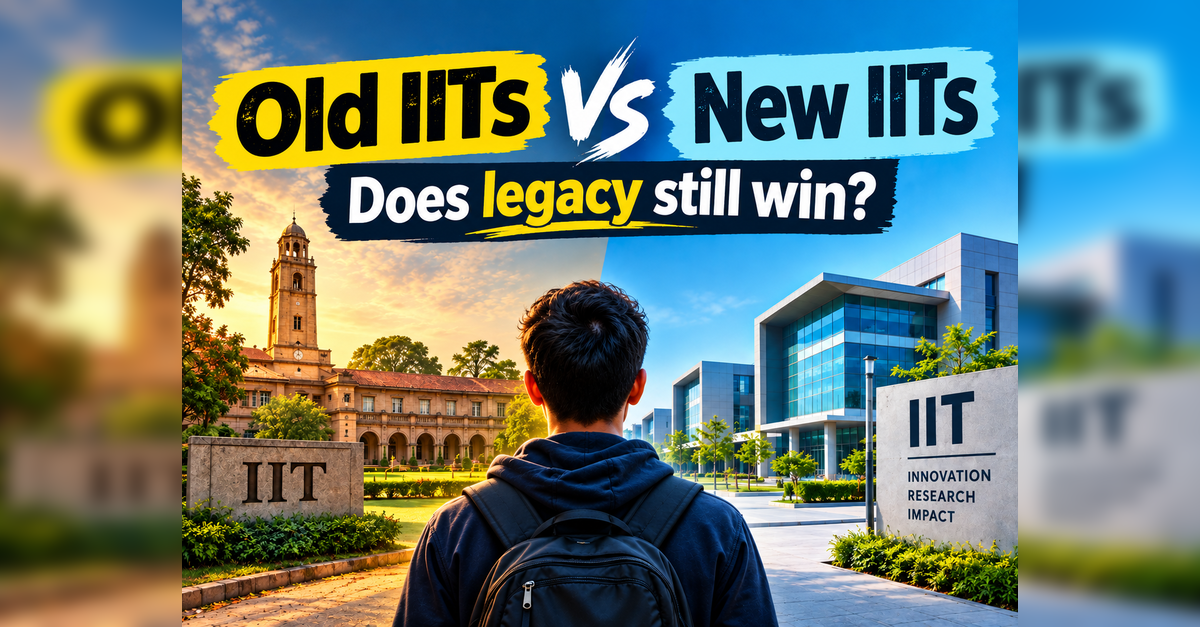
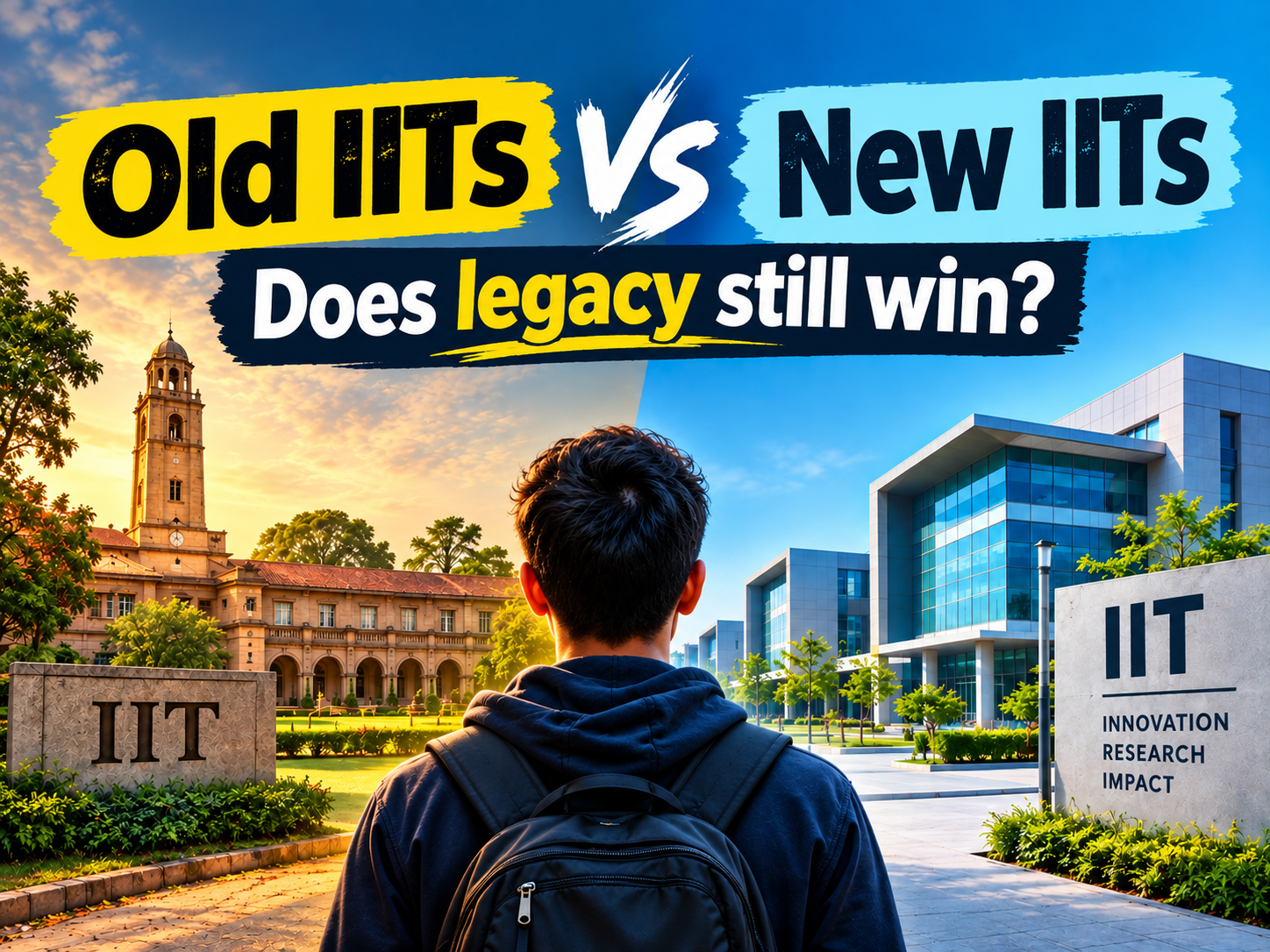
As engineering moves from conventional disciplines to AI, quantum, semiconductors and deep tech, the real IIT advantage may no longer be defined by age
Every year, JEE Advanced results create the same dilemma for thousands of aspirants: a preferred branch at a newer IIT, or a less-preferred branch at an older one?
For generations, the answer appeared almost obvious. IIT Kharagpur, IIT Bombay, IIT Madras, IIT Kanpur and IIT Delhi carried something that newer institutions could not immediately acquire — decades of academic reputation, powerful alumni networks, established industry relationships and research ecosystems built over generations.
But engineering itself is no longer the same discipline.
The engineer entering the workforce in 2035 is likely to work at the intersection of artificial intelligence, robotics, semiconductors, quantum technologies, advanced materials, biotechnology, climate technology and computing. The question, therefore, is no longer simply whether an IIT is old or new.
It is whether the institution can keep pace with the technology it is expected to teach.
And that is where the old-versus-new IIT debate becomes considerably more complicated.
Six decades apart, one evolving engineering model
The IIT story began in May 1950, when the first institution was established at Kharagpur, at the site of the former Hijli Detention Camp. It was formally inaugurated as an IIT on August 18, 1951.Within the next decade came IIT Bombay in 1958, IIT Madras and IIT Kanpur in 1959, and IIT Delhi in 1961. These institutions were built when India’s engineering priorities were centred largely around strong disciplinary foundations, specialised technical education, industrialisation and the creation of a domestic scientific workforce.
The newer IITs entered a dramatically different environment. They were born into an economy shaped by digital technologies, startups, globalisation, AI and deep-tech innovation. That difference in historical context may be one of their biggest structural advantages.
As Prof Rajeev Ahuja, Director, IIT Ropar, puts it, being a newer IIT offered the institution the freedom to “design for the future rather than retrofit the past.”
At IIT Ropar, this has translated into curricula incorporating design thinking, research methodology, innovation management and IP strategy, alongside mission-driven research in areas including agricultural AI, quantum sensing, defence technology and advanced manufacturing.
Prof Ahuja argues that the late start was therefore not necessarily a handicap.
It was an opportunity to build an IIT around the technology priorities of the next decade rather than those of the previous one.
The first uncomfortable truth: legacy is an advantage — but not the whole advantage
It would be misleading to suggest that the newer IITs have erased the advantages of their older counterparts. They have not.
The older IITs possess institutional capital that cannot simply be replicated by creating a new campus: decades of research expertise, extensive alumni networks, global recognition, established industry relationships and academic traditions.
Prof Avinash Kumar Agarwal, Director, IIT Jodhpur, acknowledges this directly.
“Institutional legacy is unquestionably valuable,” he says, pointing to the extraordinary research capabilities, alumni networks, academic traditions, global recognition and industry relationships developed by older IITs.
But there is a distinction between having accumulated capital and converting that capital into future capability. “Legacy is only one component of institutional strength,” Agarwal argues.
The more important question, he says, is how effectively an institution converts knowledge into new capabilities, technologies, enterprises and societal impact.
That distinction could become increasingly important as technology cycles shorten.
New IITs have one thing old IITs cannot manufacture overnight: structural agility
The strongest case for newer IITs is not that they have more history.
It is that they have less of it.
That gives them room to design academic structures around emerging technologies without having to reconfigure decades-old institutional systems.
At IIT Jodhpur, this is visible in the expansion across disciplines and programmes. The institute’s academic ecosystem now spans Computer Science, Electrical, Mechanical and Chemical Engineering, AI and Data Science, Bioscience and Bioengineering, Materials, Civil and Infrastructure, Electronics, Aerospace, Economics and Environmental & Sustainability Engineering.
New departments and programmes have also emerged around areas such as Electronics Engineering, Aerospace Engineering, Energy and Automotive Engineering, Environmental & Sustainability Engineering, Engineering Physics, Engineering Chemistry and Mathematics & Computing.
| WHAT THE DIRECTORS SAY“Design for the future rather than retrofit the past.”— Prof Rajeev Ahuja, Director, IIT Ropar“Legacy is only one component of institutional strength.”— Prof Avinash Kumar Agarwal, Director, IIT Jodhpur“Agility must be combined with fundamental scientific rigour and engineering depth.”— Prof Avinash Kumar Agarwal, Director, IIT Jodhpur“Institutional agility is becoming a decisive advantage.”— Prof Rajeev Ahuja, Director, IIT Ropar |
But the bigger shift is structural. The objective, Agarwal says, is not merely to keep adding departments. It is to break the silo-based model of engineering education.
An autonomous vehicle, for instance, cannot be built by mechanical engineering alone. It requires electronics, AI, materials, energy and human-centred design.
Healthcare technology similarly requires engineering to work with medicine and life sciences.
And clean-energy technologies increasingly sit at the intersection of materials, chemical engineering, power systems and policy.
The emerging IIT model, therefore, is less about creating another department and more about creating intersections between departments.
The old IIT advantage is deep, the new IIT advantage is speed
This may be the most useful way to understand the distinction.
Older IITs have depth. Newer IITs have the opportunity to build for speed.
Prof Ahuja points to IIT Ropar’s research ecosystem in quantum technologies, defence technology, agricultural intelligence, robotics and cyber-physical systems as evidence that newer institutions can build research capabilities relatively quickly.
He also argues that newer IITs are attracting high-quality faculty with international experience and building globally competitive research ecosystems. His broader point is that in an environment where technologies can evolve within 18–24 months, institutional agility itself can become an advantage.
That does not make legacy irrelevant, it changes what legacy needs to deliver. A powerful alumni network, for instance, matters most when it can create new research partnerships, startups, technology transfer, global opportunities and industry linkages.
Similarly, a long research tradition matters most when it continues to produce research relevant to the problems of the next decade.
The value of legacy increasingly depends on what an institution does with it.
Faculty remains the fault line
There is, however, one issue that makes the old-versus-new debate more complicated: capacity.
A 2018 report cited in the source material highlighted a 34% faculty shortage across IITs, with IIT Goa reporting more than 60% shortage at the time. The same material notes that faculty vacancies remain a concern in 2026, with at least two IITs reporting vacancies above 50% and more than a third of positions vacant at 12 other IITs.
This matters because institutional agility means little without academic capacity. A technology-first curriculum needs faculty who understand those technologies. Interdisciplinary research needs researchers willing and able to work across disciplines. Industry-linked programmes require faculty with meaningful industry exposure. And deep-tech ambitions require laboratories, research funding and infrastructure capable of supporting them.
The faculty question, therefore, is not merely a staffing problem.
It is an innovation-capacity problem.
For newer IITs trying to establish their identity, building this academic depth quickly is critical.
For older IITs, maintaining faculty capacity while adapting established structures to new areas is equally important.
The curriculum battle: should IITs chase every new technology?
There is another trap in the rush towards becoming “future-ready”. Technology changes faster than academic institutions.
If every emerging technology leads to a new course, an institution could end up continuously chasing the next buzzword.
Prof Agarwal cautions against exactly this.“Agility must be combined with fundamental scientific rigour and engineering depth,” he says.
For IIT Jodhpur, the answer is not to abandon traditional engineering foundations for AI or other emerging technologies. Instead, AI is increasingly treated as an enabling layer across sectors.
Medicine, manufacturing, mobility, energy, education, infrastructure, finance and governance can all be transformed by AI.
That means the engineer of 2035 may need to understand not only how a technology works, but where it can be applied, what other disciplines it needs and what societal consequences it creates.
This is perhaps where the distinction between old and new IITs becomes less useful.
Both generations are being forced towards the same destination: from specialist engineers to interdisciplinary problem-solvers.
The PhD is changing too — from publication to technology
One of the clearest examples of this shift comes from IIT Ropar.
The institute has introduced an Innovation-Based PhD, under which scholars can complete their doctoral journey in three years by producing patents and deployable technologies. The model reflects a broader change in how engineering research is being evaluated. For decades, academic research was strongly associated with publications, citations and disciplinary expertise.
The emerging model adds another question: Can the research become a technology, a product, an enterprise or a solution to a real-world problem? That is particularly significant for India’s deep-tech ambitions, where intellectual property, indigenous technologies and advanced manufacturing capabilities are increasingly important.
So, which IIT should a student choose?
This is where the debate becomes personal. For a student, “old IIT” and “new IIT” are imperfect categories.
| AT A GLANCE | OLD IITs vs NEW IITs | ||
| Dimension | Older IITs | Newer IITs |
| Core strength | Institutional depth | Institutional agility |
| Legacy | Decades of academic and research capital | Opportunity to build without historical constraints |
| Alumni | Large, established global networks | Networks still expanding |
| Industry links | Long-standing relationships | Opportunity to build new-age industry partnerships |
| Research | Deep, accumulated expertise | Rapid growth in emerging/deep-tech areas |
| Curriculum challenge | Modernising established structures | Designing future-oriented structures from the outset |
| Technology focus | Integrating emerging technologies into established ecosystems | Building around emerging technologies |
| Interdisciplinarity | Breaking established disciplinary silos | Greater opportunity to build interdisciplinary structures |
| Biggest opportunity | Convert legacy into future capability | Convert agility into long-term institutional depth |
| Biggest challenge | Avoiding institutional inertia | Building faculty, infrastructure and research depth |
A student choosing between a preferred branch at a newer IIT and a less-preferred branch at an older IIT is not really choosing between two institutions. They are choosing between different opportunity sets. An older IIT may offer deeper alumni networks, established industry connections and an extensive research ecosystem. A newer IIT may offer greater exposure to emerging disciplines, newer academic structures and the opportunity to participate in ecosystems that are still being built.
But neither guarantees success. The source material itself reaches an important conclusion: ultimately, the outcome depends not simply on legacy, infrastructure or reputation, but on how effectively students use the opportunities available to them.
That perhaps makes the student question less about “Which IIT is better?” and more about:
“Which environment is better for what I want to become?”
The IIT of 2035 may not be old or new, it may be both!
The temptation is to turn this into a generational contest. Old IITs versus new IITs.
Legacy versus agility, Reputation versus innovation.
But India’s engineering ecosystem may not have the luxury of choosing one over the other.
Prof Agarwal makes this point explicitly: “I would not frame the future as old IITs versus new IITs.”
The older IITs bring enormous institutional depth and accumulated capital.
The newer IITs can complement that ecosystem with agility, newer academic configurations and faster engagement with emerging technology domains.
The way forward, therefore, may be less about competing generations and more about creating a networked IIT ecosystem — one in which older institutions leverage their research depth, alumni and global networks while newer institutions experiment with academic structures, emerging technologies and interdisciplinary models.
The real test will be whether these strengths can be connected.
The way forward
From “Which IIT?” to “What kind of engineer does India need?”
The next decade should push IITs beyond the binary of old versus new.
First, legacy institutions must continuously renew themselves. Established departments, curricula and academic structures cannot become advantages if they prevent institutions from responding to new technology cycles.
Second, newer IITs must convert agility into depth. Being flexible is valuable, but long-term institutional credibility will ultimately depend on research quality, faculty strength, infrastructure, patents, industry partnerships and student outcomes.
Third, interdisciplinary education needs to move from rhetoric to architecture. AI, semiconductors, quantum technologies, robotics, climate technology and advanced manufacturing cannot be developed effectively inside disciplinary silos.
Fourth, engineering education must connect classrooms to technology creation. India’s IITs need to produce not only employable engineers, but researchers, founders, inventors and technology builders.
And finally, the two generations of IITs should collaborate rather than compete solely on age.
Because by 2035, the defining question will not be whether an IIT was established in 1950, 1960 or 2008.
It will be whether it can create the engineer, technology and knowledge India needs next.
The IIT that wins the future may therefore not be the oldest or the newest.
It will be the one that learns fastest without forgetting what makes engineering worth learning in the first place.
| FACT BOX | THE IIT TIMELINE1950 — First IIT established at Kharagpur 1951 — IIT Kharagpur formally inaugurated 1958 — IIT Bombay established 1959 — IIT Madras established 1959 — IIT Kanpur established 1961 — IIT Delhi establishedThe shift: The first-generation IITs were built around the engineering and industrial priorities of the mid-20th century. Newer IITs emerged in an era shaped by digital technologies, startups, AI and deep-tech innovation. |
THE 2035 ENGINEER
Not just a specialist. The emerging IIT model points towards an engineer who is:
Deeply technical + Interdisciplinary + AI-enabled + Research-oriented + Innovation-driven + Industry-connected + Socially responsible
As Prof Agarwal puts it, the engineer of 2035 must become a problem-solver, innovator and responsible citizen capable of working across disciplines.