

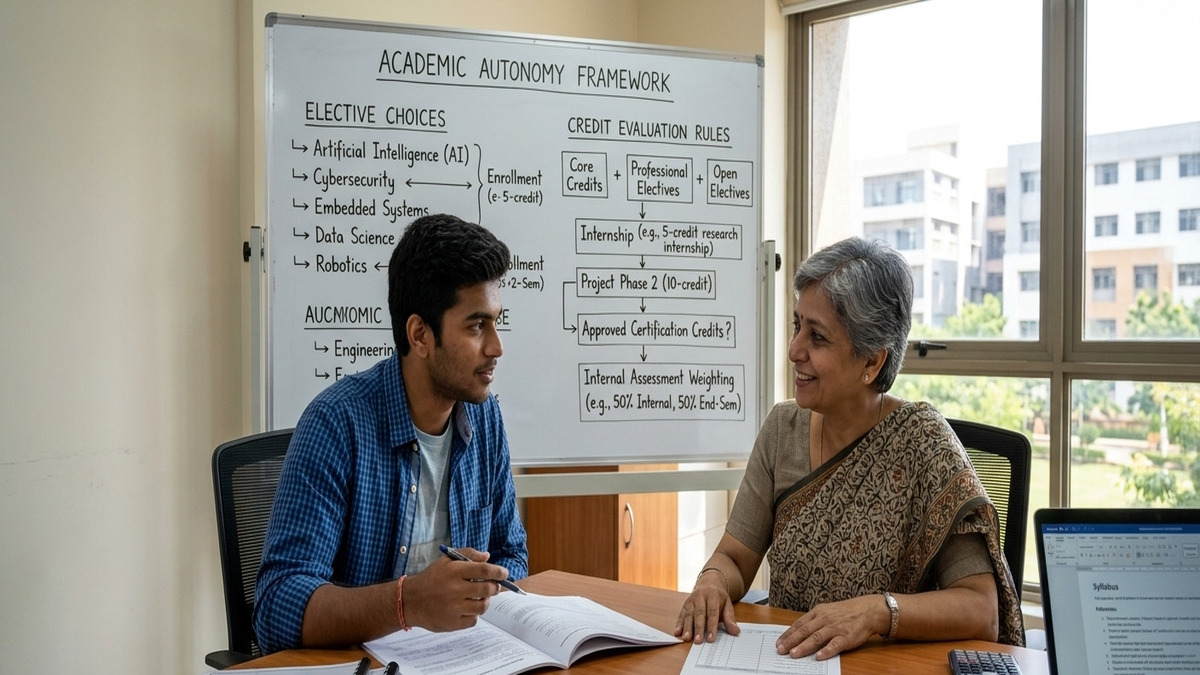
To compare autonomous engineering colleges in Bangalore, check three things for each: which electives you can actually take, how credits work and how internal assessments count towards your grade, for your branch and admission year.

TL;DR: When comparing the top autonomous engineering colleges in Bangalore, look beyond the autonomous label. Check which electives you can actually take, how credits work and how internal assessments affect your grades. A college’s academic flexibility is valuable when it gives you meaningful choices and clear rules.
Autonomy is only the starting point
When shortlisting engineering colleges, placements and campus facilities often get the most attention. But the way a college structures your degree can shape your everyday learning experience, too.
According to VTU’s Autonomy Cell, academic autonomy gives eligible colleges freedom to frame their schemes of study, curricula and student evaluation within the applicable framework. VTU grants autonomy provisionally, with the concurrence of the Karnataka Government and the UGC, and a college needs permanent affiliation for at least 80% of its programmes in each category (UG and PG) to be eligible.
That can allow colleges to revise subjects and assessment methods as fields evolve. However, autonomy does not automatically mean unlimited electives, easier examinations or fewer academic requirements. The details matter.
1. Check which electives you can actually take
Electives let you explore interests beyond compulsory subjects. Depending on your branch, these could include artificial intelligence, cybersecurity, data science, embedded systems or other specialised areas.
Before comparing the top autonomous engineering colleges in Bangalore, ask:
- Are electives offered regularly, or only when enough students enrol?
- Can you choose subjects outside your own department?
- Are there prerequisites or timetable restrictions?
- Do the subjects include practical projects or laboratory work?
A subject appearing in a syllabus does not guarantee it will be available to every student. Check the options offered to your branch and admission batch.
2. Understand the credit rules
Credits represent the academic workload assigned to courses and count towards completing your degree. Some academic schemes also provide approved options involving open electives, internships, projects or additional courses.
The important question is how these options work in practice. How many credits must you complete? Can an approved certification count towards your degree? Are there eligibility conditions or additional approvals?
Cambridge Institute of Technology (CIT), K R Puram, provides a useful example of why these details deserve attention. It was approved as autonomous in September 2023 under the UGC Autonomous Colleges Regulations, 2023, for academic years 2023-24 to 2032-33, and is affiliated to VTU. Its published autonomous academic scheme documents course and elective arrangements. For example, the published CSE scheme includes a five-credit research internship of 14 to 18 weeks and a ten-credit Project Phase 2 in semester eight, and lets eligible students (CGPA above 7.5, no backlogs) take a research route in place of an open elective.
However, the linked scheme is for 2023-24, so students applying for a newer intake should request the current regulations rather than assume every provision remains unchanged.
3. Compare assessment, not just examinations
Your final grade may depend on more than an end-semester paper. Internal tests, assignments, laboratory work and projects can also contribute, depending on the course and academic regulations.
Before enrolling, find out:
- How are internal and end-semester marks weighted?
- How are practicals and projects evaluated?
- What are the passing criteria and attendance requirements?
- What happens if you fail a course or miss an assessment?
Continuous assessment may suit students who prefer regular feedback, but it also requires consistent effort throughout the semester. Neither assessment style is automatically better; transparency and a good fit with your learning habits matter more.
Cambridge’s published assessment and evaluation document illustrates how such rules can be documented. Check the current version applicable to your programme before making a decision.
Make your college comparison more useful
When evaluating autonomous colleges, compare the same three things for every shortlisted institution: elective availability, credit requirements and assessment weightings. Then check whether the rules apply to your specific branch and admission year.
At Cambridge, published academic documents give prospective students a starting point for understanding its academic structure, and the college holds NAAC A+ accreditation (CGPA 3.42), valid to 10 October 2027. The next step is to confirm current provisions directly with the college.
Ultimately, the top autonomous engineering colleges in Bangalore are not necessarily those with the longest elective lists or the most flexible-sounding policies. Look for relevant subject choices, transparent credit rules and an assessment system you understand. The best flexibility is flexibility you can actually use.
About Cambridge Institute of Technology
Cambridge Institute of Technology (CIT), K R Puram, Bengaluru, is led by Principal Dr. B. V. Ravishankar (Principal’s message). Its Talent Transformation Hub, which covers training and placement, is headed by Director P. Bhanurekha Reddy (Director’s message).
