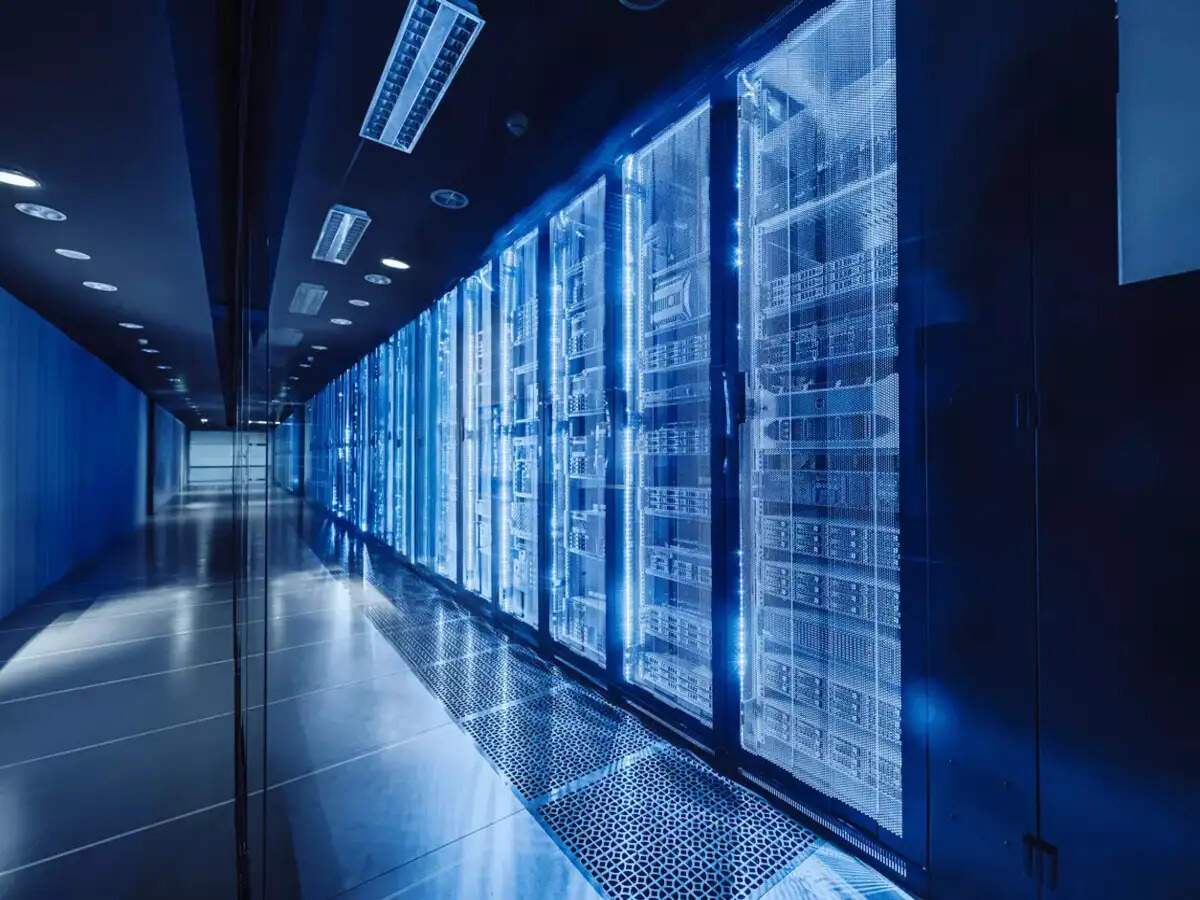
India’s digital economy increasingly runs on an infrastructure that most citizens rarely see. Every UPI payment, cloud-based government service, video stream, digital health record and increasingly every artificial intelligence query ultimately depends on physical computing capacity housed inside data centres.
As India moves from digitisation to an AI-intensive economy, the question is no longer whether the country needs more data centres. It is how quickly it can build them, how much of the underlying infrastructure can be located within India, and whether the enormous electricity and water requirements can be managed sustainably.
Karnataka’s new Sustainable Data Centre Policy 2026–31 must be viewed against this larger national challenge. The state Cabinet has approved a ₹1,300.45-crore framework targeting one gigawatt of cumulative data-centre IT load by 2031, while aiming to account for 10–12% of India’s AI-ready data-centre capacity. The policy covers data-centre parks, edge facilities, connectivity, R&D, skills and incentives, while putting considerable emphasis on renewable power, advanced cooling and water efficiency.
The scale of India’s requirement is becoming formidable. According to the Ministry of Electronics and Information Technology, installed data-centre power capacity increased from around 375 MW in 2020 to 1.57 GW by August 2026 and could approach 8 GW by 2030. Private-sector forecasts are even more ambitious. Wood Mackenzie projects operational capacity could rise from 2.2 GW in 2025 to 12 GW by 2030, with AI-dedicated capacity expanding from 275 MW to 6,546 MW.
Whatever estimate eventually proves closest to reality, the direction is unmistakable: India needs a massive expansion of computing infrastructure.
There is a structural reason for this. India has built one of the world’s largest digital user bases, but its domestic data-centre infrastructure remains relatively modest compared with the volume of data being generated. Government estimates have noted that India accounts for nearly 20% of global data while hosting only about 3% of global data-centre capacity.
This imbalance cannot continue indefinitely if India wants greater control over the infrastructure supporting its digital economy. The arrival of generative AI makes the gap considerably more important.
Traditional cloud computing already requires substantial storage and processing capacity. AI changes the economics because training and operating large models require enormous concentrations of GPUs, high-speed networking, memory and power. AI workloads are also substantially denser than conventional enterprise computing. India is therefore entering an era in which data-centre planning cannot simply extrapolate from the requirements of banking, e-commerce, streaming or government databases.
The government has already recognised the compute dimension of this transition. As of March 2026, about 38,231 GPUs had been onboarded through 14 empanelled service providers and data centres under India’s AI compute-capacity framework, with subsidised access being provided to startups, researchers and academic institutions. But India’s AI ambitions will ultimately require infrastructure on a much larger scale.
Data centres should consequently be treated as strategic infrastructure, alongside electricity grids, highways, ports and telecommunications networks. Without sufficient domestic compute capacity, India risks becoming a gigantic consumer of digital and AI services while a disproportionate share of the infrastructure and economic value associated with processing its data sits elsewhere.
There is also a sovereignty dimension. Government databases, financial transactions, healthcare systems, industrial platforms and AI applications increasingly constitute critical national infrastructure. Domestic data-centre capacity does not by itself guarantee data sovereignty or cybersecurity, but adequate computing capacity within India provides policymakers and enterprises with greater choices over where sensitive workloads are processed and stored.
Yet building capacity cannot become a race for gigawatts without considering where those gigawatts will come from.
Data centres operate continuously and require exceptionally reliable electricity. AI facilities make the challenge harder because high-density GPU clusters consume large quantities of power and generate enormous amounts of heat. Deloitte estimates that AI-led data-centre growth in India could require an additional 40–45 TWh of electricity and eventually push the sector’s consumption towards 2.5–3% of national electricity demand.
That makes power policy inseparable from data-centre policy. States competing for investments cannot merely offer cheaper land, tax concessions and expedited approvals. They must demonstrate reliable electricity availability, transmission capacity and increasingly access to round-the-clock renewable power. Otherwise, India could build an AI economy whose electricity requirements increase dependence on fossil-fuel generation precisely when the country is attempting to decarbonise.
Water presents another constraint. Conventional cooling systems can consume significant quantities of water, creating obvious problems in water-stressed urban regions. Karnataka’s decision to monitor Power Usage Effectiveness and Water Usage Effectiveness and undertake resource heat-mapping before determining suitable locations is therefore important. Such standards should become central to data-centre planning across India.
The geographical distribution of capacity also deserves attention. Mumbai, Bengaluru, Hyderabad, Chennai and Delhi-NCR already dominate the sector. But concentrating future AI infrastructure in a handful of metropolitan clusters will intensify pressure on land, electricity grids and water systems. Fibre connectivity, renewable-energy corridors and edge computing create opportunities for carefully selected Tier-II locations to participate in the next phase of growth.
Karnataka’s attempt to develop capacity beyond Bengaluru is therefore significant. Its policy recognises that the next generation of data infrastructure must be planned around the availability of energy, water, connectivity and land rather than simply around proximity to established technology districts.
India has successfully built the digital public infrastructure that brought hundreds of millions of citizens and businesses into the digital economy. AI represents the next infrastructure test. The country now needs the physical layer capable of supporting the enormous quantities of computation that this transformation will generate.
The objective should not simply be to build more data centres. India needs AI-ready, energy-efficient and globally competitive computing infrastructure at a scale commensurate with the size of its digital economy. Karnataka’s one-gigawatt ambition is one piece of that larger transformation. Other states will have to accelerate their own capacity creation.
In the AI era, compute infrastructure will increasingly become economic infrastructure. Countries that possess abundant computing capacity, reliable electricity and high-speed connectivity will have an important advantage in developing AI applications, attracting investment and retaining digital value. For India, building data centres is therefore no longer merely a real-estate or technology-sector opportunity. It is becoming an essential part of the infrastructure required for the next stage of economic growth.