For decades, Chhattisgarh’s security conversation was shaped by Left Wing Extremism and the difficult terrain of Bastar. Today, as the State seeks to accelerate investment, infrastructure and technology-led growth, that conversation is expanding.
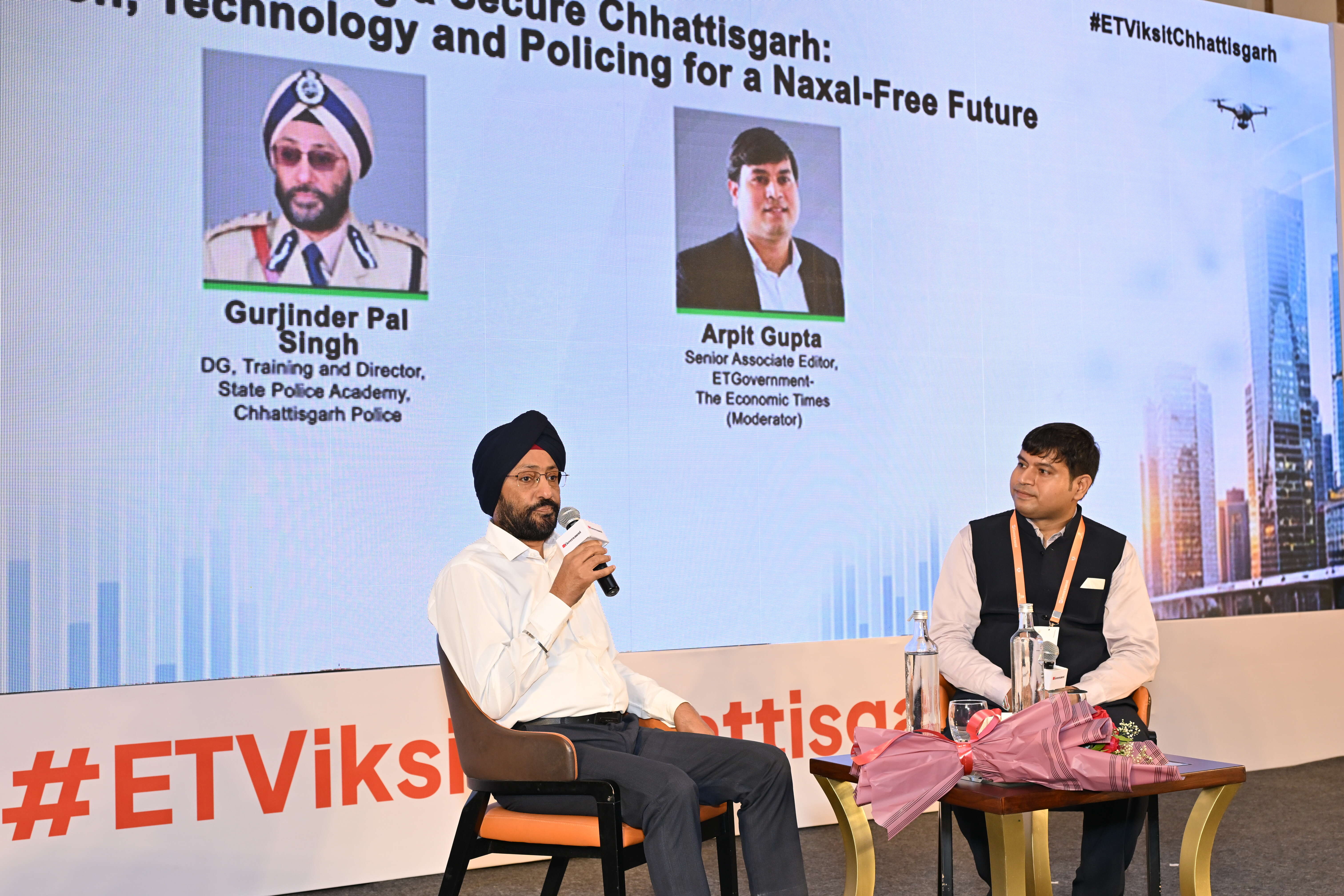
At the Viksit Chhattisgarh Conclave 2026, organised by ETGovernment – The Economic Times, G. P. Singh, DG Training and Director, State Police Academy, Chhattisgarh Police, spoke to Arpit Gupta about how policing is evolving, from securing territory to enabling connectivity, governance, investment and opportunity.
In this conversation, Singh explains why security is increasingly an economic enabler, how the approach to Left Wing Extremism has evolved, why roads and telecommunications have become part of the security-development architecture, and how policing must prepare for cyber threats and the needs of a growing industrial economy.
Edited excerpts:
The Viksit Chhattisgarh Conclave is about growth, investment, innovation and the transformation of Chhattisgarh. Your subject is security and policing. Why should security be part of an investment conversation?
Security is not separate from economic development; it is one of its foundations. An investor looks at land, power, infrastructure and resources, but also at the predictability of the operating environment. Are employees safe? Can goods move without disruption? Can critical infrastructure function continuously? Can local issues be resolved quickly?
So, I would put it quite simply: security creates confidence, confidence enables investment, and investment creates employment and opportunity.
For the police, this means our role cannot be limited to responding after an incident has occurred. We also have to create an environment in which citizens feel secure and legitimate businesses can operate with predictability. In that sense, security is part of the economic infrastructure of a modern State.
Chhattisgarh has had a long and difficult experience with Left Wing Extremism. What has changed in the approach towards creating a Naxal-free Chhattisgarh?
The fundamental change is that we no longer look at the challenge only through the lens of a security operation. Security remains fundamental, but security has to create the space for governance and development. I would describe the approach as clear, hold and build.
First, areas affected by extremism have to be secured through focused, intelligence-led operations. Second, that security presence has to be sustained. And third, the space created by security has to be filled with governance, connectivity, education, healthcare and livelihood opportunities.
The objective is not simply to clear an area of violence. The objective is to create conditions in which violence does not return. That requires security, governance, development and community confidence to work together.
How important have roads and telecommunications been in changing the security and development landscape in formerly affected areas?
For a long time, geography itself was a challenge. Difficult terrain and limited connectivity could isolate communities and make the delivery of government services difficult. When roads come into these areas, they do much more than improve mobility. They allow security forces to move, but they also allow doctors, teachers and government officials to reach communities.
The expansion of telecommunications has had a similar effect. Connectivity allows people to access information, digital services and the wider economy. More than 4,000 kilometres of roads and 1,333 telecommunications towers have been brought into operation in these areas, according to the figures available to us. So, connectivity becomes both a security enabler and a development multiplier.
And where does Niyad Nellanar fit into this larger approach?
Niyad Nellanar reflects the idea that the benefits of governance and development must reach communities that have historically been difficult to access. Security camps can provide a platform for sustained presence. But the larger objective is to use that presence to facilitate roads, electricity, water, schools, healthcare and livelihood opportunities for surrounding communities.
The measure of success is not simply the establishment of a security camp. It is whether people living around it experience a tangible improvement in their lives. The security footprint ultimately has to become a development footprint.
Let us turn to technology. We hear about AI, drones, data analytics and digital evidence. What does technology actually mean for policing in a State like Chhattisgarh?
Technology is a force multiplier, but it is not a substitute for human judgment. AI, drones, data analytics and digital evidence can help us identify patterns, improve situational awareness, use resources more intelligently and strengthen investigations.
But technology is only as effective as the people and institutions using it. That is why training and institutional capacity have to develop alongside technology. The police of the future will have to understand both the physical geography of crime and the digital geography of crime.
Does the growth of the digital economy also create a new security challenge?
The nature of crime changes with the nature of the economy. As more financial transactions, public services and business processes move online, the attack surface also expands. UPI fraud, phishing, impersonation, digital-arrest scams and data-related offences are examples of this changing threat environment.
Our response therefore has to work at two levels: prevention through public awareness, and capability building within the police organisation. We need citizens who are more cyber-aware and police personnel who are increasingly cyber-capable. The larger objective is to ensure that the security architecture evolves at the same pace as the digital economy.
What does industry need from the police?
An investor should expect safety, predictability, responsiveness, trust and confidence. Safety means protecting people and assets. Predictability means that law-and-order issues and potential disruptions are identified and dealt with in time. Responsiveness means that when an issue arises, the police are accessible and act quickly.
But there is another important dimension – prevention. Industry should not have to wait for a serious disruption before the security system responds. We need to understand vulnerabilities in advance and work with businesses and other stakeholders to address them. For us, the objective is to create an environment in which an entrepreneur can focus on building the business rather than worrying about whether the security environment will allow that business to operate smoothly.
The phrase we hear repeatedly is “Ease of Doing Business”. But once an investment arrives, businesses need an environment in which they can actually operate continuously and predictably. Can policing contribute to what we might call “Ease of Running Business”?
I think that is an important distinction. Ease of Doing Business is about creating the conditions for investment. But once the investment is made, there is a much larger ecosystem; employees, suppliers, transporters, contractors, local communities and infrastructure.
Any disruption in that ecosystem can have an economic cost. The police can contribute by preventing disruption, resolving local issues quickly, protecting critical infrastructure and ensuring that legitimate economic activity continues without unnecessary interruption.
So our approach has to move from incident response to risk anticipation. If we can identify a potential dispute before it becomes a confrontation, or a vulnerability before it becomes a security incident, we have done our job more effectively.
As industrial activity expands, how is the concept of industrial security itself changing?
Industrial security can no longer be understood simply as guarding the gates of a factory. An industrial ecosystem includes employees, critical infrastructure, logistics, transportation routes, supply chains and business continuity.
If any one of these is seriously disrupted, the economic impact can extend well beyond the immediate premises. That is why strengthening dedicated industrial-security capabilities is important as Chhattisgarh’s industrial footprint grows.
The objective should be to provide industry with a security architecture that is professional, responsive and aligned with the requirements of a modern economy. Ultimately, protecting an industry also means protecting the ecosystem that allows that industry to function.
Ultimately, development is about people. What does improved security and connectivity mean for a young person in an area that was once affected by Left Wing Extremism?
The purpose of improved security is to expand choices. When a region becomes more secure and connected, geography becomes less of a limitation. Better roads improve access to education, healthcare and markets. Telecommunications connects people to information and digital services. Improved governance brings public services closer.
And when investment and enterprise begin to expand, new possibilities emerge around skills, employment and entrepreneurship. So the long-term outcome we are looking for is not simply the absence of violence. It is the presence of opportunity. A young person should be able to think about education, a career, a business or entrepreneurship without the limitations imposed by insecurity and isolation.
Can investors look at Chhattisgarh with confidence?
I would ask investors to look at both the history and the trajectory. Chhattisgarh has faced serious security challenges, but the security architecture has also evolved. There is greater integration between security, connectivity, governance and development.
For an investor, the relevant question is whether the State can provide a stable and predictable operating environment. That requires not only effective policing but coordination across the wider governance ecosystem.
Our responsibility is to ensure that wherever legitimate economic activity takes place, people, infrastructure, logistics and business continuity receive the security attention they require. A secure investment environment is ultimately about confidence—not just in today’s conditions, but in the resilience of the system tomorrow.
If you had to leave this audience with one message about a secure and Viksit Chhattisgarh, what would it be?
For me, a secure Chhattisgarh is not simply a Chhattisgarh with fewer security incidents. It is a Chhattisgarh where citizens feel confident, communities are connected, governance reaches the last mile, industry can operate predictably and young people can see opportunities for themselves. The security architecture has to support that larger transformation.
I would describe the journey quite simply: Security, Connectivity, Access, Governance, Investment, Employment, Opportunity.
Each link strengthens the next. So, security is not the destination. Security creates the space in which development can happen. The Chhattisgarh we are working towards should not merely be Naxal-free. It should be secure, confident, connected, investment-ready, technology-enabled and prosperous. That, to me, is the real meaning of Viksit Chhattisgarh.