

The SSC CHSL (Staff Selection Commission Combined Higher Secondary Level) Exam is a national-level exam for 12th-pass candidates to recruit for posts like LDC, JSA, Postal Assistant, Sorting Assistant, and DEO. General Awareness (GA) is a high-scoring section in Tier 1, and preparing repeated questions can significantly improve your score. This blog covers the most repeated questions on General Awareness in SSC CHSL Tier 1, along with tips, topics, and examples.
Most Repeated SSC CHSL Tier 1 Questions PDF
SSC CHSL Tier 1 exam is one of the most competitive exams in India. Practicing the most repeated questions can help candidates improve their accuracy and speed. Below is a set of complete 100 MCQs from previous year trends, covering General Awareness, Quantitative Aptitude, English Language, and Reasoning. You can download it as a PDF for offline practice.
Most Repeated GA Questions in SSC CHSL
Over the past 5-10 years, certain questions appear almost every year. Below is a list of highly repeated questions:
1. Who was the first President of India?
A) Rajendra Prasad
B) Zakir Husain
C) Sarvepalli Radhakrishnan
D) V.V. Giri
2. What is the capital of Bhutan?
A) Thimphu
B) Kathmandu
C) Paro
D) Phuntsholing
3. Who wrote ‘Gitanjali’?
A) Bankim Chandra Chatterjee
B) Rabindranath Tagore
C) Sarojini Naidu
D) Premchand
4. Which Article of the Constitution deals with Fundamental Rights?
A) Article 15
B) Article 12–35
C) Article 21
D) Article 51A
5. The River Ganga originates from?
A) Yamunotri
B) Gangotri Glacier
C) Kedarnath
D) Nanda Devi
6. Who is known as the Father of Indian Constitution?
A) Jawaharlal Nehru
B) B.R. Ambedkar
C) Sardar Patel
D) C. Rajagopalachari
7. First woman Prime Minister of India?
A) Sonia Gandhi
B) Pratibha Patil
C) Indira Gandhi
D) Sarojini Naidu
If such questions are difficult to retain, enroll in our Foundation Courses to clear concepts along with systematic GK coverage.
8. Headquarters of WHO?
A) New York
B) Geneva
C) London
D) Paris
9. Who discovered the vaccine for Smallpox?
A) Louis Pasteur
B) Edward Jenner
C) Robert Koch
D) Alexander Fleming
10. Which gas is used in electric bulbs?
A) Argon
B) Neon
C) Nitrogen
D) Helium
Start using the 360° Study Kit after every class for retention (notes, practice, revision, tests). and finish your revision in just 10 minutes.
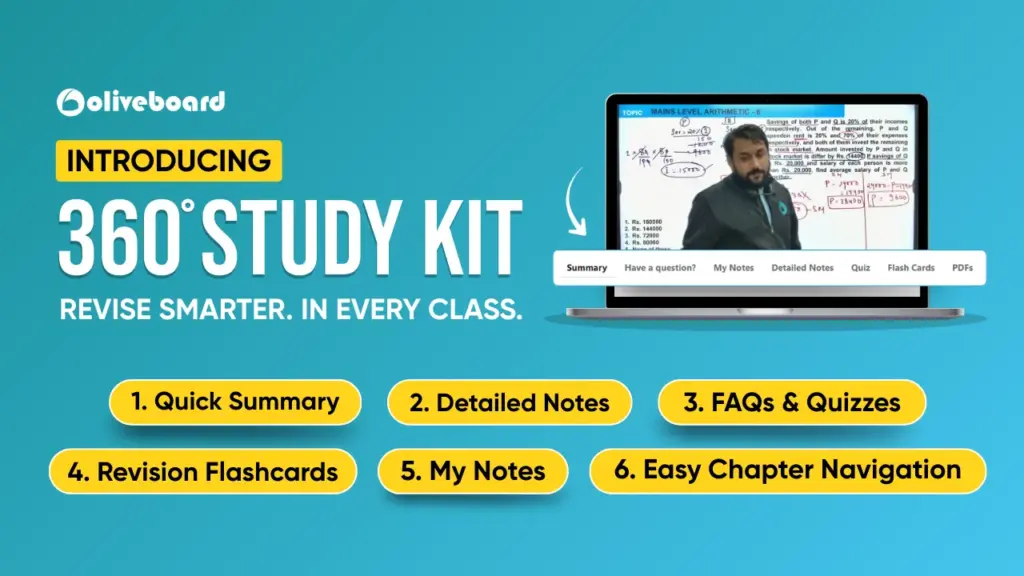
| Component | Purpose |
| Notes | Quick concept recall to understand and remember key facts easily |
| Practice Questions | Reinforce memory and strengthen understanding through repetition |
| Revision Modules | Prevent forgetting by revisiting concepts at spaced intervals |
| Tests | Build exam temperament and assess preparation under realistic conditions |
11. The Indian National Congress was founded in which year?
A) 1885
B) 1905
C) 1919
D) 1920
12. Who gave the title of ‘Father of the Nation’ to Mahatma Gandhi?
A) Subhas Chandra Bose
B) Mahatma Gandhi
C) Sardar Patel
D) Jawaharlal Nehru
13. Which planet is known as the Red Planet?
A) Venus
B) Mars
C) Jupiter
D) Saturn
14. National Science Day is celebrated on?
A) 28 February
B) 26 January
C) 11 February
D) 15 August
15. Which is the largest desert in India?
A) Thar Desert
B) Kutch Desert
C) Rann of Kachchh
D) Great Indian Desert
16. The Prime Minister of India is appointed by?
A) Chief Justice
B) President
C) Parliament
D) Vice President
17. Which state is called the ‘Land of Rising Sun’?
A) Arunachal Pradesh
B) Assam
C) Sikkim
D) Manipur
18. RBI stands for?
A) Reserve Bank of India
B) Rural Bank of India
C) Regional Bank of India
D) None of the above
Q19. Which major renewable energy milestone did India achieve by January 2026 according to the Ministry of New and Renewable Energy?
A) 150 GW total installed capacity
B) 198 GW total installed capacity
C) 210 GW total installed capacity
D) 230 GW total installed capacity
20. Which is the smallest planet in the Solar System?
A) Venus
B) Mercury
C) Mars
D) Pluto
Answer Key
Below is the answer key in tabular format for the above listed questions:
| Q. No. | Correct Answer |
| 1 | A |
| 2 | A |
| 3 | B |
| 4 | B |
| 5 | B |
| 6 | B |
| 7 | C |
| 8 | B |
| 9 | B |
| 10 | A |
| 11 | A |
| 12 | A |
| 13 | B |
| 14 | A |
| 15 | A |
| 16 | B |
| 17 | A |
| 18 | A |
| 19 | B |
| 20 | B |
Topic wise SSC CHSL General Awareness Syllabus
The SSC CHSL General Awareness Syllabus is as follows:
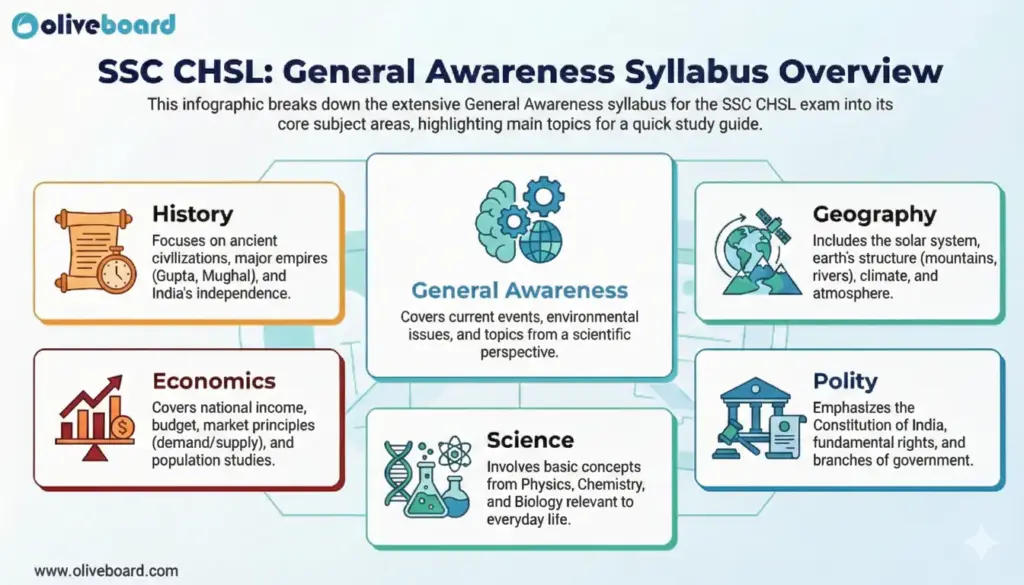
| Subject | Topics |
| General Awareness | 1. Environment and its Societal Applications 2. Current Events 3. Everyday Observations 4. Scientific Aspects 5. India and Neighboring Countries |
| History | 1. Indus Valley and Civilization 2. Buddhism and Jainism in India 3. The Magadha Empire 4. Gupta Dynasty 5. Delhi Sultanate and Mughal Empire 6. India and its Independence |
| Geography | 1. The Universe and the Solar System 2. Earth 3. Mountains and Rivers 4. Hydrosphere, Lithosphere, Atmosphere 5. Wind Cyclone6. Climate 7. Geological Survey of India 8. Indian Climate, Natural Vegetation and Soil |
| Economics | 1. General Economics 2. Economic Planning 3. National Income of India 4. Budget 5. Market 6. Demand and Supply 7. Economic Concepts 8. Population of India, Mortality Rate, Unemployment |
| Polity | 1. Constitutional Development of India 2. State, Union Territory 3. Fundamental Rights 4. Directive Principles of State Policy 5. Executive, Legislation, Judiciary 6. Constitution of India |
| Science | Basic Topics of Chemistry, Physics, and Biology |
Get other SSC CHSL based preparation tools:
SSC CHSL Preparation Strategy for General Awareness
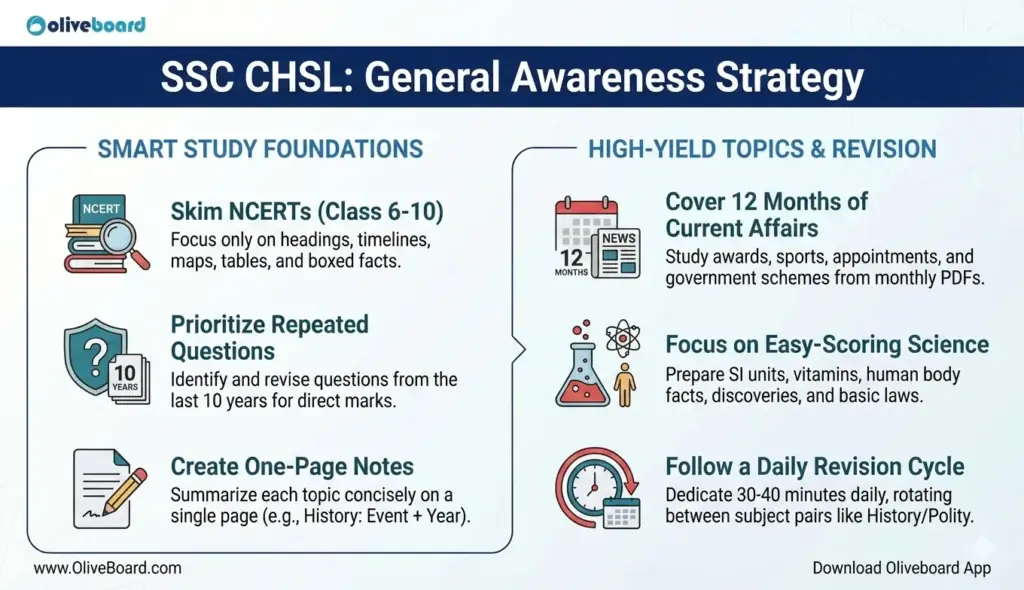
General Awareness (GA) is important for SSC CHSL Tier 1, covering current events, history, geography, polity, economy, and science. Some questions repeat every year, so focusing on them is a smart part of your SSC CHSL Preparation Strategy to save time, improve accuracy, and score easy marks. Study NCERT books and previous papers, make short notes, practice mocks, stay updated with current affairs, and revise awards, sports, and government schemes.
| Topic / Action | What to Study & How to Study |
|---|---|
| NCERT (Class 6–10) | Read only headings, timelines, maps, tables, and boxed facts. Skip explanations. Focus on Modern History events, Indian rivers, climate terms, and basic polity definitions. |
| Previous Year Questions (PYQs) | Identify questions repeated in last 10 years. Revise battles, movements, constitutional articles, discoveries, inventors, founders first. These give direct marks. |
| Static GK Notes | Make one-page notes per topic only. History → Event + Year. Polity → Article + Part. Science → Unit, inventor, law. If notes exceed one page, cut them down. |
| Current Affairs (Last 12 Months) | Study monthly PDFs only. Cover awards, sports winners, appointments, government schemes (ministry + objective). Ignore political news. |
| Science (Easy Scoring Area) | Prepare SI units, vitamins, diseases, human body facts, discoveries, basic laws. Skip numericals and deep theory — not needed for CHSL. |
| Mock Test Practice | Attempt GA section separately. After each test, note wrong + guessed questions. Revise only those topics, not the full syllabus again. |
| Revision Plan | Daily 30–40 minutes GA. Day 1: History + Polity. Day 2: Geography + Science. Day 3: Current Affairs. Repeat this cycle. |
| Elimination Technique | Eliminate options with wrong year, wrong person, wrong place. Very useful when answer is not sure. |
| Last 1 Day Strategy | Revise one-liners, repeated PYQs, current affairs list only. Do NOT open NCERT or bulky books. |
Important steps for SSC CHSL General Awareness Preparation:
FAQs
Ans. Repeated questions save preparation time, improve accuracy, and help score easy marks.
Ans. NCERT books (History, Geography, Polity), previous year papers, and current affairs magazines.
Ans. Weekly revision for current affairs and monthly revision for static topics is recommended.
Ans. Yes, they help track weak areas, improve speed, and provide exam-like practice.
Ans. Focus on repeated questions, study NCERT and previous papers, make short notes, practice mocks, and stay updated with current affairs.
I’m Mahima Khurana, a writer with a strong passion for creating meaningful, learner-focused content especially in the field of competitive exam preparation. From authoring books and developing thousands of practice questions to crafting articles and study material, I specialize in transforming complex exam-related topics into clear, engaging, and accessible content. I have first hand experience of 5+ months in SSC Exams. Writing, for me, is not just a skill but a way to support and guide aspirants through their preparation journey one well-written explanation at a time.
