

The passage of the Central Armed Police Forces (General Administration) Bill, 2026, represents a historic recalibration of our national security framework. As the nature of internal threats evolves—from sophisticated cyber-terrorism to the hybrid warfare seen at our borders—the need for a unified, legally-backed leadership structure has never been more urgent.
For decades, the “sentinels of our borders” and the “backbone of internal stability”—forces like the BSF, CRPF, CISF, ITBP, and SSB—operated under a patchwork of executive orders and fragmented service rules. This Bill is not merely an administrative update; it is a strategic necessity that reinforces the cohesive link between the Union and the States.
To appreciate the gravity of this Bill, one must look beyond the immediate headlines and delve into the deep historical currents that shaped the Indian Police Service (IPS) and the CAPFs. This is a story of evolution—from colonial instruments of control to the democratic guardians of a sovereign republic.
The Vision: Why This Bill is a Necessity
The primary idea behind the CAPF Bill 2026 is institutional permanence. Modern security challenges—ranging from Left-Wing Extremism (LWE) and cross-border insurgency to the protection of critical industrial assets—require a leadership that can bridge the gap between grassroots state policing and national strategic objectives.
The Bill addresses several critical gaps:
Legal Clarity: By codifying recruitment, service conditions, and disciplinary mechanisms, it removes the “administrative friction” that previously arose from ad-hoc executive instructions.
Unified Command: It reinforces the role of the All India Services (AIS). The Indian Police Service (IPS) serves as the connective tissue between the State Police and the Central Forces. Without this cross-pollination, there is a risk of security silos, where the right hand (state intelligence) does not know what the left hand (central operations) is doing.
End to Litigation: The Bill directly addresses concerns raised in various judicial forums, including the Supreme Court. By creating a statutory framework for deputation and promotion, it provides a “legal solution” to “service disputes,” allowing the leadership to focus on operations rather than courtrooms.
A History of Sacrifice: The Genesis of the CAPFs
The CAPFs—comprising the BSF, CRPF, CISF, ITBP, and SSB—each have a unique lineage born out of national crises:
CRPF (1939): Originally the Crown Representative’s Police, it was rechristened after Independence under the CRPF Act of 1949 as Central Reserve Police Force. It is the “lead internal security force,” having fought from the integration of princely states to leading counter-insurgency in Kashmir, anti-Naxal operations (via its specialized CoBRA wing), and riot control (via the Rapid Action Force).
BSF (1965): Raised following the 1965 war with Pakistan to provide a specialized border-guarding force, relieving the state police of this arduous task. The BSF played a pivotal role in the 1971 Liberation of Bangladesh, training the Mukti Bahini and conducting successful operations on the Eastern Front before the formal war began. It is the world’s largest border guarding force, securing India’s borders with Pakistan and Bangladesh.
ITBP (1962): Born in the aftermath of the Chinese aggression, these “Himveers” guard the arduous heights of the Himalayas. It was initially conceived as a small, specialized guerrilla force trained to operate behind enemy lines in the Himalayas. Originally raised under the CRPF Act, it eventually got its own statutory identity under the ITBPF Act of 1992. They are specialized high-altitude troops guarding the 3,488 km Indo-China border from the Karakoram Pass in Ladakh to Jachep La in Arunachal Pradesh.
SSB (1963): The Special Service Bureau (as it was then known) was raised in 1963 under the administrative control of the Research and Analysis Wing (RAW) to secure the Himalayas after 1962 aggressions. Following the Kargil War (1999) and the “One Border, One Force” recommendation of the Group of Ministers, it was transferred to the Ministry of Home Affairs and renamed Sashastra Seema Bal in 2001. It was designated as the Lead Intelligence Agency and border guarding force for the India-Nepal (1,751 km) and India-Bhutan (699 km) borders. Unlike the BSF, which guards “hostile” fenced borders, the SSB manages “open” and “friendly” borders characterized by heavy civilian movement, making their task a delicate balance of high-level intelligence and community policing.
CISF (1969): The CISF was born out of the industrial boom of the 1960s, a period when India’s “Temples of Modern India” (PSUs) were frequently hit by labor unrest and sabotage. Initially, the CISF was not an “Armed Force” of the Union in the strictest sense. However, an amendment in 1983 officially converted it into an Armed Force, giving it the legal teeth and discipline required to handle growing security threats to industrial hubs. In 2000 (after the 1999 IC-814 hijacking), the CISF took over the security of major airports, transforming into the most “public-facing” CAPF. After the 26/11 Mumbai attacks, the government realized that private economic hubs (like Infosys or Reliance refineries) were also national assets. An amendment in 2009 allowed the CISF to provide security to the private sector on a cost-reimbursement basis. They are the only CAPF with a specialized Fire Wing.
These forces were never meant to be “mini-armies” or “departmental silos.” They were designed to be versatile extensions of the Union’s executive power. However, for decades, they operated under disparate executive orders. The CAPF Bill 2026 finally grants them a unified legal status, elevating their institutional dignity to match their operational valor.
The Evolution of Leadership: From Imperial Police to the IPS
The Indian Police Service was not conceived in a vacuum. Its predecessor, the Imperial Police (IP), was established by the British in 1905 following the recommendations of the Fraser Commission (1902-03). The colonial objective was clear: create a “Superior Police Service” to maintain imperial order across a vast and diverse subcontinent.
However, with the dawn of Independence in 1947, Sardar Vallabhbhai Patel—the “Iron Man of India”—envisioned something fundamentally different. He conceptualized the All India Services (AIS), including the IPS, under Article 312 of the Constitution. Patel’s vision was not to preserve colonial control, but to create a bridge of administrative continuity that would bind the fledgling Union together.
While the “Imperial Police” was an instrument of the Crown, the IPS is an instrument of the Constitution. The role has shifted from “ruling” to “serving,” yet the foundational logic for its leadership in CAPFs remains more relevant than ever:
The “Force-Police” Duality: Unlike the military, which operates against external enemies, the CAPFs operate among our own citizens. Whether it is riot control or anti-Naxal operations or prevention of cross-border infiltration and smuggling, these tasks require a “police-mindset”—an understanding of the Bhartiya Nyay Sanhita, Bhartiya Nagrik Suraksha Sanhita, Bhartiya Sakshya Adhiniyam, local laws, and the sensitivities of civil administration. Historically, committees like the Gore Committee (1971) emphasized that CAPFs do not operate in a vacuum; they act in “aid of civil power.”
Cross-Pollination of Experience: IPS officers serve in the States and at the Centre. An IPS officer who has served as a Superintendent of Police (SP) in a sensitive district brings ground intelligence and a network of state police contacts that a cadre-bound officer simply cannot replicate. This synergy is the “secret sauce” of successful counter-insurgency. For instance, an IPS officer leading a CAPF battalion or Range in Chhattisgarh brings an intimate understanding of the local state police machinery, the district administration, and the judicial process. This “theatre-wide” perspective is something a cadre-locked officer, despite their immense tactical bravery, often lacks.
The Federal Glue: Internal security is a State subject, but the forces are Central. The IPS acts as the diplomatic and operational link between the Union Home Ministry and the State Director Generals of Police (DGPs). Without IPS leadership, CAPFs risk becoming “island forces.”
The Numbers: A Bill for the Million, Not the Few
While recent media discourse has been dominated by a vocal minority of Group ‘A’ officers, the raw data reveals where the true impact of this Bill lies. The most significant—yet often ignored—aspect of the CAPF Bill 2026 is its impact on the Rank and File. The Central Armed Police Forces (CAPFs) comprise a staggering 10 lakh (one million) personnel.
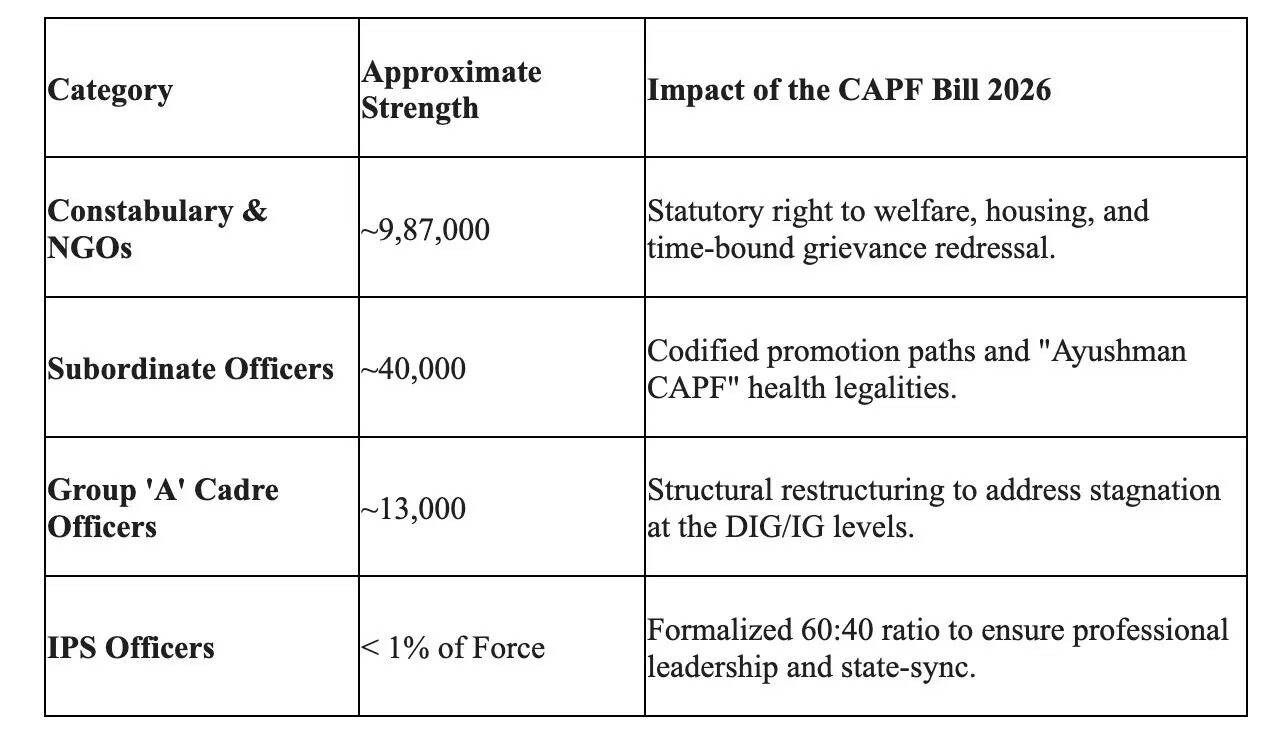
The Bill introduces a codified Grievance Redressal System with statutory timelines. For a Jawan posted in the dense forests of Bastar or the freezing heights of the Himalayas, knowing that their administrative concerns — be it leave, medical allowances, or family housing — will be addressed within a legal timeframe is a massive morale booster.
- The Beneficiaries: Approximately 9.8 lakh of these personnel are Constabulary, Head Constables, and Non-Gazetted Officers (NGOs). These are the men and women stationed in the “Red Corridor,” the shifting sands of Jaisalmer, and the high-altitude posts of the LAC who face the maximum hardships.
- The Contenders: The current friction is largely confined to a segment of roughly 13,000 Group ‘A’ Gazetted Officers (GOs).
The Bill prioritizes the 98%—the “silent majority”—by codifying their service conditions, ensuring the continuity of financial benefits, and streamlining the Ayushman CAPF healthcare and housing schemes. By providing a statutory umbrella, the Bill ensures that the “maximum sacrifice” made by those at the frontlines is met with a career progression that is transparent and rule-based so that the welfare of the Jawan is no longer a matter of administrative discretion but a legal mandate.
The Regrettable Rise of Social Media “Vily Campaigns”
In recent months, we have witnessed a distressing trend: CAPF cadre officers using social media to run coordinated campaigns against the IPS leadership, frequently presented as a struggle for “force identity,” but in reality, they often are driven by personal aspirations for faster promotion to top-tier ranks.
While every officer has the right to career aspirations, the current methodology is in poor taste for several reasons:
- Ignoring the Jawan: These campaigns focus almost exclusively on senior-level posts (IG, ADG, DG). They rarely mention the stagnation at the Constable or Sub-Inspector level, who make up for over 98% of the force and face maximum hardships, where personnel often wait 20 years for a single promotion.
- Harm to the Fabric: By painting the IPS as “outsiders,” these campaigns sow seeds of distrust within the units. Internal security is built on the sanctity of the ‘Chain of Command’. Publicly undermining senior officers for personal promotion speed is a disservice to the uniform.
- National Security Risks: A divided house is a vulnerable one potentially compromising operational synergy during joint operations with state police. Our adversaries thrive on perceived fractures within our security forces. Using hashtags to settle professional grievances weakens the institutional gravity of the CAPFs.
Professional grievances should be settled through the institutional mechanisms that this very Bill strengthens, not through the court of public opinion, which lacks the nuance of security requirements.
Enhancing Avenues for Cadre Officers
It is a fallacy to suggest that the Bill “kills” career growth. On the contrary, by providing a stable framework, it allows for creative solutions to address stagnation without compromising national security. The Bill allows the government to create more “in-situ” promotions and specialized technical wings where cadre expertise is paramount, ensuring that promotion doesn’t always have to mean a change in leadership role. The CAPF officers should be encouraged to serve in specialized central agencies to gain the experience required for higher command. This would help reduce their career stagnation.
Conclusion: A Unified Future
The CAPF Bill 2026 is a promise kept. It is a promise to the Jawan that his welfare is a national priority. It is a promise to the citizen that their security forces are led by a unified, expert command. And it is a promise to the Constitution that the “All India” character of our security will never be compromised for departmental interests.
It respects the domain expertise of the cadre while leveraging the strategic administrative experience of the IPS. By focusing on the welfare of the millions who serve in the ranks rather than the promotion grievances of a few at the top, this Bill ensures that our internal security architecture remains agile, unified, and unbreakable.
We are moving towards a system where merit-cum-seniority is respected, where the welfare of the Jawan is a statutory right, and where the leadership is chosen for its ability to integrate the diverse security needs of a billion people. This is more than just a piece of legislation; it is a commitment to those who stand between us and the threats to our democracy. The future of India’s internal security is now on a firmer, more certain footing.
(The author is an IPS officer of the Chhattisgarh cadre; Views expressed are personal)