

Deep inside the National Testing Agency’s paper-setting operation is a highly secured premises in New Delhi that was not supposed to be breached. It’s effectively hermetically sealed: no phones, no laptops, no devices, no internet, air-gapped computers, logs tracking every document, mandatory shredding of all notes. It was designed, after the NEET leak of 2024, to be the last word in securing the medical entrance test.
The people at the centre of the NEET-UG 2026 leak investigation were trusted insiders embedded in the most protected phase of the examination process. And at least one of those arrested had worked on last year’s NEET paper, too.

That the leak happened despite this has rattled the Government.
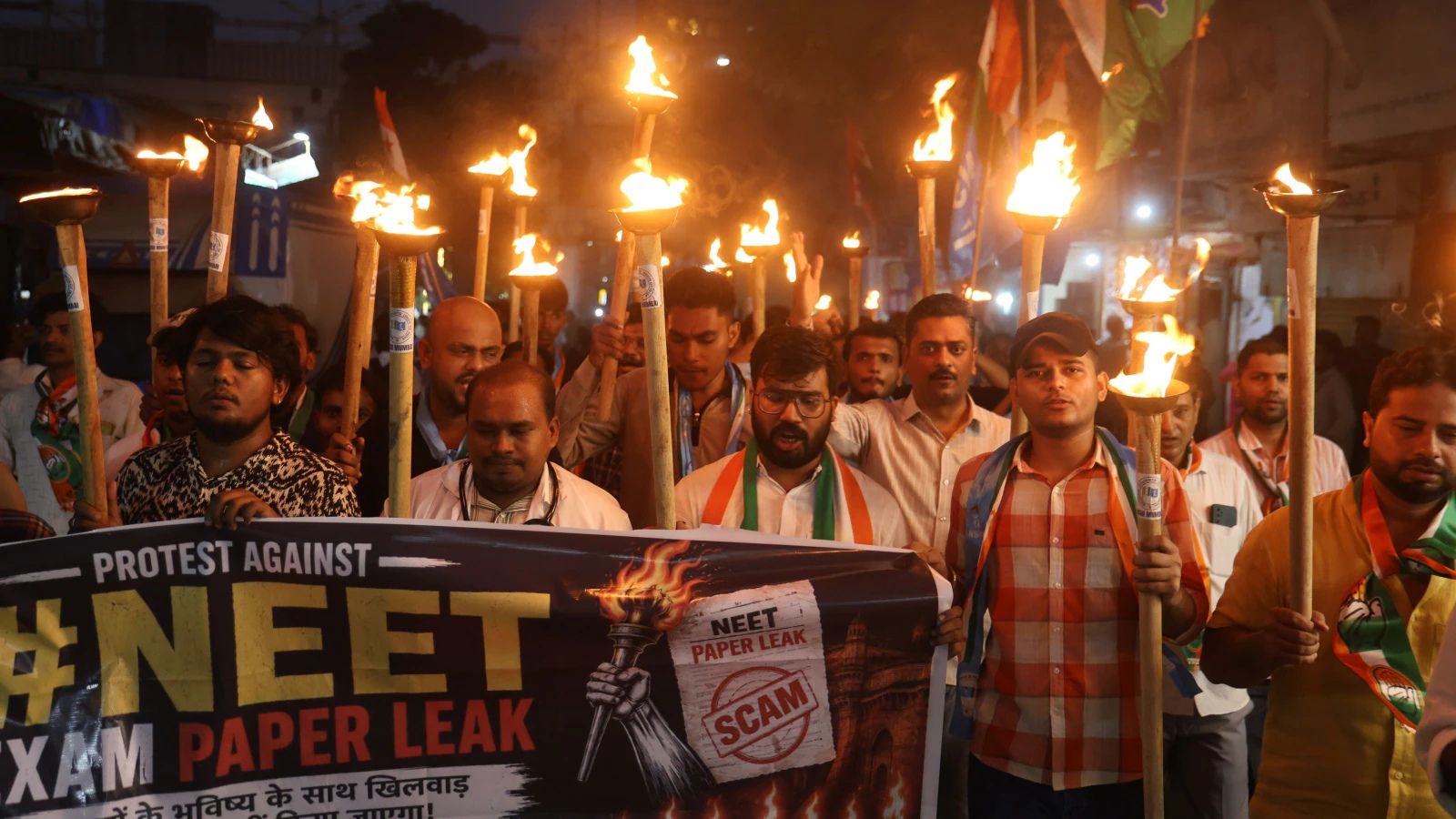
The CBI has arrested 13 people so far, including paper translators, subject experts and intermediaries accused of circulating sections of the question paper before the May 3 exam, taken by over 20 lakh students. Interviews with over a dozen officials, NTA insiders and experts associated with NEET-UG 2024, 2025 and 2026 by The Indian Express reveal there’s a broad internal consensus on an institutional failure that created conditions for the leak.
Two things, they believe, went wrong.
One, the security framework built after the 2024 controversy, known internally as “confidential operations” or CONOPs, was not consistently enforced in 2026. And the person who had built and overseen that framework was gone at the wrong moment, leaving a leadership vacuum in the system during the most sensitive phase of exam preparation.
“We are missing the larger issue,” said one official, who did not wish to be identified. “If the confidential operations protocols were functioning the way they were supposed to, it would have been extremely difficult for anybody to access, retain and circulate complete sections of the paper.”
The Education Ministry and the NTA did not respond to emails seeking comment.
Story continues below this ad
Two Leaks, Two Different Failures
To understand what may have gone wrong in 2026, it helps to first understand how this controversy differs from 2024.
The NEET-UG 2024 scandal stemmed from vulnerabilities that emerged after the paper had left the NTA system: during printing, transportation, bank storage and movement to examination centres. The leak that year occurred in Jharkhand. Those gaps were substantially plugged ahead of NEET-UG 2025 through a series of stringent protocols — the CONOPs at the heart of these — introduced on the recommendations of a high-level committee headed by former ISRO chief K Radhakrishnan, constituted in the wake of the 2024 controversy. Four members of this very committee were tasked with overseeing the implementation of CONOPs for 2025.
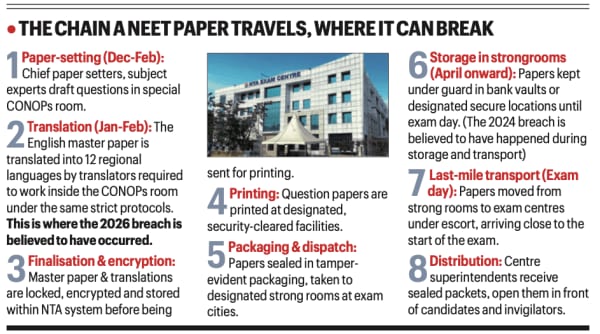
CONOPs have two distinct phases. The first covers paper-setting, which happens months in advance, between December and February. The second covers paper transportation, closer to the exam, in April.
In 2024, it was the second phase that was compromised. In 2026, officials now believe it was the first — the phase that was supposed to be the most tightly sealed of all.
Story continues below this ad
Inside the CONOPs Room
The protocols introduced after 2024 effectively transformed the paper-setting ecosystem into a sealed operation almost identical to the highly restricted systems used by the IITs for the JEE Advanced examination.
The CONOPs room itself, where papers were set with the help of subject experts and chief paper setters, was designed to be entirely self-contained. Books, storage facilities, a refrigerator, microwave and pantry were all provided inside, so that paper setters, translators, vetters and domain experts had no reason to step out. A vestibule at the entrance was where team members were required to leave all personal belongings — phones, laptops, iPads, pen drives. No electronic devices were permitted past that point. There was no internet access.
Only authorised CONOPs team members could enter. All translation work was to be conducted on air-gapped computers, physically disconnected from the internet and external networks, with file access logs tracking every time a document was opened. No material was to be left on tables at the end of the day. Rough sheets and working notes were shredded daily.
Each evening, the room was locked and sealed by the chief paper setter or chief vetter, who alone retained the key. Team members were also barred from participating in any external activities while paper-setting operations were underway.
Story continues below this ad
“No phones, laptops, pen drives or external devices were supposed to enter the confidential operations room,” said a person familiar with the 2025 protocols. “Even movement and access inside the system was meant to be tightly controlled.”
It was inside this system, or at least one nominally bound by its rules, that the translators now accused of the leak were working. NEET-UG is conducted in 13 languages, which means the English paper must be translated into regional languages before the exam. That translation work, considered as sensitive as paper-setting itself, was required to happen inside the CONOPs room under the same strict protocols.
All three individuals arrested as translators were involved in translating the paper into Marathi. Retired Chemistry teacher PV Kulkarni, allegedly associated with the Marathi translation process, is accused of leaking the Chemistry section. Pune-based teacher Manisha Havaldar allegedly leaked the Physics section, while Manisha Mandhare is suspected of leaking Botany and Zoology questions, according to the investigators. Notably, Kulkarni was also involved in translating the Chemistry section for the 2025 exam, the very exam the CONOPs were designed to protect.
“The entire logic of CONOPs during the paper-setting and translation phases is that no individual should be able to freely access, retain or move complete sections of the paper outside the system,” said an official associated with the examination process. “If investigators are now alleging that happened with individuals linked to different sections of the paper, then naturally questions arise about whether the safeguards developed and implemented in 2025 were enforced with the same rigour in 2026.”
Story continues below this ad
A System Without a Steady Hand
The protocols, officials insist, did not fail on their own. Some attribute it to a change in guard with gaps in transition.
After the 2024 controversy, the government removed NTA chief Subodh Kumar Singh and gave additional charge to PS Kharola, then serving as Chairman and Managing Director of the India Trade Promotion Organisation. Kharola oversaw the design and implementation of the entire CONOPs framework for 2025. But his extended tenure at the NTA expired on October 19, 2025 — just as the paper-setting cycle for NEET-UG 2026 would have been getting underway.
Between October and January, a period considered crucial for paper-setting preparation, NTA’s additional charge was handled by Navodaya Vidyalaya Samiti chairperson Rajesh Lakhani — who was simultaneously serving in his primary role elsewhere. A permanent head, Abhishek Singh, was appointed only a month before the May 3 exam.
The result was a leadership vacuum at the most sensitive moment. The protocols that Kharola had built and personally championed had no consistent owner as they were being applied for the first time without him.
Story continues below this ad
“The CONOPs of 2025 did not smoothly translate into 2026. That is the core of the problem,” said one official. “These protocols are not self-executing. They require institutional ownership, consistent enforcement and leadership that understands what is at stake.”
The Irony of May 3
On May 3, the Education Ministry issued a press release highlighting the elaborate monitoring systems in place for NEET-UG 2026. Education Minister Dharmendra Pradhan visited the NTA headquarters to supervise preparations, while ministry officials monitored examination centres round the clock for 48 hours from a control room at Ambedkar Bhawan.
Within days, however, NTA received information suggesting a possible leak in Chemistry. It began with an email. On May 7, a tip-off arrived without any attachment, just an allegation that Chemistry questions had been leaked before the exam. The agency tracked down the whistleblower the following day and obtained a PDF of a guess paper circulating online. The Chemistry questions matched.
On May 9, the highest levels of government were informed of the suspected leak, around the same time preparations were underway for the swearing-in of West Bengal’s new chief minister. NTA and the Education Ministry were told to first confirm the suspicion, and if verified, cancel the exam.
Story continues below this ad
Over May 9 and 10, Sikar police in Rajasthan, where the whistleblower was based, verified whether the guess paper PDF had been circulated before the examination. On May 11, they confirmed it had — establishing that the leak had occurred before May 3. NTA formally wrote to the ministry. The ministry formally approached the CBI. On May 12, the government announced the exam had been scrapped and the investigation handed over to the CBI.
Officials defended the decision, saying allowing the result to stand despite evidence of a leak would have strengthened what one officer called the “paper leak economy.” “Yes, something wrong happened. But there was a view that if the examination was allowed to continue, the message would go out that there are no real consequences for the exam mafia,” said a senior official. “If someone has spent lakhs procuring a question paper, then the system must ensure there are consequences for that too.”
What Comes Next
CONOPs are back in focus ahead of the NEET-UG re-test scheduled for June 21. A fresh batch of subject experts has been brought in to set the paper, though officials declined to detail the specific measures being taken.
On May 27, a meeting was held with former ISRO chief K Radhakrishnan, whose committee’s recommendations had originally shaped the 2025 CONOPs framework.
Story continues below this ad
That addresses the first leg of the process, paper-setting. For the second leg, discussions are underway on whether assistance from the defence forces should be sought to strengthen the secure transportation and storage of question papers after printing.
