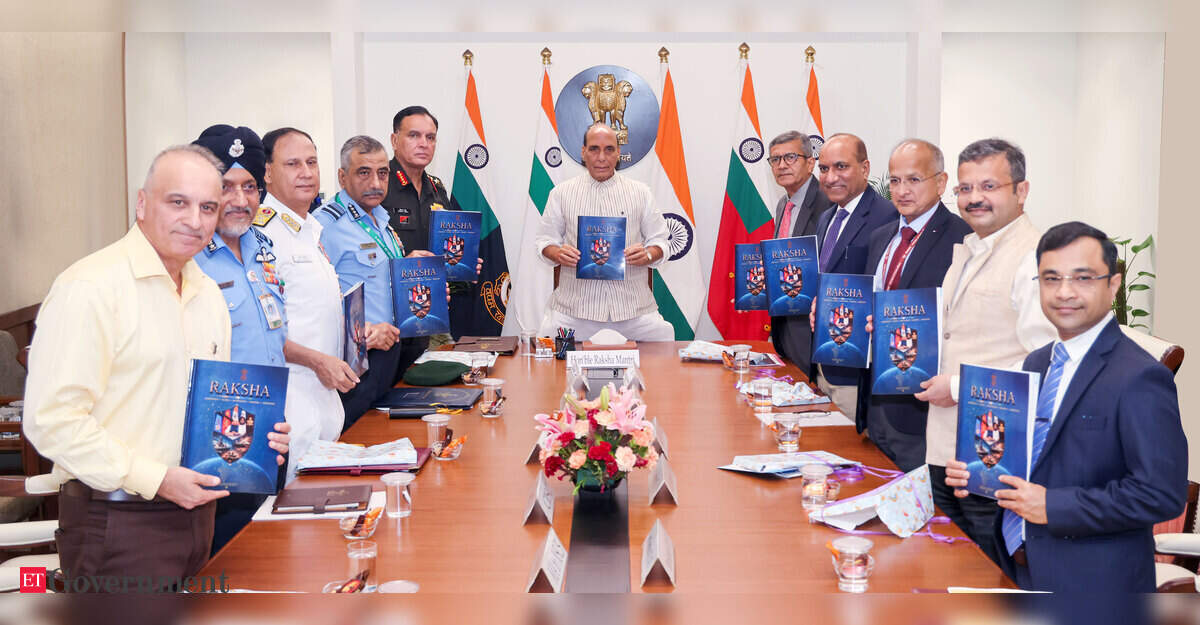
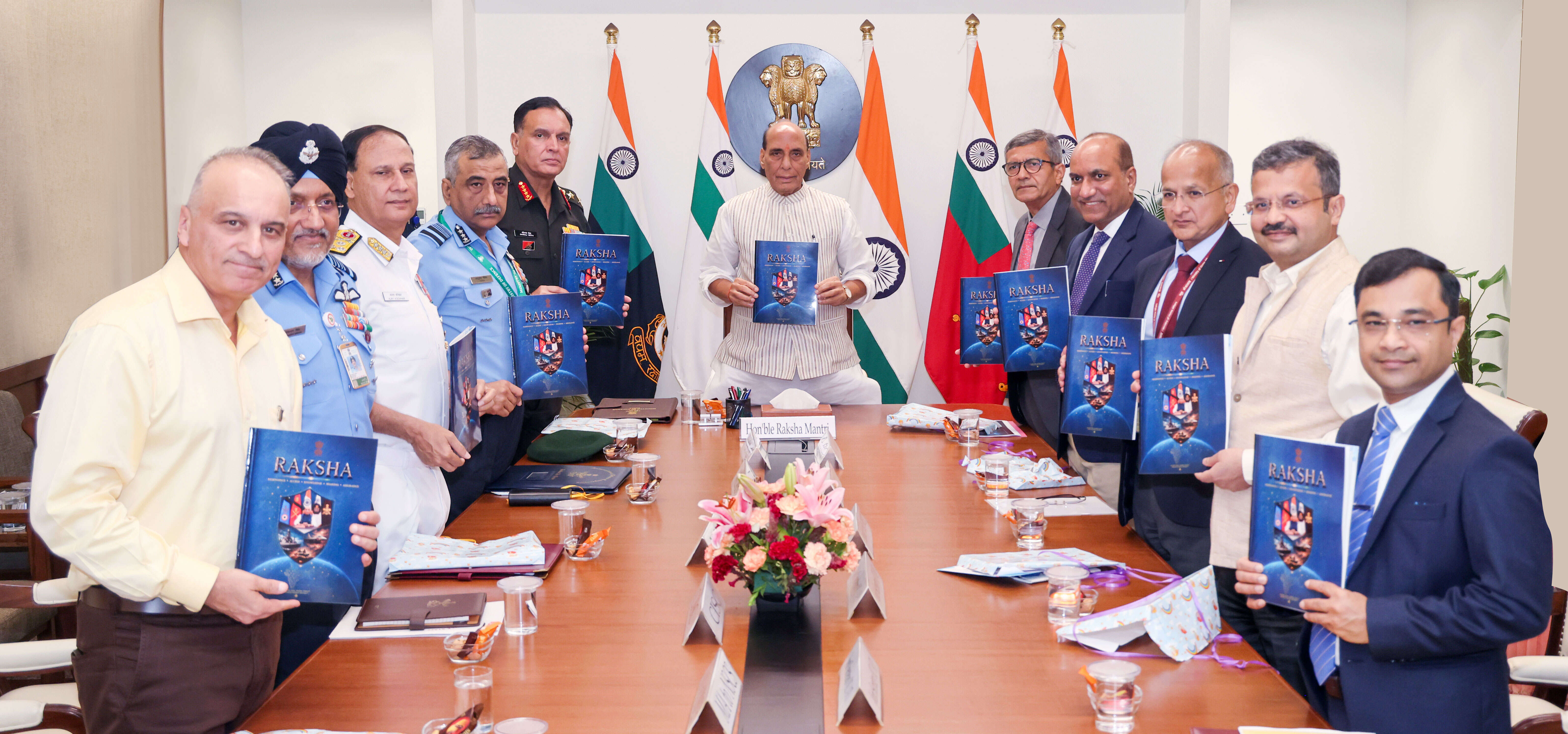
India conducts military exercises with major powers, trains personnel from friendly countries, maintains defence relationships across competing geopolitical blocs and is emerging as an exporter of missiles, radars, artillery and other military systems. Yet a harder question remains: how much of this expanding defence diplomacy can India convert into actual contracts, technology partnerships and jointly developed platforms?That is the real test for RAKSHA, the 10-year defence diplomacy roadmap unveiled by Defence Minister Rajnath Singh on September 3.
For years, India’s military diplomacy and defence-industrial ambitions have largely advanced on parallel tracks. One has been driven by strategic dialogues, exercises, training, port calls and high-level military exchanges; the other by Atmanirbhar Bharat, domestic production, export promotion and the search for critical technologies. RAKSHA attempts to bring these tracks together.
Its four pillars—strategic partnerships, capacity building, indigenous defence exports and maritime security—suggest that New Delhi increasingly sees defence diplomacy not merely as an adjunct to foreign policy, but as an instrument of military capability, industrial growth and strategic influence. The opportunity is significant. So is the governance challenge.
Defence deals are rarely won by manufacturers alone. A major export can require political support from New Delhi, sustained engagement by an Indian mission overseas, military-to-military confidence, export clearances, financing, training and assurances about ammunition, spares, maintenance and upgrades. Technology partnerships can be even more demanding, requiring alignment between foreign policy, national security, intellectual property and industrial capability.
RAKSHA, therefore, must accomplish something more difficult than expanding India’s defence relationships. It must create machinery capable of converting those relationships into measurable outcomes.
The institutional complexity was visible at the roadmap’s launch. Senior representatives of the armed forces, Ministry of Defence, Ministry of External Affairs, Department of Defence Production, Integrated Defence Staff and National Security Council Secretariat were part of the event. That breadth is essential because no single institution controls the entire defence-diplomacy cycle.
The MEA and India’s missions abroad manage political relationships and country priorities. Defence attachés provide military connectivity and can identify requirements in overseas markets. The armed forces build confidence through exercises and training. The Department of Defence Production connects opportunities with public and private manufacturers. Export-control and licensing authorities determine whether equipment and technologies can be transferred. The weakness of any one link can undermine the entire chain.
This is why the most important element of a 10-year roadmap may not be its diplomatic ambition but its system of institutional ownership. Which countries should be prioritised? Which platforms should India actively promote? Who follows up after a bilateral defence dialogue? Who tracks an opportunity identified by a defence attaché? Who coordinates government support when an Indian company competes for a major foreign tender?
Without clear answers, defence diplomacy can generate activity without necessarily generating outcomes. The timing of RAKSHA is nevertheless favourable. India’s defence-industrial base has expanded rapidly, and the government’s ambition has shifted from import substitution towards global competitiveness.
Reviewing defence public sector undertakings recently, Rajnath Singh summed up that transition: “In pursuit of the ‘Make in India, Make for the World’ objective, we must resolve to transform all DPSUs into global giants.” That objective requires diplomacy to become part of India’s defence-export architecture.
Unlike consumer goods, military systems are rarely bought purely on price and specifications. Governments assess strategic reliability, political relationships, financing, training, interoperability and whether the supplier will continue supporting the platform during a crisis. A missile system, aircraft, helicopter, radar or naval platform can create a relationship lasting decades. Defence exports are therefore simultaneously commercial transactions and instruments of statecraft.
India has already seen what such diplomacy can achieve. The export of the BrahMos supersonic cruise missile to the Philippines demonstrated how an indigenous or jointly developed capability can move from strategic cooperation to a major overseas defence contract. Interest in Indian artillery, missiles, helicopters, naval systems and electronics points to a potentially larger market. But moving from occasional high-profile deals to sustained exports requires a different institutional model.
RAKSHA could provide that model by developing country-specific strategies. India’s objectives will not be identical everywhere. In parts of Southeast Asia, missiles, maritime systems and coastal defence may offer opportunities. In Africa and the Indian Ocean, training, patrol vessels, surveillance systems, maintenance and capacity building may be more relevant. With technologically advanced partners such as France, the United States, Israel and European countries, access to critical technologies, co-development and co-production may matter as much as exports.
A mature defence-diplomacy strategy should distinguish between these objectives instead of treating every bilateral relationship through the same template. The capacity-building pillar can be particularly powerful. India has trained military personnel from numerous friendly countries for decades and conducts an expanding range of bilateral and multilateral exercises. These relationships create familiarity with Indian institutions, doctrines and equipment.
That familiarity can have industrial consequences. Personnel trained on Indian systems are more likely to understand their capabilities. Exercises can demonstrate platforms under operational conditions. Training relationships can subsequently develop into maintenance, equipment and technology partnerships. In other words, capacity building and defence exports need not be separate activities.
The maritime pillar offers another opportunity. RAKSHA seeks to reinforce India’s role as a net security provider and first responder in the Indian Ocean Region. India’s geography gives it considerable advantages, but regional leadership must be sustained through capability.
Maritime-domain awareness, information sharing, hydrography, coastal-surveillance networks, training, humanitarian assistance, disaster relief and naval exercises can deepen relationships with smaller Indian Ocean states. Indian-built patrol vessels, surveillance equipment and other maritime systems can become part of the same engagement. But credibility will depend on delivery.
Recent wars have reinforced an uncomfortable reality for defence manufacturers: producing a sophisticated platform is only the beginning. Customers need assured ammunition, spares, repairs and upgrades, sometimes during prolonged conflict.
Rajnath Singh recently highlighted precisely this requirement, saying contemporary conflicts had demonstrated the importance of “assured supply chains, surge capacity, critical spares, rapid repair capabilities, and the ability to sustain production during prolonged conflicts”.
For India, this is an important warning. A successful defence-export strategy cannot be measured only by contracts signed. It must include lifecycle support and the ability to sustain foreign customers over decades. Poor after-sales support could damage India’s reputation far beyond an individual contract. Technology is the other side of the RAKSHA equation.
India does not merely want to sell more defence equipment; it also needs partnerships that accelerate access to advanced engines, sensors, semiconductors, electronic warfare, artificial intelligence, unmanned systems, propulsion and other critical technologies.
The best defence partnerships should therefore work in both directions—creating markets for Indian products while bringing technology, intellectual property, manufacturing capability and research partnerships into India. This makes measurable outcomes essential.
A 10-year roadmap should eventually be judged against indicators such as defence exports generated through priority relationships, joint-development projects initiated, technologies acquired, personnel trained, exercises conducted, Indian platforms inducted by partner countries and supply-chain partnerships created.
The roadmap must also operate within India’s commitment to strategic autonomy. New Delhi maintains significant defence ties with Russia while expanding cooperation with the United States, France, Israel, Europe, Southeast Asia and the Indian Ocean region. These relationships do not fit neatly within a single geopolitical bloc.
RAKSHA will therefore have to deepen partnerships without creating new dependencies that restrict India’s strategic choices. Ultimately, the roadmap’s success will not be determined by the number of delegations exchanged, agreements signed or joint statements issued.
The harder metrics will matter: Did exports rise? Did India acquire critical technologies? Were platforms jointly developed? Did Indian companies enter global supply chains? Did training and military cooperation create durable strategic relationships?
India has spent the past decade building a larger indigenous defence-industrial base. RAKSHA poses the next question: can the country connect that industrial capacity with its growing diplomatic and strategic reach?
If it can, defence diplomacy could become a powerful instrument for turning relationships into technology, manufacturing and exports. If institutional silos persist, however, India may continue accumulating defence partnerships without extracting their full strategic and economic value. For RAKSHA, therefore, the challenge is no longer simply to expand India’s defence diplomacy. It is to make defence diplomacy deliver.