

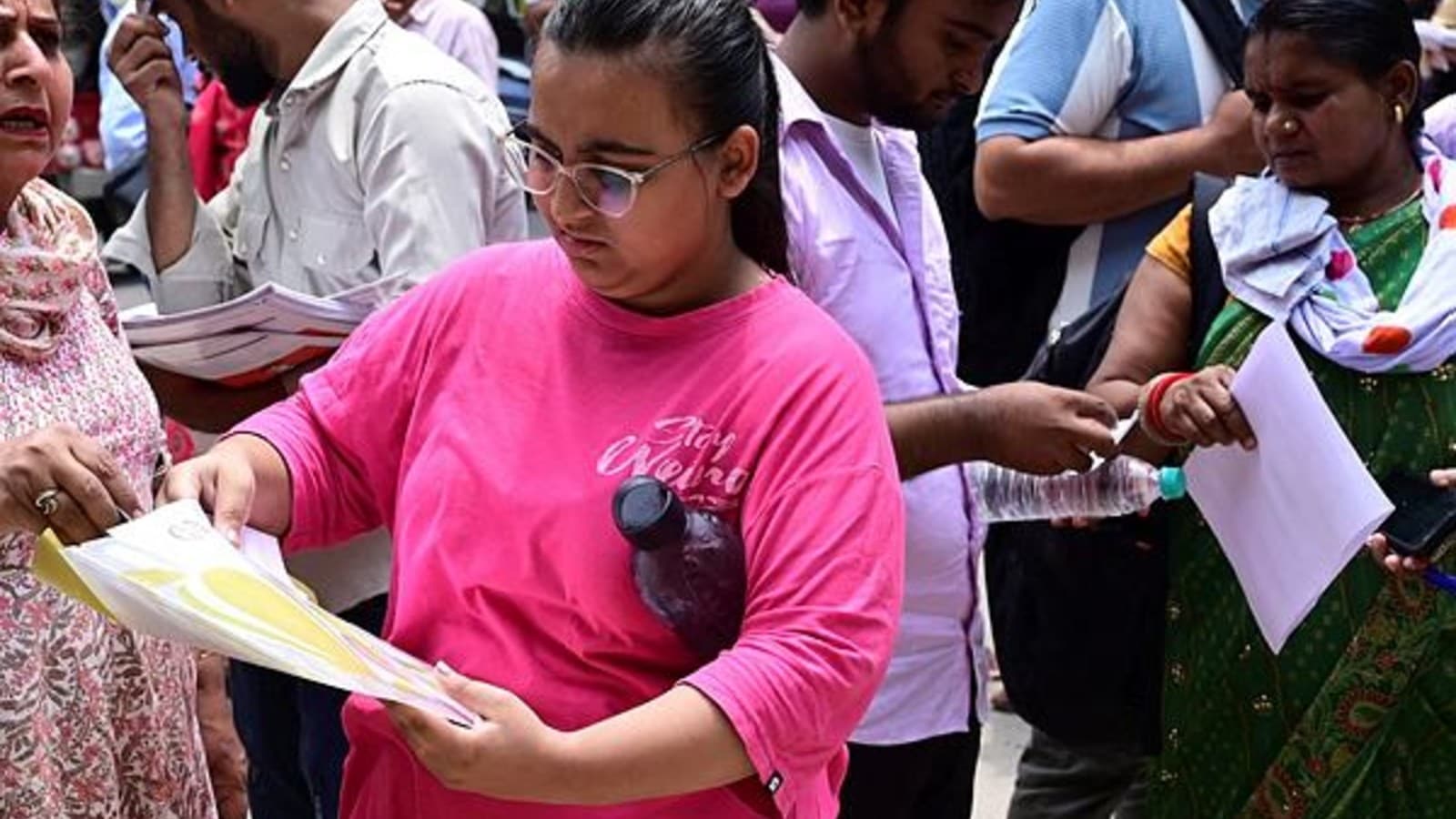
JEE Main 2026: The Joint Entrance Examination Main (JEE Main) BTech, BE paper held on the first day of the April 2026 session comprised of mathematics, physics and chemistry papers of 300 marks. The JEE Main day 1 morning session paper was easy to moderate and student-friendly, according to candidates who appeared for the exam, and experts said, while analysing the paper.
The JEE Main day 1 exam is held in two shifts — first from 9 am to 12 noon, and the second shift between 3 pm and 6 pm.
Among the three subjects, mathematics was the most difficult, Ajay Sharma, national academic director, engineering at Aakash Educational Services Limited, said. The paper, according to him, was moderate to difficult, with easy to moderate physics, moderate to difficult chemistry due to its calculation-intensive nature and most difficult mathematics. Both mathematics and chemistry were time-consuming, making it challenging to complete the paper within the given time. Overall, the paper was well-balanced in terms of question distribution and chapter coverage.
JEE Main 2026 Rank Predictor
The overall paper, according to Ujjwal Singh, Founding CEO, Infinity Learn by Sri Chaitanya, was “easy to moderate and more student-friendly compared to the January 2026 session.” The focus was clearly on strong fundamentals and conceptual understanding, rather than tricky or advanced problem-solving.
With simpler calculations, balanced subject coverage, and manageable time pressure, the paper allowed students, especially those with strong basics to maximise attempts and accuracy. This shift is expected to be high-scoring, with top-performing students having the potential to achieve near-perfect scores.
The JEE Main BTech April 2026 paper comprised three subjects – physics, chemistry and mathematics. All the subjects have two sections – 1 and 2. While section 1 has 20 multiple-choice questions for each subject with a single correct answer, section 2 has 5 numerically based questions in all subjects.
There will be negative marking for incorrect answers in Section A and Section B. For each question in Section B, a candidate has to enter the correct integer value of the answer using the mouse and the on- screen virtual numeric keypad in the place designated to enter the answer. For Section B, the answer should be rounded off to the nearest integer.
JEE Main April 2 Exam Analysis: Shift 1 Physics
The physics section, as per Sharma, was relatively easier. Questions were asked from most major chapters, with a higher weightage from Electromagnetism, while Optics and Waves had comparatively fewer questions. Mechanics had average representation. A few questions were time-consuming, but overall, the section was manageable. Topics such as Electromagnetic Waves, Thermodynamics, and Modern Physics were adequately covered.
Story continues below this ad
Read More | How AI helped me prepare for JEE Main
Physics was easy and highly manageable within time, Singh said, while analysing the paper, adding that the questions were largely aligned with previous year patterns and appeared slightly easier than the January 2026 session. Most questions were formula-based and tested core concepts, allowing students to attempt a higher number with accuracy, he said.
JEE Main April 2 Exam Analysis: Shift 1 Chemistry
As per Sharma, the chemistry section was moderate in difficulty. Questions were almost evenly distributed among Organic, Inorganic, and Physical Chemistry, with slightly greater emphasis on Inorganic Chemistry and comparatively fewer questions from Organic Chemistry. While not very difficult, some questions were calculation-intensive and time-consuming, which impacted overall time management.
Chemistry, according to Singh, emerged as the most scoring section, with an overall easy-to-moderate difficulty level. The paper had balanced coverage across Organic, Inorganic, and Physical Chemistry. Organic Chemistry included statement-based questions, focusing on conceptual clarity rather than memorisation. The section required basic understanding and quick application, with minimal complex calculations, he added.
Story continues below this ad
JEE Main April 2 Exam Analysis: Shift 1 Mathematics
Mathematics was moderate in difficulty and slightly lengthy, as expected, Singh said analysing the JEE Main day 1 morning session exam paper. While the questions were not unusually difficult, they required time and careful calculation, making time management crucial, he added. Compared to some earlier shifts, this section felt more approachable, though still the most time-consuming.
As per Sharma, the Mathematics section was moderate to difficult and the most time-consuming. Questions were well distributed across the syllabus, with higher weightage from Integral Calculus, Conic Sections, and Algebra. Topics such as 3D Geometry, Vectors, and Complex Numbers had average representation. Algebra appeared slightly dominant, while Coordinate Geometry had moderate coverage. Lengthy calculations and tricky problems made this section the toughest, Sharma added.
Singh said that the April session has begun on a more balanced and student-friendly note compared to the January 2026 JEE Main session. The paper clearly reflects a shift towards testing conceptual clarity over complexity, he added, saying that for students, this reinforces an important takeaway that strong fundamentals and consistent practice matter more than ever.
As competition continues to rise, the ability to stay accurate, manage time effectively, and apply concepts with confidence will be key to achieving top outcomes.
