On March 25, the Ministry of Defence released a comprehensive Framework for Testing Security Vulnerabilities in Drones, marking a decisive inflection point in India’s approach to unmanned aerial systems.
In an era where drones have evolved from tactical tools to strategic assets, the framework signals a shift from acquisition-driven thinking to a doctrine rooted in cyber resilience, system integrity, and technological sovereignty.
The timing of the framework is instructive. Recent conflicts have demonstrated that drones are no longer merely platforms of surveillance or strike—they are nodes within a contested digital battlespace. As the framework underscores, vulnerabilities within drone systems can enable adversaries to intercept communications, manipulate mission data, hijack controls, or compromise entire operational networks.
The threat, therefore, is not limited to physical destruction but extends to invisible, systemic subversion.
Mapping the Invisible Battlefield
One of the most analytically rigorous aspects of the framework is its detailed mapping of vulnerabilities across system-level and component-level architectures. It identifies critical avenues of exploitation—ranging from unencrypted communication links and GPS spoofing to firmware backdoors and data exfiltration pathways.
Drones, in this conception, are fully-fledged ICT systems. Every interface—whether between the drone and its Ground Control Station or within its internal subsystems—represents a potential attack vector. For instance, weak encryption in transmission systems can enable interception or command injection, while compromised firmware can allow persistent, undetectable control by adversaries.
The framework further identifies critical components such as flight controllers, electronic speed controllers, transmission units, navigation systems, sensors, and ground control software—each of which, if compromised, can trigger cascading operational failures.
Indigenisation as Strategic Imperative
Beyond vulnerability detection, the framework situates drone security within the larger national project of indigenisation. It articulates a clear vision: secure drones must be secure by design, built on domestically controlled hardware, software, and supply chains.
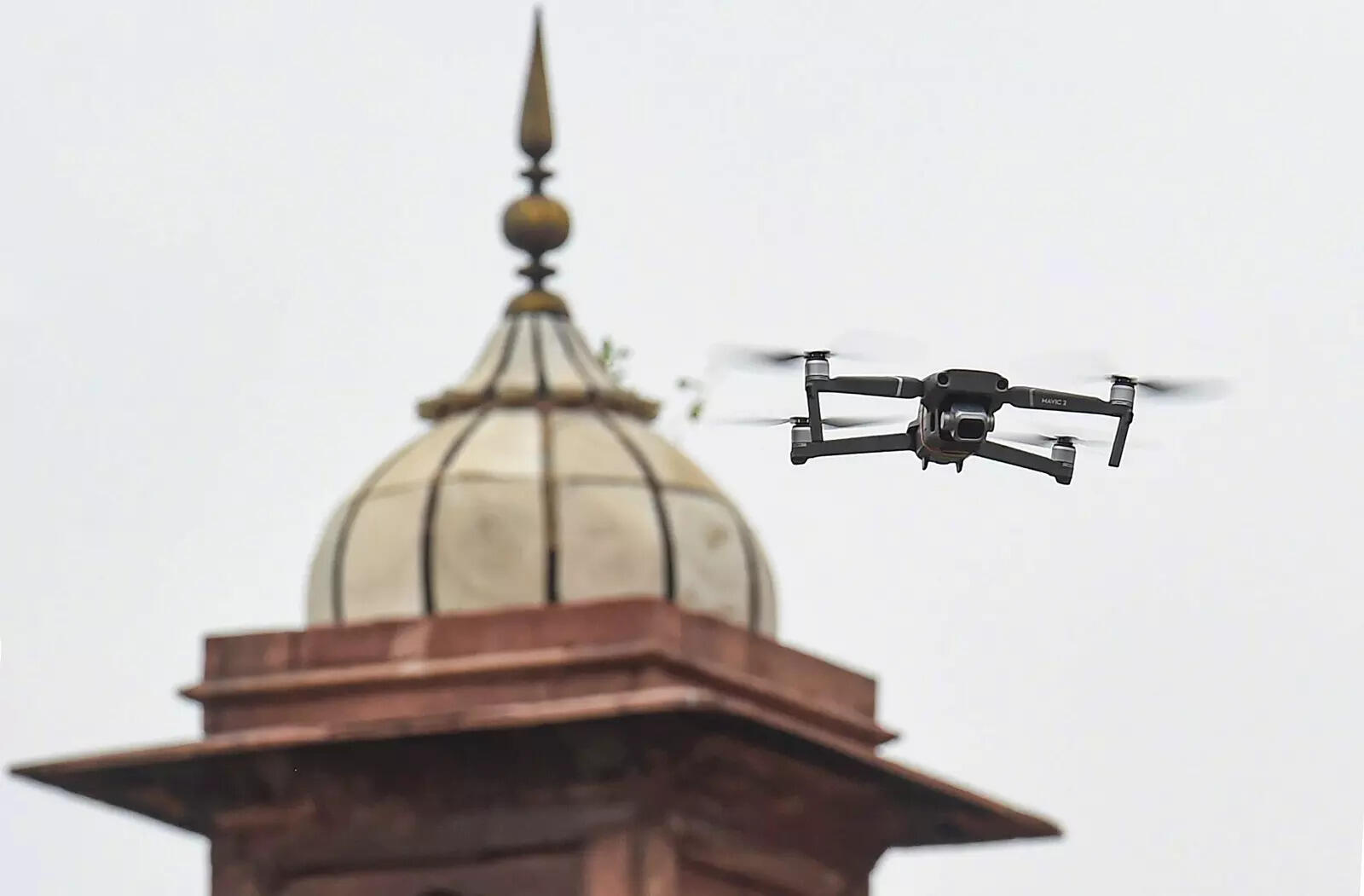
The emphasis on indigenous development of critical components—ranging from encrypted communication systems to NAVIC-enabled navigation architectures—reflects a deeper strategic logic. In a globally fragmented supply chain environment, dependence on foreign components introduces opaque risks, including hidden backdoors and compromised firmware.
Yet, the framework is grounded in realism. It acknowledges that India’s industrial ecosystem—particularly in semiconductor fabrication and advanced electronics—will take time to mature. As an interim measure, it mandates rigorous testing and certification of drone components through accredited laboratories and government agencies, ensuring that operational security is not deferred in pursuit of long-term self-reliance .
Testing as a Strategic Gatekeeper
The framework’s most consequential innovation lies in embedding security testing across the entire procurement lifecycle. From the Request for Information stage to trials, pre-delivery inspections, and post-contract management, security validation becomes a non-negotiable criterion.
This includes a comprehensive suite of hardware and software tests—ranging from penetration testing and cryptographic validation to secure boot verification and firmware integrity checks. For example, systems must ensure that only authenticated firmware is executed, that cryptographic keys are uniquely managed, and that software updates follow secure, verifiable protocols .
By aligning these requirements with globally recognised standards such as ISO/IEC 27001 and IEC 62443, the framework positions India within an interoperable global security architecture while simultaneously strengthening domestic assurance mechanisms.
The Supply Chain Dilemma
A particularly notable feature of the framework is its candid recognition of supply chain vulnerabilities. It acknowledges that achieving complete traceability—down to the deepest layers of component sourcing—is fraught with challenges, including counterfeit components, re-routing of supply chains, and falsified documentation .
To mitigate these risks, the framework mandates transparency through Software and Hardware Bills of Materials (SBOM and HBOM), alongside stringent vendor disclosures and periodic audits. While these measures cannot eliminate all risks, they introduce a structured mechanism for accountability in an otherwise opaque ecosystem.
From Strategic Warning to Policy Architecture
The intellectual lineage of this framework can be traced to earlier strategic discussions within India’s defence ecosystem. At the Bharat Defence Conclave organised by ETGovernment in September 2025, Major General C.S. Mann, VSM, Additional Director General of the Army Design Bureau, had flagged the growing risks associated with insecure drone systems and foreign-origin components.
As he observed, “In modern warfare, a compromised drone is not just ineffective—it becomes an intelligence asset for the adversary. Security vulnerabilities in unmanned systems are no longer technical issues; they are strategic risks.”
The framework released on March 25 translates precisely this concern into institutional policy—bridging the gap between operational insight and regulatory design.
Toward a Doctrine of Trusted Autonomy
Ultimately, the MoD’s framework represents more than a technical checklist—it is a doctrinal statement on the future of warfare. It recognises that autonomy without security is a vulnerability, and that the credibility of unmanned systems depends as much on code integrity and supply chain assurance as on aerodynamic performance.
By embedding security into design, testing, and procurement, India is laying the groundwork for a trusted drone ecosystem—one that can operate with resilience in contested environments while reducing systemic dependencies. While presently focused on drone systems, the framework is poised to serve as a foundational benchmark for higher categories of Unmanned Aerial Systems, including MALE and HALE platforms, as well as their critical sub-components.
In an age where the line between cyber and kinetic warfare is increasingly blurred, the framework offers a clear proposition: trust in autonomous systems must be engineered, verified, and continuously enforced.
(Anoop Verma is Editor-News, ETGovernment)