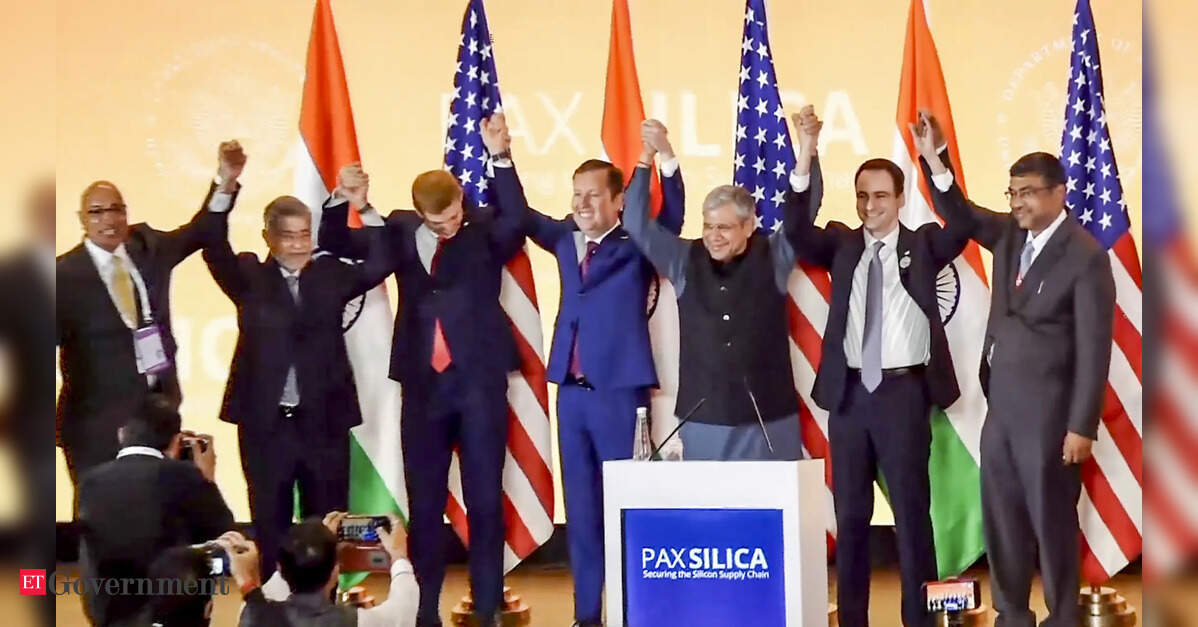
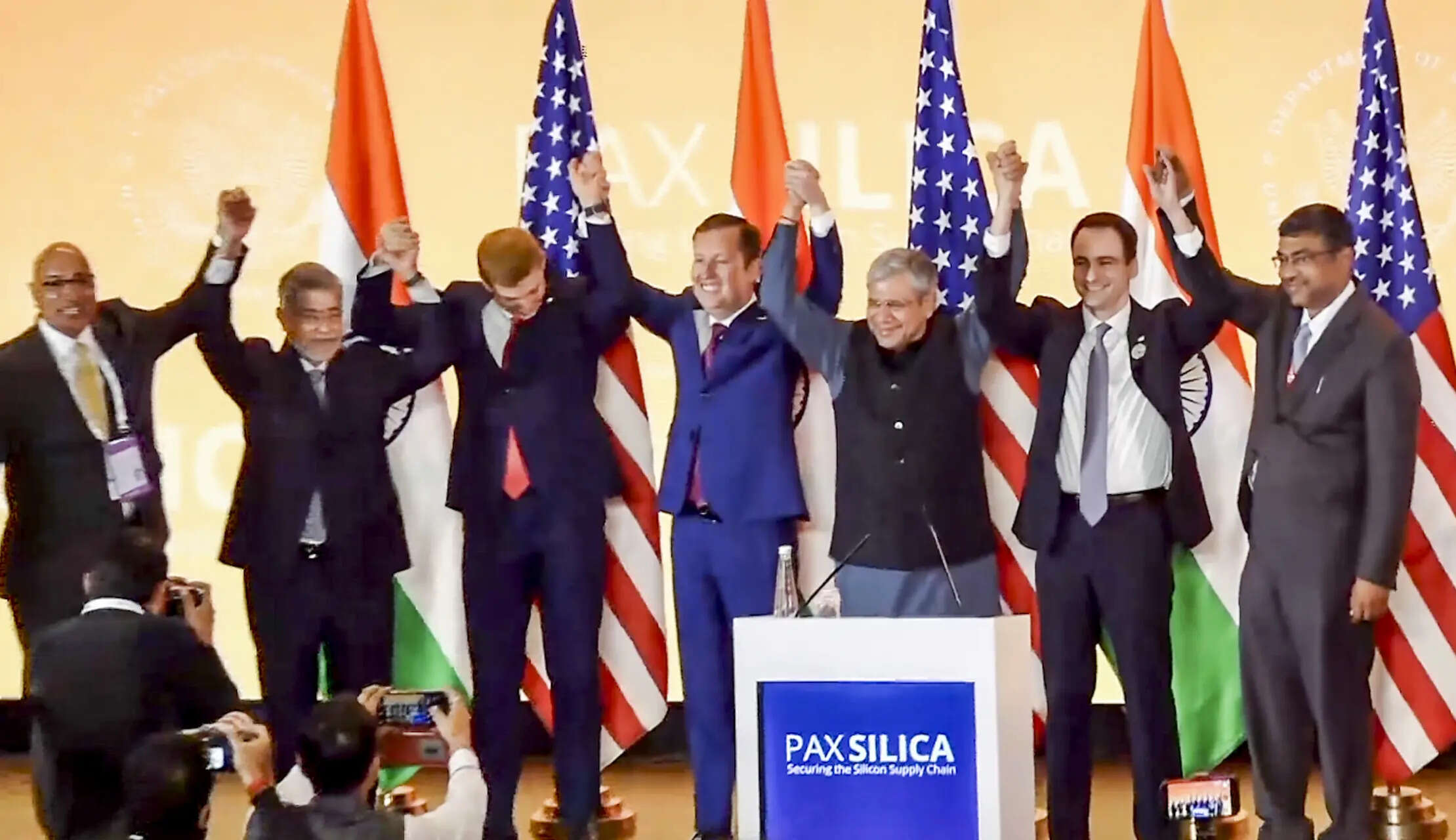
India’s entry into the Pax Silica framework in early 2026 marks a decisive moment in the evolution of its technology strategy—one that sits at the intersection of geopolitics, supply chain realignment, and the emerging architecture of artificial intelligence governance.
What appears, at first glance, to be a sectoral coalition on AI infrastructure is, in reality, part of a much larger contest over technological sovereignty in a fragmented global order.
The decision to join Pax Silica—a US-led coalition of technologically advanced economies including the United States, Japan, South Korea, Australia, and others—signals India’s intent to embed itself within trusted supply chains that span the entire AI stack, from critical minerals to semiconductor fabrication and advanced computing infrastructure.
Yet, as analysts have cautioned, this is not merely a story of opportunity; it is equally a test of India’s ability to balance access with autonomy in an increasingly polarized technological ecosystem.
At its core, Pax Silica represents a strategic response to the structural vulnerabilities exposed in global supply chains over the past decade. The dominance of China in the processing of critical minerals—accounting for a substantial share of global capacity—has forced major economies to reconsider their dependencies.
In this context, India’s participation is less about alignment in a traditional alliance framework and more about calibrated engagement in a domain-specific coalition.
As one senior policymaker in New Delhi recently observed, “India’s approach to global partnerships is increasingly issue-based. We collaborate where interests converge, but we do not cede strategic space.”
This formulation captures the essence of India’s engagement with Pax Silica. It is neither a departure from strategic autonomy nor a passive acceptance of Western technological frameworks; rather, it is an attempt to shape outcomes from within.
The timing of India’s entry is particularly significant. Coming on the heels of the India AI Impact Summit in February 2026, where global conversations on sovereign AI infrastructure gained momentum, the move reflects a recognition that artificial intelligence is no longer a purely technological domain.
It is infrastructure in the same sense as energy, telecommunications, or finance—deeply embedded in questions of national security, economic competitiveness, and geopolitical influence.
India brings considerable strengths to this equation. Its large pool of semiconductor design talent, expanding digital public infrastructure, and a rapidly growing AI market position it as a critical node in any future supply chain configuration.
Moreover, its ambitions in next-generation technologies such as 6G and edge computing provide an additional layer of strategic relevance. As a senior official associated with India’s digital policy ecosystem noted, “India is not entering Pax Silica as a passive participant. It is entering as a country that can contribute across multiple layers of the value chain—from design to deployment.”
Yet, the opportunities offered by Pax Silica are accompanied by structural constraints. The framework, while collaborative in design, is not devoid of asymmetries.
This nomenclature—evoking historical constructs such as Pax Americana—hints at the possibility of a hierarchical order in which the rules of engagement are shaped by dominant actors. The establishment of mechanisms like the Pax Silica Fund, with its emphasis on advancing commercial interests of leading economies, reinforces this concern.
For India, the central challenge lies in ensuring that participation does not translate into dependency. Access to advanced technologies, streamlined procurement channels, and joint financing mechanisms can accelerate domestic capacity building. However, without a parallel strengthening of indigenous capabilities, such access risks entrenching structural imbalances.
Industry leaders have echoed this caution. A senior executive in India’s semiconductor ecosystem remarked, “Partnerships are essential, but they cannot substitute for domestic capability. The real test is whether these collaborations lead to technology absorption and innovation within India.”
This perspective underscores a broader consensus that external engagement must be complemented by internal reform—particularly in areas such as policy execution, infrastructure development, and regulatory clarity.
One of the recurring critiques of India’s technology strategy has been the gap between ambition and implementation. While policy frameworks have been robust and forward-looking, the pace of execution has often lagged. In the context of Pax Silica, this gap acquires greater significance.
Coalition partners are likely to calibrate their commitments—particularly in sensitive areas such as semiconductor fabrication and advanced packaging—based on India’s demonstrated ability to deliver on its promises.
At the same time, the framework offers tangible benefits that India can leverage in the near term. Initiatives such as streamlined access to AI technologies, collaborative research platforms, and funding for critical infrastructure projects can provide immediate impetus to domestic industries. The potential for joint ventures in semiconductor manufacturing and the development of secure network infrastructure could help bridge existing capability gaps.
From a geopolitical standpoint, India’s participation also enhances its positioning within the broader Indo-Pacific architecture. By aligning with a coalition that seeks to diversify supply chains away from concentrated dependencies, India strengthens its role as a credible alternative hub for technology and manufacturing. This aligns with its broader economic strategy of attracting global investment while building resilient domestic ecosystems.
However, the implications extend beyond economics. The emergence of frameworks like Pax Silica signals a shift towards what may be described as “technological blocs”—configurations of countries that collaborate on specific domains while competing with others. In such a landscape, the ability to navigate multiple partnerships without being subsumed by any single one becomes a critical strategic skill.
India’s historical experience provides some guidance in this regard. The 2008 civil nuclear agreement with the United States, for instance, demonstrated how sector-specific engagement could transform bilateral relations without compromising broader strategic autonomy. Pax Silica, in many ways, represents a similar inflection point—albeit in a domain that is far more dynamic and contested.
The broader question, therefore, is not whether India should participate in such frameworks, but how it can do so on terms that enhance its long-term capabilities. This requires a multi-pronged approach: accelerating domestic reforms, investing in research and development, fostering industry-academia collaboration, and ensuring that regulatory frameworks keep pace with technological change.
There is also a need for strategic clarity in identifying priority areas. While the scope of Pax Silica spans the entire AI stack, India must focus on segments where it can achieve competitive advantage—such as chip design, software development, and the integration of AI with digital public infrastructure. By concentrating resources and policy attention on these areas, it can maximize the benefits of participation while mitigating risks.
India’s entry into Pax Silica is emblematic of a broader transition in global governance. As traditional multilateral institutions struggle to keep pace with technological change, new forms of collaboration are emerging—more flexible, more targeted, and often more politically charged. For countries like India, these frameworks offer both opportunities and dilemmas.
As one senior diplomat put it, “The future of global order will not be defined by single alliances, but by networks of cooperation across domains. The question is not whether we join these networks, but how we shape them.” This insight captures the strategic calculus underpinning India’s engagement with Pax Silica.
The coming years will determine whether this calculus yields the desired outcomes. If leveraged effectively, the framework could accelerate India’s journey towards technological self-reliance and global influence. If not, it risks becoming another instance where potential remains unrealized.
For now, India has positioned itself at the table where the rules of the next technological order are being written. Whether it emerges as a rule-shaper or remains a rule-taker will depend not on the framework itself, but on the choices it makes in translating opportunity into capability.